Recommended System: Anthbot US
Wire-free centimeter-level RTK satellite navigation, dual cutting discs, and intelligent slope climbing up to 45% grade for residential turf.
Affiliate disclosure: We may earn a commission from partner links (for example Anthbot) at no extra cost to you. Editorial opinions stay independent. Read our affiliate disclosure where published.
Step 1: identify the weed
Photograph the whole plant, leaf arrangement, stem, flower or seedhead, and the patch pattern. A grass, sedge, broadleaf rosette, and creeping perennial require different control. Crabgrass is an annual grass; nutsedge is a sedge with underground structures; dandelion has a crown and taproot. Treating all three with one random spray is how lawns get injured without solving the problem.
Use a local extension identification resource when uncertain. Do not touch an unknown plant that may be poison ivy. If it has three leaflets or a hairy climbing vine, move to the poison ivy safety page.
Step 2: count and map the problem
Walk a simple grid and mark patches. Fewer than a couple dozen scattered tap-rooted weeds can often be handled individually. A solid mat or lawn-wide annual grass problem needs a season-long plan. Note whether weeds cluster along hot pavement, in shade, in compacted traffic routes, or in wet low spots. That pattern reveals the condition to repair.
Step 3: fix the opening
| Weed pattern | Condition to check | Lawn repair |
|---|---|---|
| Crabgrass along driveway | Heat, low mowing, shallow compacted soil | Raise height, improve density, repair thin edge in the right season |
| Plantain in a path | Traffic and compaction | Redirect foot traffic and relieve compaction during active growth |
| Nutsedge in low area | Overwatering or poor drainage | Audit irrigation and correct water movement |
| Ground ivy in shade | Low light and weak turf | Improve site fit or replace turf with a shade-suitable use |
| Dandelions through bare spots | Open soil and seed entry | Remove crowns and re-establish suitable cover |
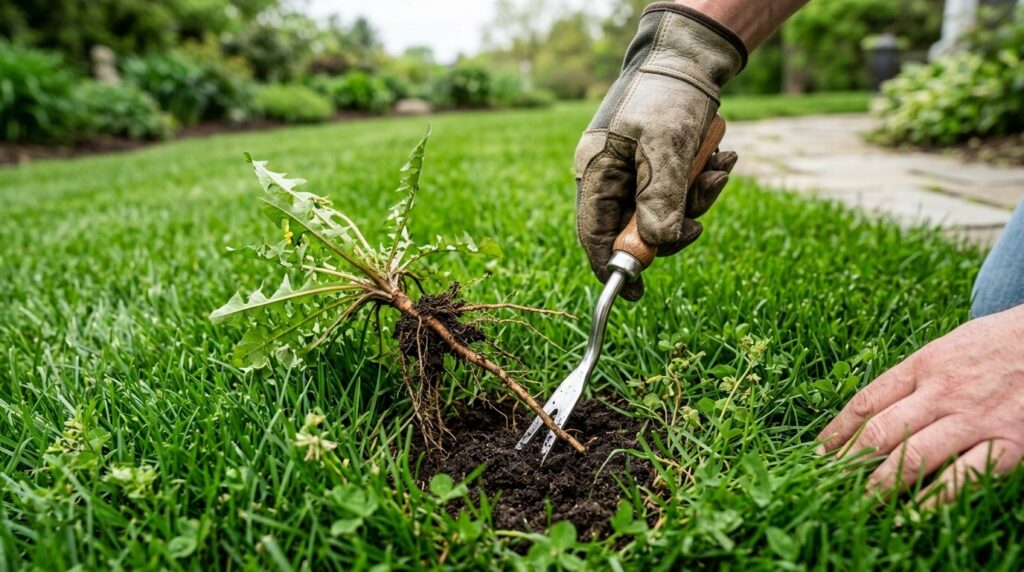
Step 4: pull scattered weeds cleanly
- Work after rain or water the spot lightly so roots release without making mud.
- Place a forked or narrow weeder beside the crown, not through neighboring grass.
- Loosen the soil and lift steadily. For dandelion, remove the crown and as much taproot as practical.
- For creeping weeds, follow runners and lift rooted nodes rather than tearing only leaves.
- Collect plants that have flowers, seedheads, bulbs, or persistent roots.
- Press soil back, fill the hole if needed, and repair bare cover during the correct grass-growing window.
- Return in one to two weeks and remove regrowth while small.
Do not cultivate nutsedge patches into pieces or string-trim poison ivy. Pulling is a tool, not a universal doctrine. Stop when the plant’s reproductive system or hazard makes digging counterproductive.
Step 5: decide whether a herbicide is justified
Choose a selective postemergence product only if it lists the weed and is safe for the turf species. A preemergence product works before or during early germination and will not erase mature plants. It may also interfere with desired grass seed. Nonselective herbicide can injure every contacted plant.
Spot-treat scattered clusters instead of blanketing the lawn. Keep droplets off garden plants, exposed roots, pavement, water, and drains. Use a dedicated labeled sprayer. Avoid treating drought-stressed or heat-stressed turf outside the label conditions.
Step 6: protect the grass during recovery
Do not scalp to expose weeds. Continue an appropriate mowing height and the one-third rule. Water from soil need, not as a reaction to every yellow leaf. Delay fertilizer until the turf can use growth and a soil test or established program supports it.
If the label requires leaf area for absorption, respect the mowing interval before and after treatment. If seed was applied, follow establishment moisture and keep incompatible herbicides away for the stated interval. Track exactly what was applied, where, and when.
Step 7: monitor instead of stacking treatments
Check at the time the product or method reasonably needs to work. Pulled roots may resprout. Systemic herbicides may take time. Adding a second product too quickly increases injury risk and obscures the result.
Photograph the patch from the same position. If weeds decline but turf remains thin, repair the cover. If nothing changes, revisit identification before trying a stronger approach. Persistent widespread problems justify diagnostic help rather than chemical escalation.
What damages lawns during weed control
- Spraying before identification.
- Using a nonselective product on green turf.
- Treating during extreme heat or wind contrary to the label.
- Ignoring overseeding intervals.
- Pulling only dandelion leaves and leaving the crown.
- Breaking creeping roots into many new pieces.
- Scalping grass to “get closer” to weeds.
- Fertilizing and watering heavily to repair product injury before diagnosis.
Build a denser lawn next
Use the Lawn Weeds pillar for crabgrass, dandelion, and nutsedge details. Continue with Lawn Care Basics and watering frequency. The tools hub explains root tools, dedicated sprayers, and cleanup gear.
Cons / limitations
Product-specific limitations for this job — not a generic “UI changes weekly” list:
- Wrong-target spray: A broadleaf mix that lists dandelion will still scorch St. Augustine or injure newly seeded fescue if the turf species is not on that label. Identification first is slower than a blanket pass.
- Pulling leaves, leaving crowns: Dandelion and plantain resprout when only foliage comes out. Moist soil and a forked weeder are required; dry compacted paths make clean extraction unlikely.
- Seeding lockout: Many post-emergent and pre-emergent actives block desired grass seed for weeks. A July spray can cancel an August overseed unless you read the reseeding interval on the current label.
Desk metrics (11 September 2026)
Desk method and documented ranges. We did not invent a Foxy Gardens test plot, yield, or timed field trial.
- USDA zone (desk map, 11 September 2026): Cool-season repair windows in USDA zones 4–7; warm-season lawns in USDA 8–10 skip fall seeding of rye as a permanent fix.
- Soil pH: Home color-kit target 6.0–7.0 pH for most turf; we did not run a lab sample. If the kit reads below 5.5 pH, lime is a soil-test decision, not a weed spray.
- Fertilizer dose: Do not stack nitrogen on injured turf. Documented label band is about 0.7–1.0 lb N per 1,000 sq ft per application when the lawn is actively growing; 22 min to read N-P-K and the reseeding interval. Not a plot trial.
- Desk duration: 18 min structured re-read of public USDA zone guidance, a soil pH kit procedure, and the fertilizer label math above.
Always disconnect main power sources—remove battery packs or unplug cords—before inspecting mower blades, clearing aeration tines, or handling sharp garden equipment. Keep hydroponic nutrient concentrates stored securely.
Practical guides curated by horticultural practitioners and yard care enthusiasts. Field-tested methods, verifiable steps, and zero automated fluff.
Frequently asked questions
Should I pull weeds before spraying?
Pulling is often best for scattered weeds that can be removed without spreading roots. Large or fragmenting patches need a species-specific plan.
Can weed killer damage grass?
Yes. The wrong product, turf species, rate, temperature, drift, or seeding interval can injure a lawn. Follow the exact current label.
Why do weeds keep returning?
The crown, root, runner, seed bank, or underlying thin-lawn condition may remain. Removal must be paired with site repair and follow-up.