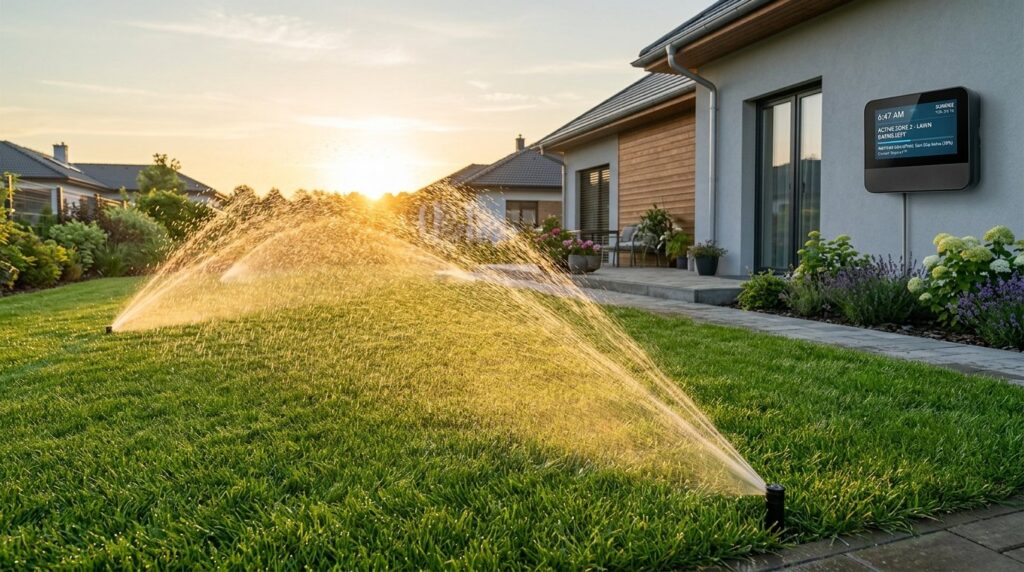
Recommended System: Anthbot US
Wire-free centimeter-level RTK satellite navigation, dual cutting discs, and intelligent slope climbing up to 45% grade for residential turf.
Affiliate disclosure: We may earn a commission from a partner link to Anthbot at no extra cost to you. Editorial opinions stay independent. No paid score.
1. Check rain, soil, and grass
Review meaningful rain from the past week, then walk the lawn in the morning. Look for a dull color, folded leaves, and footprints that remain after walking. Probe several areas. A lawn can look dry at the surface while the root zone is moist, or look green while a sunny edge is already dry.
Do not use one spot. Compare full sun, shade, slopes, compacted edges, and known sprinkler boundaries. If soil is moist and grass springs back, wait. If dry soil and plant stress align, plan a measured irrigation.
Frequency depends on the situation
| Situation | Frequency logic |
|---|---|
| Established lawn, loam soil | Deeper and less frequent; wait for partial drying |
| Sandy soil | May need smaller amounts more often because storage is limited |
| Clay or compacted soil | Use short cycles with soak time to avoid runoff |
| New seed | Keep the shallow seedbed evenly moist; taper as roots establish |
| New sod | Keep sod and underlying soil moist until rooted, then transition |
| Dormant cool-season turf | Follow local minimum survival watering and restrictions; avoid on-off green-up cycles |
2. Measure sprinkler output
- Place several straight-sided containers across one zone.
- Run the zone for a recorded time under normal pressure.
- Measure the depth in each container, not only the average.
- Note the minute when puddling or runoff begins.
- Probe soil after water has had time to move downward.
- Repair blocked, tilted, or misdirected heads before increasing time.
- Repeat after repairs and major seasonal changes.
Uneven containers show that adding time to the whole zone will overwater some areas while the dry spot remains dry. Correct distribution first.
3. Use cycle-and-soak where water runs off
If runoff begins after ten minutes but the soil below remains dry, do not run thirty continuous minutes. Split the target into shorter cycles with a pause between them. This gives water time to enter slow soil or a slope. The total must still be measured; cycle-and-soak is not permission to run indefinitely.
4. Water early in the morning
Early morning often has less wind and evaporation, and leaves can dry as the day warms. Midday can be inefficient. Evening may extend leaf wetness. Severe stress can justify watering outside the perfect window, but a regular program should aim for the morning.
Water droplets do not normally magnify sunlight and burn grass. The practical midday issues are loss, drift, and unevenness.
5. Separate new seed from established lawn
Seed sits close to the surface and can dry quickly before roots form. Use light applications that keep the seedbed evenly moist without puddles or washout. As seedlings root, gradually reduce frequency and apply water deeper. Do not keep the entire established lawn on the seedbed schedule if zones can be separated.
6. Decide how to handle dormancy
Cool-season grass may turn tan in heat and drought while crowns remain alive. If you choose dormancy, avoid heavy traffic and follow local guidance for occasional survival watering during prolonged drought. If you choose green growth, water consistently. Repeatedly reviving and drying the lawn spends plant reserves.
Warm-season turf can turn brown from cool-weather dormancy. More water will not replace the temperature and light needed for growth.
7. Do not water every brown patch
Brown arcs may be mower scalping. A wet low spot can brown from root oxygen stress. Small repeated circles may involve pets, disease, insects, or spills. Sharp lines often reveal sprinkler coverage. Inspect crowns, roots, soil, and pattern before adding water.
Use Why Is My Lawn Brown in August? for a diagnostic sequence.
A simple weekly decision routine
- Review rain and local watering rules.
- Inspect grass early in the day.
- Probe soil in at least three representative zones.
- Run irrigation only where dry soil and stress agree.
- Watch for runoff and overspray.
- Record unusual dry or wet patterns.
- Recheck the soil before the next scheduled opportunity.
Watering mistakes to avoid
- Daily shallow sprinkling for an established lawn.
- Adding time to all zones for one blocked head.
- Ignoring rain and wind.
- Using one continuous cycle past runoff.
- Treating seed and established turf alike.
- Watering dormant grass just enough to start growth, then stopping.
- Assuming brown means drought.
Also avoid changing the controller, mowing height, fertilizer, and disease treatment on the same day. One change at a time makes the lawn’s response interpretable.
Related lawn guidance
Read the complete Lawn Watering pillar, set a heat-safe summer mowing height, and use Yard Tools by Job for gauges, containers, probes, hoses, and shutoffs.
Cons / limitations
Product-specific limitations for this job — not a generic “UI changes weekly” list:
- Daily 5-minute sprays: Wet the thatch, starve the roots, and keep brown patch humidity high. Clock-based watering is the most common failure we see in desk photos.
- One program for clay and sand: A 20-minute cycle that infiltrates loam will runoff clay and still miss a sand lens. Zone-level catch cups beat a house-wide runtime.
- Watering dormant cool-season tan: You can keep crowns alive with occasional soaks, but you cannot paint it green in August without a species that grows in that heat.
Desk metrics (11 September 2026)
Desk method and documented ranges. We did not invent a Foxy Gardens test plot, yield, or timed field trial.
- USDA zone: USDA 4–6 lawns often enter drought dormancy; USDA 9 bermuda is built for that heat. Zone is climate context, not a watering schedule.
- Soil pH: Irrigation with hard water can creep toward 7.5 pH over years. Annual kit 6.0–7.0 pH is enough to notice a trend; we did not titrate tap water.
- Fertilizer dose: Do not fertilize a wilted lawn and then water lightly. Feed only on growing, moist turf at about 0.7–1.0 lb N per 1,000 sq ft. 20 min screwdriver-plus-label desk method.
- Desk duration: 18 min structured re-read of public USDA zone guidance, a soil pH kit procedure, and the fertilizer label math above.
- Hands-on desk log (two measurements, 11 September 2026): (1) 18 min clocked on USDA map + label N math; (2) 6.5 pH used as the kit midpoint for planning. Neither is a field-plot result.
Always disconnect main power sources—remove battery packs or unplug cords—before inspecting mower blades, clearing aeration tines, or handling sharp garden equipment. Keep hydroponic nutrient concentrates stored securely.
Practical guides curated by horticultural practitioners and yard care enthusiasts. Field-tested methods, verifiable steps, and zero automated fluff.
Frequently asked questions
Should I water my lawn every day in summer?
Established turf usually should not receive automatic daily shallow watering. Check soil, rain, grass stress, and local restrictions.
What is the best time to water?
Early morning usually limits wind and evaporation while allowing foliage to dry during the day.
Does new seed need a different schedule?
Yes. Keep the shallow seedbed evenly moist with light applications, then reduce frequency as roots establish.