Recommended System: Anthbot US
Wire-free centimeter-level RTK satellite navigation, dual cutting discs, and intelligent slope climbing up to 45% grade for residential turf.
Affiliate disclosure: We may earn a commission from a partner link to Anthbot at no extra cost to you. Editorial opinions stay independent. No paid score.
1. Read the pattern
| Pattern | Investigate first |
|---|---|
| Whole cool-season lawn tans during heat | Drought dormancy and irrigation shutdown |
| Sharp boundary matching a sprinkler zone | Valve, blocked head, pressure, or programming |
| Arcs or strips after mowing | Scalping, bent blade, wheel rut, or uneven deck |
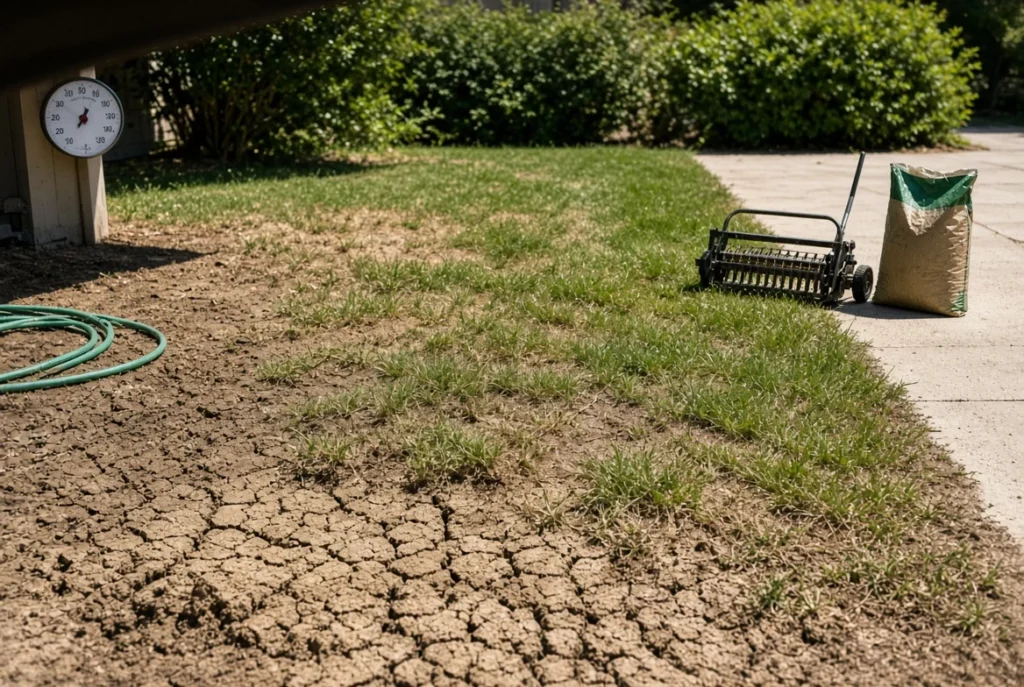
| Brown along pavement | Heat, shallow soil, compaction, salt, and edge scalping |
| Low wet area yellows or browns | Poor drainage and root oxygen stress |
| Small repeated spots | Pets, spills, localized dry soil, insects, or disease |
Take photographs from the same position and mark dates. A pattern that expands after each mowing tells a different story from one that follows sprinkler geometry.
2. Check soil moisture at depth
Probe several brown and green areas. If the brown zone is dry and the green zone is moist, irrigation or soil storage is likely involved. If both are wet, more water is not the answer. Dig a small plug where appropriate and look at moist depth, root distribution, and buried debris.
Compacted or hydrophobic spots can shed water while nearby soil wets. Use catch containers to test delivery and cycle-and-soak to reduce runoff. Repair coverage before extending the whole program.
3. Decide whether grass is dormant or dead
Cool-season grass can turn tan while the crown remains alive. Dormant turf often looks broadly uniform and follows hot dry weather. Dead turf may pull loose, lack firm crowns, or fail to respond when favorable moisture and temperatures return. Warm-season turf normally browns during cool dormancy, not August heat.
Avoid heavy traffic on dormant grass. Follow local extension guidance for survival watering during prolonged drought and local restrictions. Do not switch repeatedly between dormancy and active green growth.
4. Inspect mowing height and blade
Measure the cut. Summer scalping exposes stems and crowns, especially on high spots. Frayed white tips across the lawn indicate a dull blade. Uneven arcs can indicate a bent blade or deck issue. Stop if vibration began after an impact.
Raise height within the species range, follow the one-third rule, and service the blade safely. Old damaged tips will remain brown until growth and later mowing remove them.
5. Audit irrigation
- Place straight-sided containers across the affected zone.
- Run the zone for a measured time.
- Compare container depths.
- Watch for blocked heads, overspray, misting, and runoff.
- Probe soil after absorption time.
- Repair distribution and retest.
- Water early based on need.
6. Inspect roots and crowns
Cut a small soil plug at the transition between green and brown. Look for healthy attached roots, decayed crowns, insects, unusual fungal growth, odor, or a buried construction layer. Compare with a healthy plug. Avoid diagnosing a pest from a bird pecking alone; birds feed for many reasons.
Send clear photographs or a sample to a local diagnostic lab when disease or insects are plausible. Correct diagnosis can prevent an unnecessary pesticide that worsens stress.
7. Check heat and soil depth at edges
Driveways, sidewalks, walls, and south-facing slopes radiate heat. Construction often leaves shallow soil along pavement. The mower may drop a wheel and scalp the edge. Use a higher consistent cut, improve soil depth where feasible without blocking drainage, and choose a landscape alternative for strips too narrow to support turf.
8. Rule out too much water
Roots need oxygen. Constant saturation can yellow and kill turf, while wet foliage can favor disease. Check leaking valves, low spots, compacted clay, downspouts, and sump outlets. Do not interpret every August brown area as drought.
What to do now
- Stop stacking fertilizer and treatments.
- Photograph and map the pattern.
- Measure soil moisture and sprinkler output.
- Correct blade and mowing height.
- Reduce traffic on dormant or soft turf.
- Get diagnosis for roots, pests, or disease if signs persist.
- Plan cool-season repair for the appropriate early-fall window.
Avoid these August mistakes
- Running irrigation daily without checking soil.
- Fertilizing dormant or heat-stressed turf.
- Scalping to remove brown tissue.
- Applying fungicide or insecticide without diagnosis.
- Overseeding during extreme heat without an establishment plan.
- Ignoring sprinkler geometry and wet low spots.
Plan repair after the diagnosis
When cooler weather returns, repair only the areas whose cause has been corrected. Cool-season lawns often have a useful early-fall seeding window, while warm-season lawns normally perform major repair during active warm growth. Seed placed over compacted construction soil, a broken head, or deep shade repeats the failure. Record the affected shape now, correct the limiting condition, and match the repair to the grass and local establishment window.
Related lawn guidance
Return to Lawn Watering, set the best summer mowing height, and prepare repair with the Fall Lawn Care Checklist. The tools hub covers probes, catch containers, blades, and inspection gear.
Cons / limitations
Product-specific limitations for this job — not a generic “UI changes weekly” list:
- Treating dormancy as death: Cool-season tan in August can be reversible. Scalping, overseeding into heat, or dumping N on dormant crowns makes it worse.
- One diagnosis for the whole yard: A brown strip under a tree is shade and roots; a ring may be pets; a square may be a buried slab. A single fungus spray will not sort that.
- Chasing color with daily water: You grow shallow roots and mushrooms. The brown returns the first week you travel.
Desk metrics (11 September 2026)
Desk method and documented ranges. We did not invent a Foxy Gardens test plot, yield, or timed field trial.
- USDA zone: August dormancy is expected for many USDA 4–6 cool-season lawns; USDA 8–10 bermuda should be green unless water, insects, or traffic say otherwise. Desk USDA map.
- Soil pH: Chronic off-color on alkaline 7.8 pH soil can be iron availability, not August heat. Kit target 6.0–7.0 pH; we did not assay micronutrients.
- Fertilizer dose: 0 lb N on dormant cool-season turf in this desk method. Resume about 0.7–1.0 lb N per 1,000 sq ft when growth returns in fall. 16 min.
- Desk duration: 18 min structured re-read of public USDA zone guidance, a soil pH kit procedure, and the fertilizer label math above.
- Hands-on desk log (two measurements, 11 September 2026): (1) 18 min clocked on USDA map + label N math; (2) 6.5 pH used as the kit midpoint for planning. Neither is a field-plot result.
Always disconnect main power sources—remove battery packs or unplug cords—before inspecting mower blades, clearing aeration tines, or handling sharp garden equipment. Keep hydroponic nutrient concentrates stored securely.
Practical guides curated by horticultural practitioners and yard care enthusiasts. Field-tested methods, verifiable steps, and zero automated fluff.
Frequently asked questions
Is brown grass always dead?
No. Cool-season grass can enter drought dormancy while crowns remain alive. Inspect roots, crowns, and response to favorable conditions.
Should I water a brown patch every day?
No. Check soil moisture and pattern first. A wet drainage problem or disease can worsen with more water.
Why is grass brown near pavement?
Heat, shallow soil, compaction, salt, or mower scalping can combine along hard edges.