Recommended System: Anthbot US
Wire-free centimeter-level RTK satellite navigation, dual cutting discs, and intelligent slope climbing up to 45% grade for residential turf.
Affiliate disclosure: We may earn a commission from partner links (for example Anthbot) at no extra cost to you. Editorial opinions stay independent. Read our affiliate disclosure where published.
How often should you water a lawn?
There is no honest national answer such as “three times a week.” A lawn on deep loam after a cool rainy week may need no irrigation. A sandy sunny slope in hot wind may dry much faster. Heavy clay may accept water slowly and run off before the root zone is wet. The job is to replace needed moisture without keeping the surface constantly damp or sending water onto pavement.
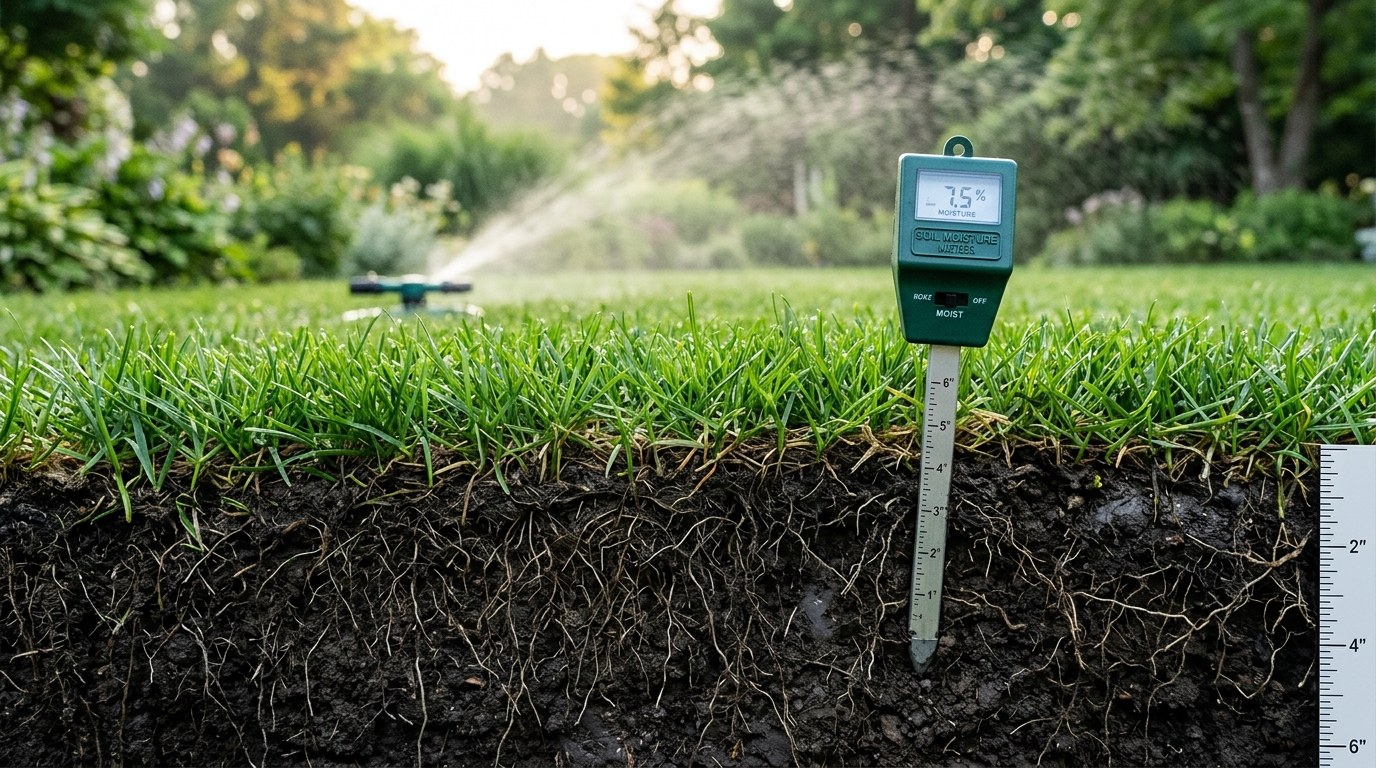
Start with the soil. Push a screwdriver or soil probe into several representative areas after watering and again before the next planned session. Easy penetration is an imperfect but useful clue to moist soil; resistance can show where water did not infiltrate. Dig a small inspection plug when appropriate to see the actual moisture depth. Compare green and stressed areas rather than judging the whole yard from one sprinkler zone.
Established roots need oxygen as well as water. Allowing the surface to dry between irrigation discourages shallow rooting and some moisture-favored problems. The aim is not to wilt the lawn repeatedly. It is to move away from automatic daily sprinkling toward measured decisions.
Watering frequency by situation
| Situation | Moisture approach | What to monitor |
|---|---|---|
| Established lawn in moderate weather | Deeply enough to moisten the active root zone, then wait until the soil begins to dry | Rainfall, footprinting, probe depth, runoff, and local restrictions |
| Hot or windy period | Inspect more often; water based on stress and soil rather than adding short daily cycles automatically | Leaf folding, color change, persistent footprints, dry slope or edge zones |
| New seed | Keep the shallow seedbed evenly moist with light applications, then taper as roots develop | Crusting, washout, puddles, germination stages, and seed label guidance |
| New sod | Keep sod and underlying soil moist during rooting, then transition toward established-lawn practice | Edges lifting, root attachment, hot seams, and installer/local guidance |
| Sandy soil | Smaller amounts may be needed more often because storage is limited | Rapid drainage below roots and localized dry spots |
| Clay or compacted soil | Use cycle-and-soak to reduce runoff while reaching depth | Ponding, runoff, cracking, and slow infiltration |
| Dormant cool-season lawn | Decide whether to maintain dormancy or irrigate enough to prevent crown loss under local guidance | Restrictions, drought duration, traffic, crown condition, and grass species |
Best time of day to water
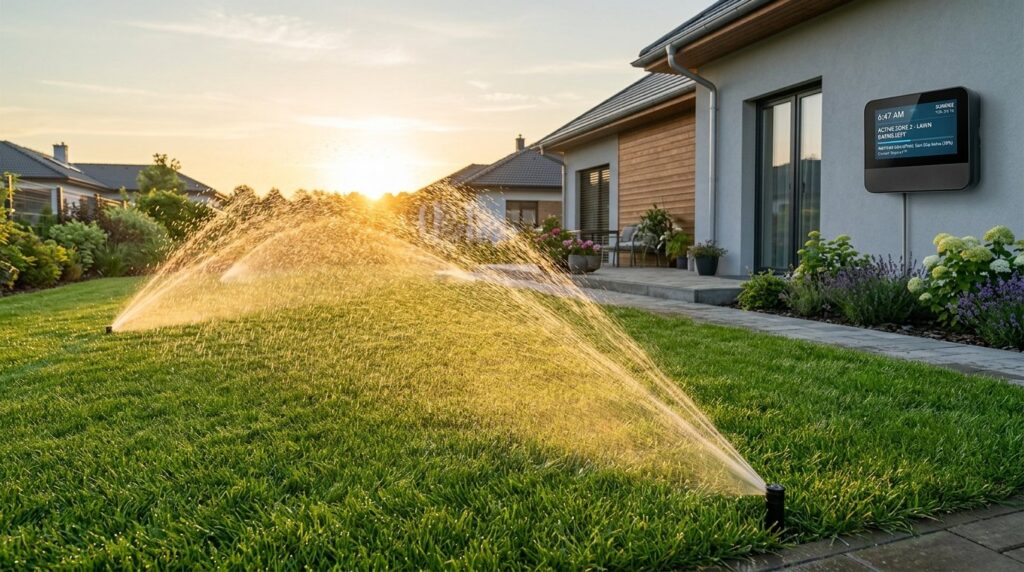
Early morning is usually the most efficient and lawn-friendly window. Wind and evaporation are often lower than midday, pressure may be steadier, and leaves can dry as the day warms. A system that completes before heavy household water demand is easier to monitor.
Midday watering loses more to wind and evaporation but does not “burn” grass through magical magnifying droplets. The practical problem is efficiency and uneven delivery. Evening irrigation can leave foliage wet for a longer period, which may favor some diseases. If a lawn is showing severe heat stress and morning has passed, protecting the plant can matter more than waiting for an ideal clock time; use judgment and local guidance.
Audit each zone in its actual operating window. Wind can bend spray away from narrow areas. Heads may be blocked by shrubs or grass. Water pressure can change when several household fixtures run. A schedule programmed once and ignored is not a watering plan.
Measure what reaches the lawn
- Place straight-sided catch containers. Distribute several through a zone, including near edges and between heads.
- Run a normal timed cycle. Record the minutes and avoid changing other variables during the test.
- Measure each container. Large differences reveal poor distribution even if the average looks adequate.
- Inspect runoff and puddling. Note the minute when water begins to leave the target or collect.
- Probe the soil later. Water needs time to move. Compare moist depth at catch points.
- Repair coverage before adding time. A blocked or misaligned head will waste more water if the entire zone runs longer.
- Set a cycle-and-soak pattern when needed. Divide the total into shorter cycles with absorption time between them.
A tuna can or rain gauge is a measurement tool, not a universal prescription. The amount that reaches the surface must be related to soil depth, recent rain, and plant response. Recheck after nozzle changes, pressure changes, landscape growth, or soil work.
What “deep watering” really means
Deep watering means moisture reaches the active root zone rather than darkening only the top fraction of soil. It does not mean running sprinklers for hours regardless of runoff. Soil texture and compaction determine how quickly water can enter. If application rate exceeds infiltration, the yard is not being watered deeply; the street is.
Cycle-and-soak is useful on slopes and slow soils. Run a shorter cycle, pause long enough for absorption, and repeat until the measured target is reached without runoff. Fix compaction and thatch issues when the grass can recover, but do not assume every water problem is solved by aeration.
Roots will not chase water into hostile soil indefinitely. Construction layers, rock, compacted subsoil, poor drainage, or tree competition can create a shallow effective root zone. A soil inspection may explain why one area cannot use the same schedule as the rest.
Dormant vs. dead grass
Cool-season grass may enter drought dormancy, turning tan while crowns remain alive. Uniform tan color that follows hot dry weather can be consistent with dormancy. Dead areas may show loose plants, decayed crowns, bare soil, or failure to respond when favorable moisture and temperatures return. But pests, disease, mower injury, dog urine, buried debris, and irrigation gaps can produce similar patterns.
Do not repeatedly switch a cool-season lawn between dormancy and active green growth. If you choose to keep it green, provide consistent moisture. If you allow dormancy, follow local extension advice on the minimum occasional irrigation needed to protect crowns during prolonged drought and observe water restrictions. Dormant grass is vulnerable to heavy traffic.
Warm-season grass naturally turns brown with cool-season dormancy. Water alone will not force healthy growth when temperature and day length are limiting. Identify the grass type and season before declaring it dead.
Use brown-lawn patterns as evidence
| Pattern | Possible clues to investigate |
|---|---|
| Sharp line at sprinkler boundary | Coverage, pressure, blocked head, valve, or schedule difference |
| Brown along pavement | Radiant heat, shallow soil, salt, compaction, scalping, or reflected wind |
| Low wet area turns yellow/brown | Poor drainage, root oxygen stress, or moisture-favored disease |
| Arcs or stripes after mowing | Low deck, bent blade, uneven terrain, wheel rut, or repeated route |
| Small repeated spots | Pet urine, spills, localized dry spot, insects, or disease; inspect closely |
| Whole cool-season lawn tans in heat | Drought dormancy or broad irrigation failure; check crowns and soil |
See the focused guide Why is my lawn brown in August? before increasing runtime. Overwatering a disease or drainage issue delays the real repair.
Reduce waste without starving turf
Turn off irrigation after meaningful rain and use a rain shutoff or soil-based control when appropriate. Repair leaks and tilted heads. Adjust spray away from walls, pavement, and fences. Water larger plant beds and turf separately because their needs and root zones differ.
Mow at an appropriate height so leaves shade soil. A sharp blade reduces shredded tissue. Reduce nitrogen-driven growth before expected heat where local practice supports it. Keep soil covered with suitable turf or landscape rather than leaving bare hot patches that dry rapidly.
Some yards should contain less irrigated turf. Narrow strips, steep slopes, deep shade, and unused corners can be converted to regionally appropriate planting, mulch, or hardscape when drainage and tree roots are respected. The goal is a useful yard, not maximum square footage of thirsty grass.
Common watering mistakes
- Adding minutes to every zone when one head is blocked.
- Watering daily because the surface looks dry while deeper soil is wet.
- Assuming brown always means thirsty.
- Running one continuous cycle past the runoff point.
- Using the same program for new seed and established turf.
- Ignoring rainfall, wind, local restrictions, and seasonal dormancy.
- Watering sidewalks and driveways instead of realigning equipment.
- Changing several variables at once, making the result impossible to diagnose.
A simple weekly watering decision
At the start of the week, review recent rain and forecast, then walk the lawn in the morning. Check leaf color and folding, persistent footprints, and soil moisture in several zones. If the root zone remains moist and the grass is resilient, wait. If clear stress and dry soil align, run the measured zone program early the next morning. Recheck for runoff while it operates.
Record unusual dry areas instead of repeatedly extending the whole system. A can test or head repair may solve the imbalance. During late summer, combine watering decisions with higher mowing and reduced traffic. During fall establishment, separate the seedbed schedule from mature areas.
Continue with How often should you water a lawn?, the brown August lawn diagnostic, and the tools hub for gauges, shutoffs, hoses, and irrigation inspection tools.
Cons / limitations
Product-specific limitations for this job — not a generic “UI changes weekly” list:
- Runtime copied from a neighbor: Their sand is not your clay. Catch cups on your heads are the measurement; their Tuesday schedule is not.
- Heads blocked by unpruned shrubs: ET controllers still water the sidewalk if the spray is intercepted. Audit the hardware.
- New seed vs established turf on one valve: Seedlings need frequent light moisture; established turf wants deeper, rarer soaks. One zone cannot optimize both.
Desk metrics (11 September 2026)
Desk method and documented ranges. We did not invent a Foxy Gardens test plot, yield, or timed field trial.
- USDA zone: Peak deficit in USDA 5–6 is midsummer; USDA 10 has a different dry season. Desk USDA.
- Soil pH: Recycled or well water can push 7.5 pH and leave scale on nozzles. Turf kit still 6.0–7.0 pH. 16 min.
- Fertilizer dose: Watering-in is required for many granular N products (often 0.25–0.5 inch). Dose remains about 0.7–1.0 lb N per 1,000 sq ft — do not “wash extra” as a second feeding.
- Desk duration: 18 min structured re-read of public USDA zone guidance, a soil pH kit procedure, and the fertilizer label math above.
Always disconnect main power sources—remove battery packs or unplug cords—before inspecting mower blades, clearing aeration tines, or handling sharp garden equipment. Keep hydroponic nutrient concentrates stored securely.
Practical guides curated by horticultural practitioners and yard care enthusiasts. Field-tested methods, verifiable steps, and zero automated fluff.
Frequently asked questions
Is early morning the best watering time?
Usually. Wind and evaporation are often lower, and foliage can dry during the day.
How can I tell whether dormant grass is dead?
Inspect crowns, roots, pattern, and response when favorable moisture and temperatures return.