Recommended System: Anthbot US
Wire-free centimeter-level RTK satellite navigation, dual cutting discs, and intelligent slope climbing up to 45% grade for residential turf.
Affiliate disclosure: We may earn a commission from partner links (for example Anthbot) at no extra cost to you. Editorial opinions stay independent. Read our affiliate disclosure where published.
Lawn weeds are clues, not one problem
“Weeds” describes unwanted plants, not a single biological group. An annual grass, a perennial sedge, a tap-rooted broadleaf, and a creeping vine reproduce and respond to control in different ways. A product or pulling method that works on one may barely slow another. The first useful question is not “What kills weeds?” but “What plant is this, how is it spreading, and why does it have room here?”
Open soil and weak turf invite germination. Low mowing exposes the surface. Compaction and poor drainage favor plants that tolerate those conditions better than lawn grass. Thin shade leaves light gaps at ground level. Bare construction soil may lack the structure needed for durable turf. Weed removal without correcting the opening creates a repeating vacancy.
Map the pattern before acting. Scattered rosettes can be pulled individually. A strip along a driveway may point to heat and shallow soil. A wet low spot full of sedge calls for drainage investigation. A lawn-wide annual grass problem may trace back to spring germination, low density, and missed timing. The pattern is part of the identification.
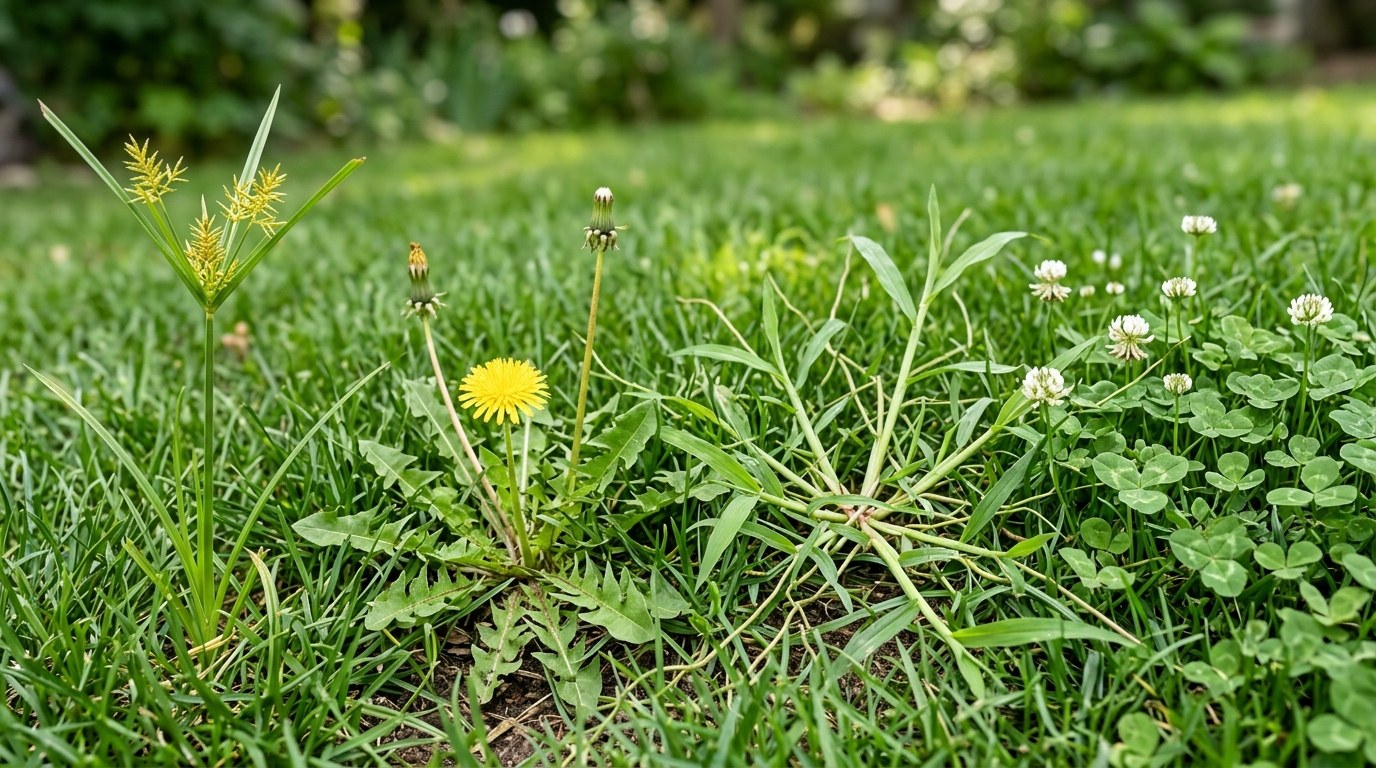
Crabgrass, dandelion, and nutsedge compared
| Plant | Useful identification clues | Why it persists | First response |
|---|---|---|---|
| Crabgrass | Coarse annual grass spreading outward from a center; often in hot, thin edges | Produces seed and germinates in open warm soil | Improve density and mowing; pull small plants before seed; plan correctly timed prevention if pressure is severe |
| Dandelion | Basal rosette, toothed leaves, hollow flower stalk, deep taproot | Crown can regrow when much of the root remains; windblown seed | Remove crown and as much taproot as practical when soil is moist |
| Nutsedge | Glossy, upright, yellow-green leaves; triangular stem; grows faster than turf | Underground tubers and rhizomes; often favored by excess moisture | Confirm it is a sedge, reduce overwatering, avoid repeated casual pulling that leaves propagules |
| White clover | Three rounded leaflets with pale markings and white flower heads | Low nitrogen and thin turf can favor it; creeping stems root | Decide tolerance first; improve turf conditions and remove patches deliberately |
| Plantain | Low rosette with strong parallel veins and seed spikes | Tolerates compaction and traffic | Relieve traffic/compaction and remove the crown |
| Ground ivy | Round scalloped leaves, square stems, mint-like odor, creeping growth | Roots at nodes and thrives in shade/thin turf | Improve site fit; repeated removal must capture runners and nodes |
Crabgrass is not simply any wide-bladed grass. Several perennial grassy weeds resemble it, and control timing differs. Crabgrass completes its life cycle in one season, leaving seed for future years. Mature plants can root at lower nodes and become hard to pull intact. The long-term plan combines denser turf with attention to germination timing rather than relying on a late-season rescue.
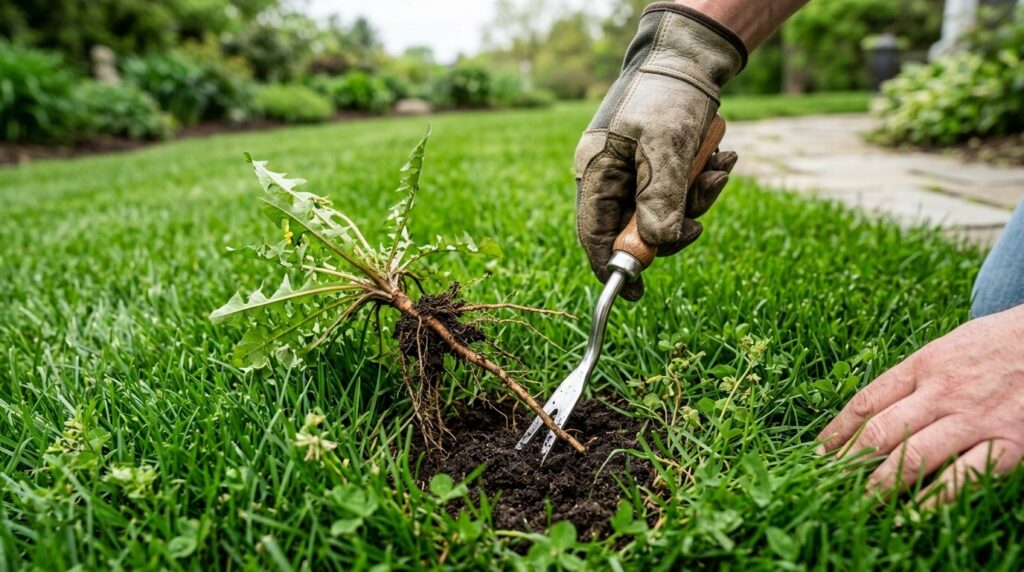
Dandelion is easier to recognize, but a flower-head snap is not removal. The growing point sits at the crown and the taproot stores energy. A narrow weeding tool used after rain can lift the crown with a substantial root section while disturbing little turf. Fill the hole and press surrounding soil back so it does not become a new seedbed.
Nutsedge is not a grass despite its narrow leaves. Sedges often have triangular stems and a shiny, upright look. Pulling very young isolated plants repeatedly may deplete them, but established patches can have underground nutlets that remain. Correct excess irrigation and identify the exact sedge before choosing any labeled treatment.
When pulling beats spraying
Hand removal is often the best answer when there are few weeds, the plants have not seeded, the soil is moist enough to release roots, and the lawn around them is healthy. It avoids treating a wide area for a narrow problem. It also gives immediate feedback: the root structure, crown, runners, or bulbs reveal how the plant is reproducing.
Pull before flowering and seed development when possible. Grasp low, use a tool that reaches the crown, and lift steadily. For taproots, loosen beside the root instead of yanking leaves. For creeping weeds, trace runners and lift rooted nodes. Place seed-bearing or persistent material where it cannot reroot; disposal requirements vary by species and locality.
Pulling is less useful when fragments readily reproduce, the patch is too large to remove without destroying the turf, or soil disturbance exposes thousands of new seeds. It can also be unsafe for plants such as poison ivy. In those cases, use a species-specific plan or a professional. Never assume gloves alone make an unknown hazardous plant safe to grab.
Fix the lawn condition that opened the door
- Correct mowing height. Keep enough leaf area to shade soil and support roots. Avoid scalping along pavement and raised roots.
- Adjust watering. Deep, appropriate irrigation favors established turf more than constant surface moisture. Repair leaks and overspray.
- Reduce compaction and traffic. Redirect shortcuts, protect wet soil, and aerate only when the grass can actively recover.
- Repair bare soil in the right season. Use a grass or alternative cover suited to the light, moisture, and region.
- Use soil information. Test before making major pH or nutrient changes. Do not fertilize solely because a weed appeared.
- Keep edges defined. Thin hot edges accumulate seed and stress; clean edging and appropriate height make inspection easier.
A dense lawn is not an absolute barrier—wind, wildlife, soil seed banks, and neighboring plants continue to deliver seed—but it reduces open niches. The goal is not a chemically sterile yard. It is a stable plant community where unwanted species can be handled early and selectively.
A careful herbicide decision
Selective herbicides control certain plants while being tolerated by specified turf species at labeled rates. Nonselective products can injure any contacted vegetation. Preemergence products interrupt germination or early development and must be timed before the target has emerged; postemergence products act on visible plants. These categories are not interchangeable.
Spot treatment reduces exposure when weeds are scattered, but droplets can drift or be tracked. Avoid windy conditions, heat outside the label range, impending rain when prohibited, and stressed turf when injury risk is high. Keep spray away from exposed tree roots, garden plants, water, drains, and hard surfaces. A dedicated, clearly labeled applicator prevents accidental use on desirable plants.
Combination “weed and feed” products treat the entire lawn and tie two jobs to one timing. That may apply herbicide where no weed exists or fertilizer when grass does not need it. Separate diagnosis makes it easier to use the smallest effective intervention. If the target or safe product is uncertain, a licensed local professional can identify the plant and site constraints.
A season-long crabgrass plan
Late-summer crabgrass plants are large, obvious, and already capable of seed. Pull isolated plants before seed drops, repair the opening when local establishment timing is suitable, and note hot compacted edges for spring. Do not let a frustrating August view trigger a heavy treatment that the product label does not support in heat.
Next season, prevention timing should follow soil conditions and local extension guidance rather than a fixed holiday. A preemergence barrier may also affect desirable grass seed, so coordinate crabgrass prevention with overseeding. In some lawns, improving density and mowing height is enough; in a severe seed-bank problem, a correctly timed labeled product may be one part of the plan.
Keep records. Note when crabgrass first appears, where it is concentrated, and what happened to the lawn cover before germination. That evidence makes the following year more precise.
A practical dandelion plan
For a handful of plants, water naturally or work after rain, insert a narrow tool beside the taproot, loosen the soil, and lift the crown. Check the hole for remaining crown tissue. Reseed or close the opening at the proper time. Revisit in a week or two because a missed root may sprout.
A large stand indicates years of seed and open turf, not a one-day failure. Preventing every neighboring seed is impossible, so focus on dense grass and removal before flowers mature. Dandelion flowers can develop seed quickly; mowing flowers alone is temporary.
Decide what level is acceptable. A few dandelions do not mean the lawn is collapsing. Managing them individually may fit an organic-search homeowner audience better than chasing a perfect surface with unnecessary inputs.
A practical nutsedge plan
First compare the plant with grass at the stem. Roll it gently between fingers only if it is a safe known plant: a sedge often feels three-sided. Observe whether it grows faster and stands lighter or glossier than the turf. Photograph the seedhead and send it to a local diagnostic service if uncertain.
Check irrigation and drainage. Nutsedge often reveals wet conditions, but simply drying the surface will not eliminate established underground structures. Avoid cultivation that spreads pieces. If using a herbicide, choose one specifically labeled for the identified sedge and the lawn grass; ordinary broadleaf weed control may do nothing.
Expect follow-up. Underground tubers make one pass unreliable. Mark the patch, monitor new shoots, and correct the moisture condition so the lawn has a better competitive environment.
Control weeds without wrecking the lawn
The safest sequence is narrow: identify, count, inspect the site condition, choose the least disruptive effective method, then monitor. Avoid mowing immediately before or after a treatment when the label requires leaf area and absorption time. Avoid seeding conflicts. Clean tools so roots and seeds do not move to a new bed.
If a treatment causes yellowing, stop adding products. Record the product, rate, time, weather, irrigation, and grass type. Give the lawn a chance to show the actual extent of injury before stacking fertilizer or another chemical. Contact the manufacturer or extension service with the label in hand for targeted guidance.
Use the step-by-step guide to remove weeds without damaging turf, learn the separate safety rules for poison ivy, and visit the tools hub for hand weeders, gloves, and dedicated applicators.
Cons / limitations
Product-specific limitations for this job — not a generic “UI changes weekly” list:
- Calling every grassy weed crabgrass: Nutsedge is a sedge; nimblewill is a perennial. Wrong ID is how you buy the wrong box three summers in a row.
- Spot-spray drift on hot days: Volatile esters can move. Morning, labeled temperature, and a dedicated nozzle are the limitation, not courage.
- Bare soil after a “successful” kill: Open ground is a seedbed. If you do not reseed or thicken turf, the weeds were only paused.
Desk metrics (11 September 2026)
Desk method and documented ranges. We did not invent a Foxy Gardens test plot, yield, or timed field trial.
- USDA zone: Crabgrass pressure is a soil-temperature story that starts earlier in USDA 7 than USDA 4. Desk USDA plus a soil thermometer.
- Soil pH: Some weeds tolerate 5.5 pH soils better than Kentucky bluegrass. Kit 6.0–7.0 pH is a turf goal, not a herbicide.
- Fertilizer dose: Dense turf from a legal 0.7–1.0 lb N per 1,000 sq ft program beats a fourth herbicide pass. 22 min to read both the weed label and the fertilizer analysis.
- Desk duration: 18 min structured re-read of public USDA zone guidance, a soil pH kit procedure, and the fertilizer label math above.
Always disconnect main power sources—remove battery packs or unplug cords—before inspecting mower blades, clearing aeration tines, or handling sharp garden equipment. Keep hydroponic nutrient concentrates stored securely.
Practical guides curated by horticultural practitioners and yard care enthusiasts. Field-tested methods, verifiable steps, and zero automated fluff.
Frequently asked questions
When does pulling beat spraying?
Pulling is often best for a small number of identifiable weeds whose roots can be removed without spreading fragments.
Why is nutsedge not controlled like grass?
It is a sedge with underground tubers and rhizomes; ordinary grass or broadleaf control may not target it.