
Recommended System: Anthbot US
Wire-free centimeter-level RTK satellite navigation, dual cutting discs, and intelligent slope climbing up to 45% grade for residential turf.
Affiliate disclosure: We may earn a commission from partner links (for example Anthbot) at no extra cost to you. Editorial opinions stay independent. Read our affiliate disclosure where published.
Home lawn mower types compared
| Type | Best fit | Main strengths | Tradeoffs |
|---|---|---|---|
| Manual reel | Very small, smooth lawns cut frequently | Quiet, light, compact, no fuel or charging | Struggles with tall grass, twigs, bumps, and some higher cut settings |
| Corded electric | Small lawns with accessible outlets | Light, consistent power, little routine maintenance | Cord management and reach limit the route |
| Battery walk-behind | Small to medium lawns | Low noise, easy starting, compact storage | Runtime, battery age, and replacement ecosystem matter |
| Gas walk-behind | Medium lawns, thick growth, longer sessions | Fast refueling and broad service knowledge | Fuel, exhaust, noise, seasonal maintenance, and storage |
| Self-propelled walk-behind | Slopes or larger walking routes | Reduces pushing effort | More weight, cost, controls, and drive parts |
| Riding mower or lawn tractor | Large, open lawns | Covers area quickly and may tow accessories | Storage, turning space, slope limits, maintenance, and high total cost |
| Robotic mower | Defined lawns maintained very frequently | Automates light recurring cuts | Boundary setup, obstacles, theft exposure, slope and edge limitations |
Reel and rotary describe the cutting mechanism. A reel mower uses multiple curved blades moving past a fixed bedknife, much like scissors. A rotary mower spins one or more horizontal blades beneath a deck. Rotary machines handle typical homeowner height ranges and imperfect lawns more easily, while a well-adjusted reel can make a very clean cut on a smooth surface. Neither mechanism excuses poor setup or a dull cutting edge.
Power source changes the ownership routine more than the basic purpose. Corded electric machines need a safe cord path. Battery mowers need enough charged capacity for the real yard and a sensible plan for future battery replacement. Gas mowers need fresh fuel practices, oil and filter attention where applicable, and storage that keeps fumes and ignition risks out of living space. Compare the recurring routine, not only the first mowing.
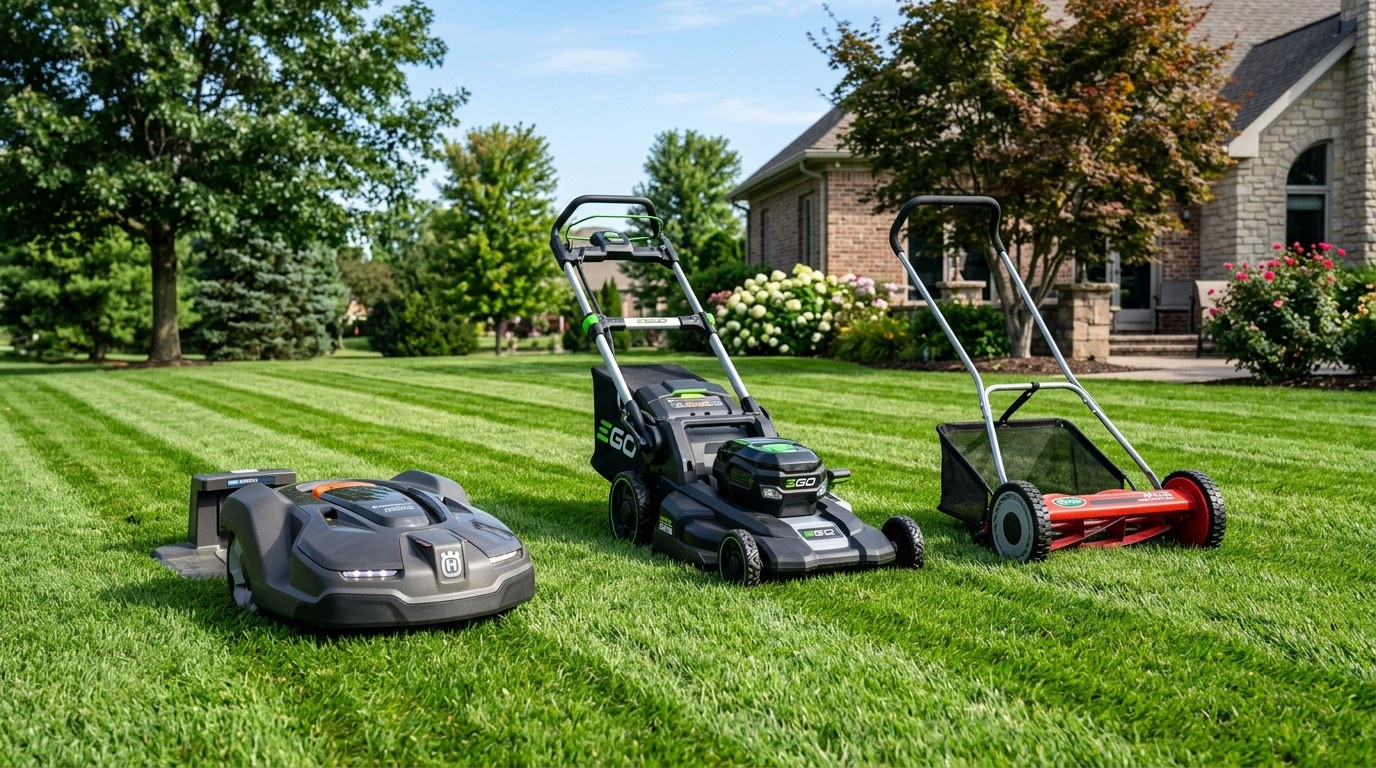
Best lawn mower factors for a small yard
“Small yard” is not a complete specification. A compact rectangle with one tree is easy; a smaller property divided by steps, planting beds, fences, and a narrow side passage can be demanding. Walk the exact route before shopping. Measure gates with room for your hands, note where the mower must turn, and identify steps that require lifting. A few inches of extra deck width can save passes in an open area but create frustration around every obstruction.
Weight matters when the mower must be carried, pivoted, or stored vertically. Self-propulsion can help on a slope but may feel abrupt in tight turns. A manual reel is appealing for a tiny lawn only if the surface is reasonably smooth and the owner can mow before the grass gets tall. A corded mower can be excellent when an outlet and a simple route make cord control predictable. Battery machines usually offer the easiest start-and-go routine, provided one charge covers the job with a reserve.
Storage should influence the choice before purchase. Measure shelf height, doorway clearance, and the space required for a folded handle. Confirm whether the manufacturer permits vertical storage and under what conditions; do not assume a fuel machine can safely be tipped or stored in any orientation. Leave room to remove and reinstall a battery without bending terminals or trapping moisture.
Noise and mowing window matter in dense neighborhoods. Electric machines reduce engine noise, although the blade still creates sound and can throw objects. A quieter mower does not make mowing at an unreasonable hour considerate. Discuss shared boundaries and choose a predictable daytime window.
Measure the yard before comparing features
- Calculate mowable area. Exclude the house, patio, beds, driveway, and other non-turf surfaces rather than using the entire lot size.
- Record the narrowest passage. Include gate hardware and space needed to keep hands clear.
- Walk the slope. Mark areas that feel unstable, remain wet, or require side-hill travel. Follow the mower manual for slope operation.
- Count obstacles and edges. Trees, posts, play equipment, islands, and tight corners reduce the value of a very wide deck.
- Time a normal session. Runtime claims mean little without the pace, grass height, moisture, and bagging load of the actual yard.
- Measure storage and transport. Confirm the machine can enter, turn, and park without blocking emergency access or creating a trip hazard.
Deck, blade, discharge, and cut quality
Deck width determines how much grass one pass can cover, but usable productivity also depends on turning, overlap, ground speed, and bag emptying. A deck that fits between beds may finish faster than a wider deck that requires repeated backing. Deck shape and airflow affect how clippings circulate, yet the most visible cut-quality factors remain correct height, a sharp balanced blade, dry-enough conditions, and manageable growth.
Most walk-behind rotary mowers offer some combination of mulching, bagging, and side or rear discharge. Mulching recuts short clippings and returns them to the turf. Bagging collects material but adds weight and stops. Discharge can handle heavier growth but requires careful control of the outlet and the area around people, windows, vehicles, and beds. Never defeat a guard or hold a discharge door open with an improvised object.
A multi-blade label does not guarantee a better lawn, and a single blade is not automatically inferior. Look for consistent performance at the intended height and grass density. After mowing, inspect the leaf tips. Clean cuts retain a natural green edge. Shredded, whitish ends mean it is time to inspect the mower blade and deck rather than blaming drought.
Battery mower buying without ecosystem lock-in surprises
Battery voltage is not a simple performance score across brands. Motor design, battery capacity, deck load, software, temperature, and grass conditions all affect useful runtime. Compare watt-hours when reliable specifications are available, but treat published runtime as a scenario, not a promise. Wet grass, tall growth, self-propulsion, and bagging can shorten a session.
Ask what one replacement battery costs, how long the warranty lasts, and whether the same pack serves tools you actually need. Buying five unnecessary tools to justify a battery platform is not a saving. A second battery can prevent downtime, but batteries degrade even when rarely used. Store and charge them according to manufacturer temperature and ventilation guidance, and inspect for swelling, cracked housings, or damaged terminals.
For a small yard, a slightly smaller machine with one healthy battery may be more practical than a large deck carrying expensive capacity. Keep a runtime reserve so the normal job does not repeatedly drain the pack to the limit. Clean dry debris from cooling passages using the method in the manual; do not wash electrical components impulsively with a hose.
Mower maintenance by interval
| When | Checks | Why it matters |
|---|---|---|
| Before every mow | Guards, handle, wheels, blade area, power source, loose parts, leaks, and yard debris | Stops an unsafe or damaging session before the blade turns |
| After mowing | Remove dry clippings as directed; inspect cut quality and visible damage | Prevents buildup and catches wear early |
| At blade intervals | Inspect sharpness, straightness, cracks, thinning, hardware, and balance | Protects grass, bearings, and operator safety |
| Seasonally | Manual-specified oil, filter, spark plug, drive, cable, battery, and fastener service | Keeps starting and controls dependable |
| Before storage | Clean, dry, stabilize or remove energy source as directed, and protect from pests and moisture | Reduces corrosion, fuel trouble, and spring surprises |
The owner’s manual is the controlling maintenance document because machines differ. Some engines require oil changes; some are designed differently. Some battery mowers permit folding or vertical storage; others have conditions. Record the exact model number and keep the manual accessible. Generic advice should never override a specific safety instruction.
Mowing safety is part of the buying decision
Pick up the mowing area before every session. A rotary blade can throw stones, wire, sticks, and toy pieces. Keep children, pets, and bystanders away, and do not mow toward people, roads, windows, or vehicles. Wear eye protection, hearing protection where appropriate, long pants, and secure closed-toe footwear. Never carry a passenger on a riding machine.
Slope safety deserves more weight than convenience. The direction considered safer differs between walk-behind and riding equipment, and each model has a stated limit. Wet grass reduces traction. Ditches, drop-offs, retaining walls, and pond edges can collapse or pull equipment over. If a section feels unsafe, change the landscape or use a different maintenance method.
Do not bypass presence controls, guards, shields, or blade-stop systems. A mower that will not operate with a required safety device is signaling a repair need, not asking for a workaround. Choose a model whose controls fit the operator’s grip and pace so the safety system is easy to use as designed.
Compare total ownership effort, not just price
Total cost includes blades, batteries, cords, fuel containers, oil or filters, service access, winter storage, and time. A cheap machine that cannot be serviced locally may become disposable. An expensive machine may be needless for a ten-minute lawn. Check whether common wear parts are identifiable by model number and whether the blade can be obtained without a long delay.
Before upgrading, improve the system you already own. Set the correct height, sharpen or replace the blade, mow before grass is excessively tall, and use the right discharge mode. Those changes often improve the lawn more than a new feature. If replacement is justified, use the measurements above and keep the shortlist narrow.
Continue with blade inspection and replacement, compare mulching versus bagging, and visit the yard tools hub for storage, cleaning, and hand-tool guidance.
Cons / limitations
Product-specific limitations for this job — not a generic “UI changes weekly” list:
- Buying width you cannot store: A 21-inch deck that does not fit the shed becomes a rust experiment. Measure the gate and the wall first.
- Battery orphaning: A platform that the maker retires leaves you with a deck and no cells. Check whether blades and batteries are still numbered parts.
- Robot on an unprepared lot: Furniture, dog toys, and a 20° wet slope are still operator work. Automation does not inventory hazards.
Desk metrics (11 September 2026)
Desk method and documented ranges. We did not invent a Foxy Gardens test plot, yield, or timed field trial.
- USDA zone: Season length in USDA 4 vs USDA 9 changes annual blade hours more than motor brand. Desk USDA.
- Soil pH: 6.0–7.0 pH for the lawn the mower cuts; 12 min to keep soil out of the SKU comparison except as a separate test.
- Fertilizer dose: Fast-growth N (1.0 lb per 1,000 sq ft) raises mowing frequency. Size the machine to growth, or cut the N, not both at maximum.
- Desk duration: 18 min structured re-read of public USDA zone guidance, a soil pH kit procedure, and the fertilizer label math above.
Always disconnect main power sources—remove battery packs or unplug cords—before inspecting mower blades, clearing aeration tines, or handling sharp garden equipment. Keep hydroponic nutrient concentrates stored securely.
Practical guides curated by horticultural practitioners and yard care enthusiasts. Field-tested methods, verifiable steps, and zero automated fluff.
Frequently asked questions
What mower is best for a small yard?
A light reel, corded, or battery mower often fits, but gates, slope, obstacles, storage, and routine matter more than lot size alone.
Does a wider deck always mow faster?
No. Turning, obstacles, overlap, weight, and bag emptying can make a smaller fitting deck faster.