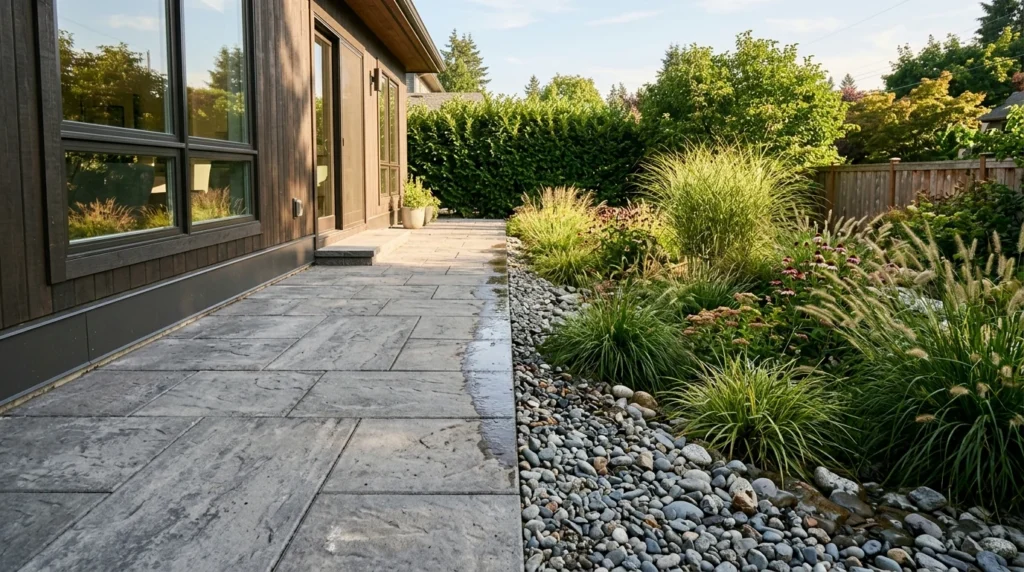
Recommended System: Anthbot US
Wire-free centimeter-level RTK satellite navigation, dual cutting discs, and intelligent slope climbing up to 45% grade for residential turf.
Affiliate disclosure: We may earn a commission from a partner link to Anthbot at no extra cost to you. Editorial opinions stay independent. No paid score.
1. Observe the yard in rain
Before choosing a shape, watch water leave the roof, move across the yard, collect in low soil, and exit the property. Mark downspouts, sump outlets, swales, compacted routes, basement windows, and neighboring flow. A patio must not become a dam or send concentrated water toward the house or another property.
Check local drainage, setback, permit, and utility rules. Call for utility marking before excavation. Protect important tree roots and ask an arborist where work approaches a mature tree.
2. Mock up the real activity
Place chairs, a table, grill-sized box, and walking route at full size. Open doors and pull chairs out. Preserve access to gates, hose bibs, meters, and storage. One comfortable use is better than three cramped zones.
Four small patio ideas
| Idea | Drainage concept | Best use |
|---|---|---|
| Angular gravel garden room | Compacted permeable base and contained surface over suitable soil | Two to four lounge chairs |
| Rectangular paver dining pad | Consistent surface slope away from the house to a legal outlet | Stable table and chair movement |
| Permeable-paver side strip | Open joints plus open-graded bedding and reservoir base | Narrow route where infiltration is suitable |
| Large slabs with planted or gravel joints | Stable individually based slabs and draining gaps | Quiet seating or garden transition |
Idea 1: angular gravel garden room
Use angular compactable gravel rather than rounded pea gravel for a firmer surface. Install a base appropriate to soil and freeze conditions, then a contained surface layer. Strong edging prevents migration into lawn. This layout suits lounge furniture with broad feet; narrow chair legs and mobility devices may sink or wobble.
Shape can be informal, but finished grades must remain deliberate. Keep gravel below siding and thresholds. Add one generous planting edge instead of tiny pockets that collect weeds.
Idea 2: compact paver dining pad
A simple rectangle wastes little cutting and gives furniture a stable plane. Work backward from finished elevation through paver, bedding, and base depth. Compact base in appropriate lifts. Edge restraint keeps units from spreading. Use the joint material specified by the paver system.
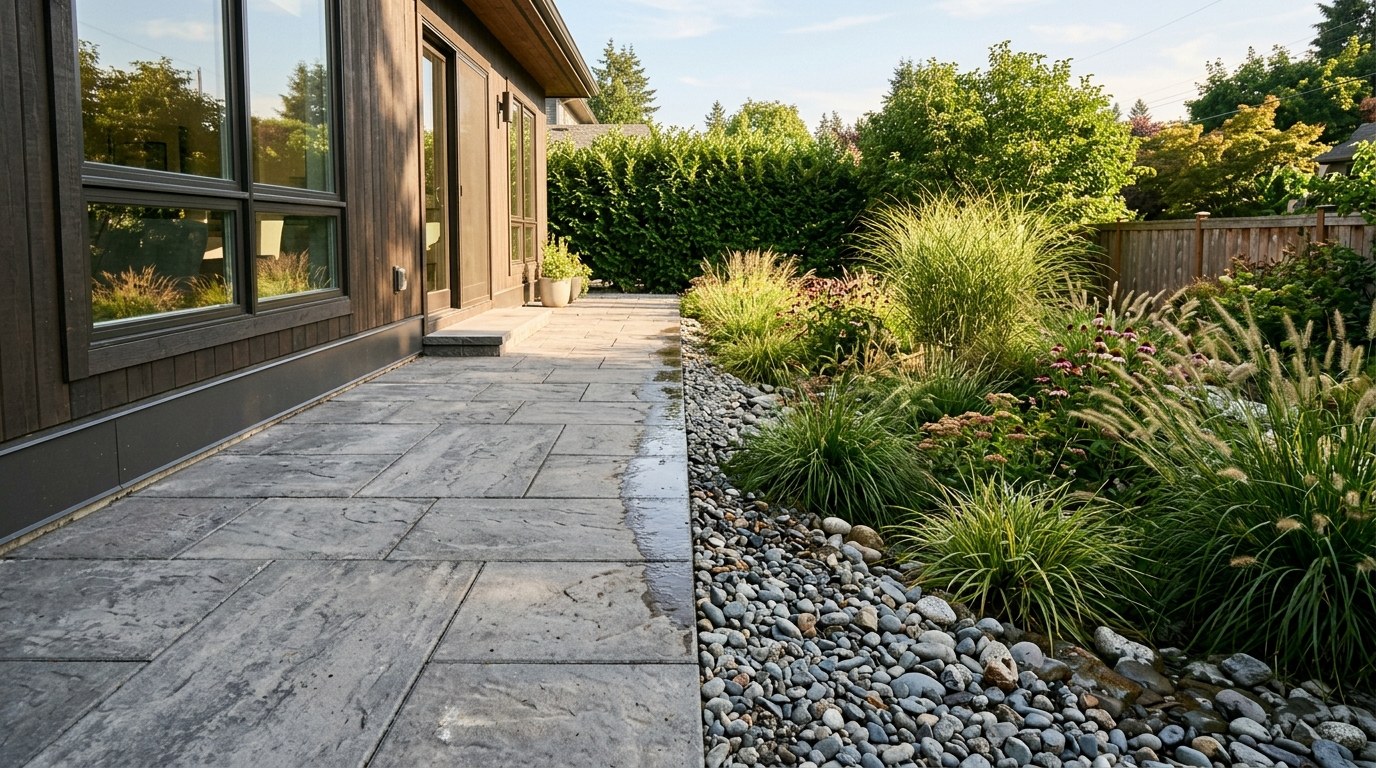
Slope the surface consistently away from vulnerable building details toward a lawful outlet. Do not create a low border that traps water. Test with a hose only after checking that water will not be sent somewhere harmful.
Idea 3: permeable paver strip
Permeable pavers are not standard pavers with wider sandy gaps. They rely on open-graded joint stone, bedding, and base that store and infiltrate or convey water. Fine sediment can clog the system. Clay, high groundwater, or concentrated roof runoff may require engineering or an underdrain.
Choose this only when local soil, codes, and maintenance support it. Keep runoff carrying soil or mulch from washing onto the joints.
Idea 4: large slabs with draining joints
Large slabs create a visually light patio in a small garden. Each slab must be stable, level to its neighbor, and supported against rocking. Joint width should fit the intended user, furniture feet, and maintenance. Loose pebbles between widely spaced slabs can be uncomfortable under chairs.
Use low planting only where it will not spill into the walking line or create wet slippery growth. Keep roots of aggressive plants away from the base.
3. Build from finished height downward
- Set the finished patio height below doors, siding, and drainage openings.
- Establish the direction and destination of runoff.
- Add the thickness of surface, bedding, and base to calculate excavation.
- Excavate without damaging utilities or protected roots.
- Prepare subgrade and separation layer where specified.
- Place and compact base in lifts.
- Install bedding, surface, joints, and edge restraint as a system.
- Test drainage and furniture stability before landscaping edges.
4. Finish edges without blocking water
Keep mulch and soil from washing onto gravel or permeable joints. Choose plants by mature size and keep thorny or floppy growth away from narrow circulation. Do not pile soil against fences or siding. If a planted swale or rain garden receives runoff, size and locate it using local guidance rather than treating it as decoration.
Drainage mistakes to avoid
- Calling gravel permeable without checking the base or clay subsoil.
- Raising a patio against siding or door thresholds.
- Emptying a downspout onto the surface.
- Using bedding sand as a substitute for compacted base.
- Omitting edge restraint.
- Sending runoff toward a neighbor, public walk, or foundation.
- Excavating across utilities or major tree roots.
- Choosing rolling gravel beneath dining chairs.
Related yard planning
Read the full Small Backyard Patios pillar, keep the boundary crisp with How to Edge a Lawn, and choose layout and digging equipment through Yard Tools by Job.
Cons / limitations
Product-specific limitations for this job — not a generic “UI changes weekly” list:
- Pretty gravel on an undrained base: Water still sits against the house if the subgrade slopes inward. Stone color will not fix grade.
- Permeable pavers over packed clay: Joints clog and the system becomes a bathtub. Permeability is a cross-section, not a catalog noun.
- Furniture before dimensions: A 7-foot pad cannot take a 90-inch table plus walk space. You then cantilever chairs into the lawn and wreck the edge.
Desk metrics (11 September 2026)
Desk method and documented ranges. We did not invent a Foxy Gardens test plot, yield, or timed field trial.
- USDA zone: Freeze-thaw heave is a USDA 4–6 patio design constraint; USDA 9 still needs hurricane/downpour drainage. Desk climate, not a frost-heave experiment.
- Soil pH: Adjacent turf 6.0–7.0 pH; polymeric sand and limestone screenings can locally raise pH at joints. We did not sample joint fines.
- Fertilizer dose: 0 lb N on paver joints — feeding weeds in the cracks is the failure mode. Lawn beside the patio, if fed, stays on about 0.7 lb N per 1,000 sq ft. 15 min desk pass.
- Desk duration: 18 min structured re-read of public USDA zone guidance, a soil pH kit procedure, and the fertilizer label math above.
- Hands-on desk log (two measurements, 11 September 2026): (1) 18 min clocked on USDA map + label N math; (2) 6.5 pH used as the kit midpoint for planning. Neither is a field-plot result.
Always disconnect main power sources—remove battery packs or unplug cords—before inspecting mower blades, clearing aeration tines, or handling sharp garden equipment. Keep hydroponic nutrient concentrates stored securely.
Practical guides curated by horticultural practitioners and yard care enthusiasts. Field-tested methods, verifiable steps, and zero automated fluff.
Frequently asked questions
Is gravel automatically permeable?
No. The base and subsoil must accept or convey water, and fine sediment can clog the system.
Should a patio slope away from the house?
It generally needs a modest consistent path away from vulnerable building details to an appropriate legal outlet. Exact grades are local.
Are permeable pavers installed like ordinary pavers?
No. They require a designed open-graded joint, bedding, and reservoir base system.