Recommended System: Anthbot US
Wire-free centimeter-level RTK satellite navigation, dual cutting discs, and intelligent slope climbing up to 45% grade for residential turf.
Affiliate disclosure: We may earn a commission from a partner link to Anthbot at no extra cost to you. Editorial opinions stay independent. No paid score.
1. Choose the line before cutting
Follow the strongest existing geometry: a sidewalk edge, patio, fence alignment, or one smooth bed curve. Avoid many small wiggles. Tight curves are difficult to mow and create tiny turf points that dry out. Lay a garden hose for a curve or pull a string for a straight line, then view it from the house and normal walking route.
Leave mower access. A bed edge that forces one mower wheel into loose mulch will never look consistent. Adjust the bed so the mower can make a stable pass or create a narrow hard mowing strip.
2. Choose a tool
| Tool | Best use | Watch for |
|---|---|---|
| Half-moon manual edger | Controlled new line and small properties | Hard dry soil and shallow utilities |
| Flat spade | Bed definition and sod removal | Less consistent curve if used as a chopping tool |
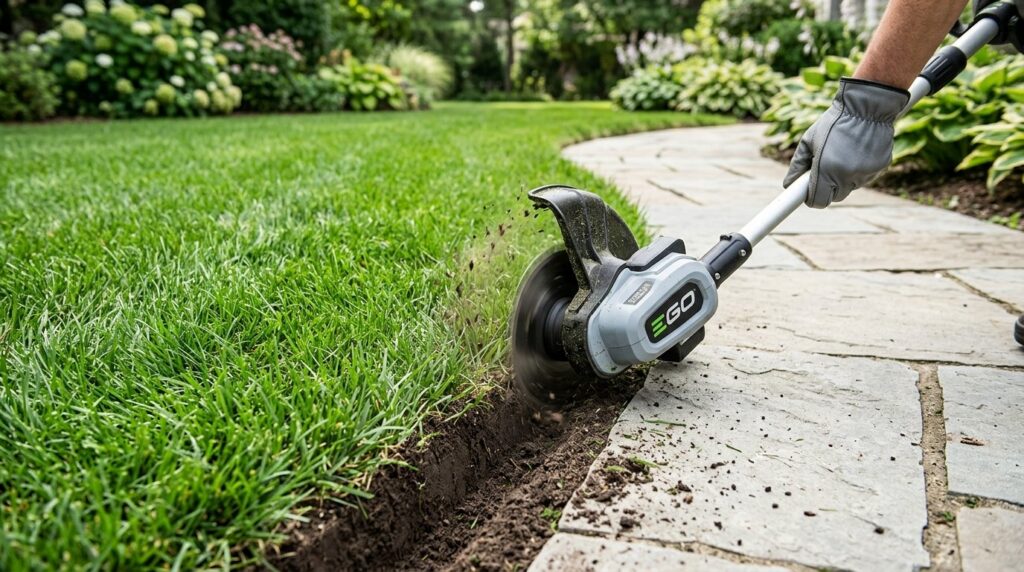
| Powered blade edger | Long repeated pavement boundaries | Debris, depth control, noise, and utility risk |
| String trimmer in approved edging mode | Light maintenance | Gouging soil, damaging hardscape, and thrown objects |
| Rigid edge restraint | Spreading grass or gravel containment | Heave, mower clearance, and trip hazards |
3. Mark utilities and irrigation
Call the local utility-marking service before deep digging. Locate sprinkler heads, drip lines, invisible dog fences, low-voltage lighting, drainage, and shallow private lines that public marking may not cover. An edge is not worth cutting a cable or pipe.
4. Cut a clean vertical edge
- Mow the lawn at its normal appropriate height so the boundary is visible.
- Mark the chosen line with string or a hose.
- Work when soil is moist enough to cut but not muddy.
- Place the manual edger vertically and step through the turf along the line.
- Lift the cut sod from the bed side, preserving the lawn side.
- Remove runners and roots that cross the line.
- Rake soil and mulch away from the vertical lawn face.
- Sweep pavement and collect debris instead of washing it into drains.
5. Shape the bed side
A shallow V or trench on the bed side creates separation and catches a modest mulch edge. Keep mulch off the grass crown and below tree flare, siding, and fence components. Do not pile a tall “volcano” ridge that collapses into the lawn after rain.
With gravel, install stable restraint so stones do not roll into the mower path. With pavers, keep the base and edge support intact; repeated blade contact can chip hardscape and throw fragments.
6. Maintain before the edge disappears
Walk the boundary every two to four weeks during active growth, adjusting for species and weather. Cut crossing runners while small. Sweep after mowing. A five-minute touch-up is easier than recutting the whole line after turf roots establish in the bed.
Warm-season spreading grasses may need more frequent control. Bunch grasses usually cross more slowly. Deep shade and wet soil can make the lawn edge thin; fix the site condition rather than cutting farther into declining turf each month.
Powered edging safely
Wear eye and hearing protection, long pants, and closed footwear. Keep people, pets, windows, and vehicles out of the debris path. Use guards and the approved blade or line. Never edge blindly through leaves or soil that could hide wire, stones, or irrigation parts.
Do not turn a string trimmer into an edger unless the manual allows that position. Stop power before clearing jams or adjusting. Powered tools save time only when the operator controls depth and route.
Curves that are easy to mow
Use broad radii rather than scallops. Test by pushing the stopped mower along the route; if repeated backing or wheel drops are needed, simplify the curve. A smooth bed can make a small yard look larger and reduce trimming.
Edges beside patios and paths
Keep turf slightly below hardscape so mower wheels remain stable without scalping. Do not undermine paver edge restraint. If water runs along the joint and erodes soil, repair drainage before adding fill. Gravel paths need containment and a surface kept below the grass cutting plane.
Edging mistakes
- Cutting a wavy line without a guide.
- Making tight curves the mower cannot follow.
- Digging before locating utilities and irrigation.
- Scalping the lawn edge with a string trimmer.
- Piling mulch against grass, trees, or siding.
- Letting gravel enter the mower path.
- Washing soil and clippings into storm drains.
- Undermining patio pavers to create a deeper trench.
Related yard guidance
Return to Lawn Care Basics, plan a draining boundary through Small Backyard Patio Ideas That Drain, and choose manual or powered equipment in Yard Tools by Job.
Cons / limitations
Product-specific limitations for this job — not a generic “UI changes weekly” list:
- Vertical cuts that scalp the collar: A string head held flat becomes a scalping tool. The edge then dies and weeds occupy the trench.
- Edging into tree flare: Repeated trenches cut surface roots. A mulch bed is the durable edge there, not a weekly string line.
- No hard edge restraint: A patio without a restraint lets gravel migrate into the trench you just cut. You then edge the same mess weekly.
Desk metrics (11 September 2026)
Desk method and documented ranges. We did not invent a Foxy Gardens test plot, yield, or timed field trial.
- USDA zone: Freeze-thaw in USDA 5 reopens edges every spring; USDA 9 edges fail more from irrigation overspray. Desk climate.
- Soil pH: Edge soil along concrete often tests higher than 7.0 pH from leachate. Turf still wants 6.0–7.0 pH in the lawn interior. 13 min kit note — no lab.
- Fertilizer dose: Do not band extra N along the sidewalk; that is how you get lush, lodging grass that needs edging twice a week. Keep the lawn on about 0.7 lb N per 1,000 sq ft.
- Desk duration: 18 min structured re-read of public USDA zone guidance, a soil pH kit procedure, and the fertilizer label math above.
- Hands-on desk log (two measurements, 11 September 2026): (1) 18 min clocked on USDA map + label N math; (2) 6.5 pH used as the kit midpoint for planning. Neither is a field-plot result.
Always disconnect main power sources—remove battery packs or unplug cords—before inspecting mower blades, clearing aeration tines, or handling sharp garden equipment. Keep hydroponic nutrient concentrates stored securely.
Practical guides curated by horticultural practitioners and yard care enthusiasts. Field-tested methods, verifiable steps, and zero automated fluff.
Frequently asked questions
How often should I edge a lawn?
Inspect every two to four weeks during active growth and cut runners while small. Spreading grasses may need more frequent work.
Is a string trimmer the best edging tool?
A manual half-moon edger gives controlled results on small yards. Use a trimmer vertically only if its manual approves the orientation.
How deep should a lawn edge be?
Deep enough to separate roots and hold the line without undermining pavement, utilities, or paver restraint. Site conditions matter.