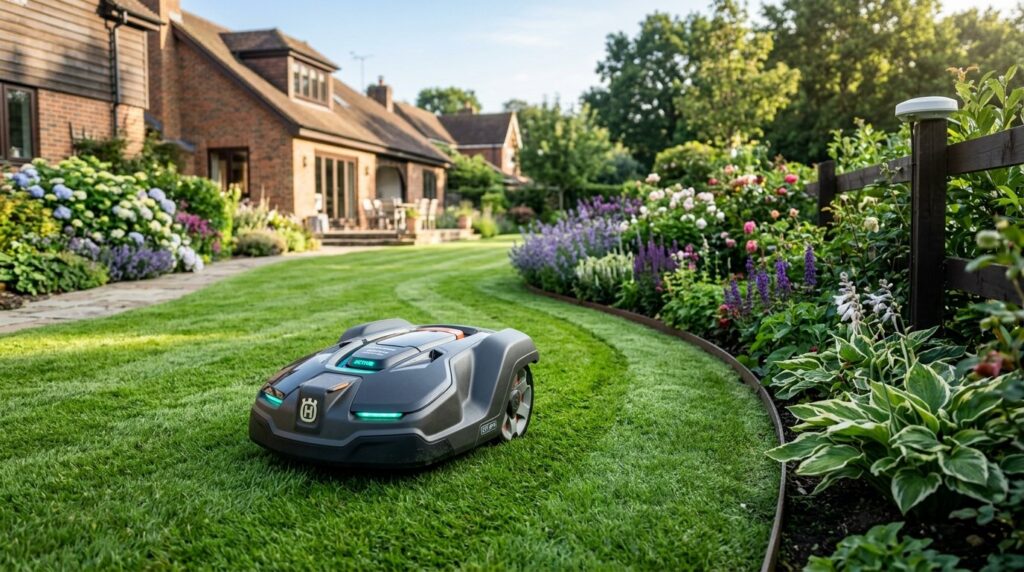
Selecting the proper autonomous robotic lawn mower requires an accurate assessment of lawn topography, total turf acreage, and battery recharge duty cycles. Property owners frequently encounter navigation failures or drive wheel spin-out because consumer marketing materials often conflate percentage slope grade with angular degrees. In this technical guide and sizing reference, we unpack the mathematical physics of yard incline, ground traction limits across 2WD vs AWD platforms, and battery duty cycles necessary to maintain healthy turfgrass.
Interactive Calculator: Calculate Incline Grade, Turf Acreage, and Mower Fit
To accurately determine which robotic mower chassis can navigate your property without rolling over or stalling, evaluate your terrain’s steepest functional incline alongside total turf square footage. Mowers engineered for flat suburban turf utilize rear-wheel drive (2WD) with front caster wheels, while steep hillside properties demand articulated all-wheel drive (AWD) chassis with aggressive lug treads and electronic traction management.
Slope Trigonometry: Understanding Degrees (°) vs Percentage Grade (%)
The most common source of sizing errors in robotic mowing is confusing angular incline degrees with slope percentage grade. When a manufacturer rates an autonomous mower for a “45% slope,” many homeowners mistakenly assume the mower can conquer a steep 45-degree angle. This misunderstanding often leads to drive wheel spin-out and terrain ruts.
Slope percentage is defined as the vertical rise divided by the horizontal run, multiplied by 100:
Conversely, the angular incline in degrees (θ) is derived from the inverse tangent of the rise-to-run ratio:
A 45% slope grade corresponds to a rise of 4.5 feet over a horizontal distance of 10 feet. Evaluating the trigonometric arctangent reveals that a 45% slope grade is an incline of only 24.2 degrees. In stark contrast, a true 45-degree angle represents a 100% slope grade (10 feet of rise over 10 feet of run)—an extreme vertical pitch that exceeds the mechanical climbing capability of standard residential robotic equipment.
Wire-Free Slope & Multi-Zone Precision: Anthbot Genie RTK
Engineered with high-torque brushless drive motors, RTK satellite positioning, and 3D vision obstacle avoidance for residential slopes and multi-zone yards.
Explore Anthbot Wire-Free Robot Mowers →Two-Wheel Drive Rear Motors vs In-Hub All-Wheel Drive (AWD) Traction
Chassis dynamics dictate whether a robotic mower can maintain straight navigational tracking along a hillside without sliding downhill. Standard robotic mowers employ two electric hub motors driving the rear wheels, supported by two unpowered, 360-degree swiveling front caster wheels. As a 2WD mower traverses across a slope horizontally, gravity pulls the chassis downward, exerting a turning moment around the front casters. Because unpowered casters cannot produce lateral counter-torque, the nose swings downhill, requiring constant algorithmic steering corrections that leave jagged mowing lines and scrub turf roots.
On inclines exceeding 16° to 20° (30% to 36% grade), 2WD casters lose steering authority entirely. Under damp conditions, rear drive wheels lose traction, initiating wheel slip that scuffs grass crowns and exposes bare topsoil. Articulated All-Wheel Drive (AWD) platforms solve this mechanical limitation by placing independent electric motors inside all four wheels. Utilizing solid omnidirectional front wheels or articulated chassis pivot joints, AWD mowers apply proactive vector torque to counter gravitational drift, maintaining straight tracking on slopes up to 38° (80% grade).
Yard Complexity Modeling: Factoring Narrow Corridors and GNSS Shadows
Evaluating lawn acreage is only the first step in sizing an autonomous mower. Yard layout geometry, narrow passages between buildings, and dense tree canopies heavily influence actual mowing performance.
Narrow Passage Minimum Widths (0.8m to 1.2m Thresholds)
Robotic mowers utilizing wire-free satellite RTK (Real-Time Kinematic) or AI optical vision require a defined spatial envelope to maneuver through bottlenecks, such as pathways between a house wall and a property fence line. When passages narrow below 1.0 meter (3.3 feet), satellite multipath signal reflection off vertical brick or siding degrades positioning accuracy. Mowers equipped with physical boundary wires can navigate channels as narrow as 0.6 meters, but wire-free autonomous mowers generally require a minimum clear passage width of 0.8 to 1.2 meters to ensure clean passage without boundary collisions.
Tree Canopy Foliage Attenuation Coefficients
Dense overhead foliage attenuates high-frequency satellite telemetry (GPS L1/L2 and Galileo E1/E5 bands). Deciduous trees like mature Maples and Oaks cause moderate seasonal signal damping, but dense conifer canopies (Spruce, Pine) absorb satellite signals year-round. In heavily forested yards, robotic mowers that rely strictly on RTK positioning frequently lose satellite lock, stalling in place until constellations shift. For these environments, sizing models must prioritize mowers with integrated 3D LiDAR sensors or visual inertial odometry (VIO) to supplement satellite navigation.
Battery Duty Cycles: Mowing Time vs Docking Recharge Cycles
Unlike traditional gas mowers that cut an entire acre in a single continuous session, autonomous robotic mowers operate on continuous maintenance cycles. The mower cuts for a designated run duration (typically 60 to 180 minutes), returns autonomously to its docking station to recharge its lithium-ion battery pack, and resumes cutting where it left off.
To calculate the theoretical hourly area mowed capacity, use the following operational equation:
Where W is cutting deck width in meters, V is forward travel speed in meters per second (typically 0.4 to 0.6 m/s), η is path overlap efficiency (≈ 0.85 for systematic striping, ≈ 0.35 for random bounce algorithms), and the final bracketed term represents the battery duty cycle fraction.
| Yard Size & Topography | Recommended Drive Type | Max Incline Rating | Battery Capacity | Daily Mowing Windows |
|---|---|---|---|---|
| Up to 0.25 Acre (Flat / Gentle) | 2WD Rear Drive + Casters | 16° (30% Grade) | 2.5 Ah – 4.0 Ah (50–80 Wh) | 3 – 5 Hours / Day |
| 0.25 to 0.50 Acre (Moderate Slopes) | 2WD High-Traction Wheels | 20° (36% Grade) | 4.0 Ah – 6.0 Ah (80–130 Wh) | 6 – 8 Hours / Day |
| 0.50 to 1.25 Acres (Hilly / Rolling) | 4WD / AWD In-Hub Motors | 27° (50% Grade) | 8.0 Ah – 10.0 Ah (180–220 Wh) | 8 – 12 Hours / Day |
| 1.25 to 2.50+ Acres (Steep Terraces) | AWD Articulated Chassis | 38° (80% Grade) | 10.0 Ah – 20.0 Ah (220–450 Wh) | 12 – 16 Hours / Day |
Estimating Daily Operating Hours Needed to Maintain 0.25 to 2.5 Acres
Because turfgrass cultivars grow continuously during peak seasonal weather (spring flushes in cool-season Kentucky Bluegrass or summer surges in warm-season Bermudagrass), the robotic mower must cycle through the entire yard surface area at least every 48 hours. A 0.5-acre property (approximately 21,780 square feet) managed by an autonomous mower with an 8-inch deck width and a 50% duty cycle requires approximately 6 to 8 hours of total daily deployment (cutting plus recharging time) to keep grass tips clipped cleanly.
Lithium-Ion Battery Sizing: Watt-Hours Required per 1,000 Sq Ft
Field testing indicates that traversing flat turf consumes approximately 4.5 to 6.0 Watt-hours (Wh) of battery energy per 1,000 square feet of cut lawn. However, operating on steep 30% to 50% inclines escalates motor load, pushing energy consumption to 9.0 to 12.0 Wh per 1,000 square feet. Sizing a robotic mower for hilly terrain requires choosing a platform with generous battery capacity (minimum 150 to 250 Wh) to prevent the unit from spending more time navigating back and forth to its charging base than actively maintaining the yard.
Technical Checklist for Yard Topography & Sizing Audits
- Measure maximum yard slope with a digital inclinometer at three distinct points along property boundaries.
- Distinguish clearly between percentage slope grade and angular degrees (remember: 45% grade = 24.2 degrees).
- Check narrow corridors between structures to confirm a minimum clearance of at least 1.0 meter (3.3 feet).
- Audit high-rise building walls and conifer tree canopies for satellite signal shadowing.
- Select All-Wheel Drive (AWD) chassis whenever hillside inclines exceed 20 degrees to prevent turf rutting.
- Calculate battery duty cycle requirements to ensure the mower can maintain the total acreage within a 48-hour mowing cycle.