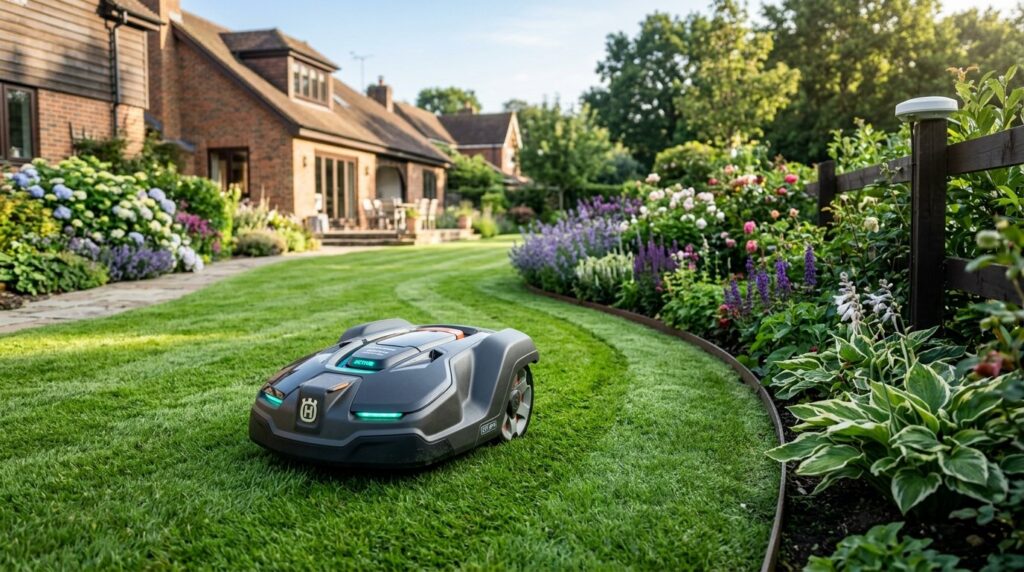
Improper seasonal decommissioning is the leading cause of premature lithium battery pack degradation and cutting spindle bearing failure in autonomous robotic lawn mowers. This comprehensive winterization protocol details electrochemical cell preservation targets, battery management system (BMS) parasitic drain mitigation, mechanical drivetrain passivation, and RTK reference station weatherproofing to safeguard robotic turf machinery during sub-freezing winter dormancy.
Electrochemical Kinetics of Lithium Degradation at Sub-Freezing Temperatures
Robotic lawn mowers utilize either Nickel Manganese Cobalt (NMC/Li-ion) or Lithium Iron Phosphate (LiFePO4) battery chemistry. While these lithium formulations deliver exceptional power density and high discharge cycle efficiency throughout the active cutting season, exposing them to winter storage conditions without proper electrochemical preparation induces irreversible cell degradation.
Storing lithium cells at 100% State of Charge (SoC)—equivalent to approximately 4.20 volts per cell for NMC configurations—accelerates electrolyte decomposition and promotes continuous growth of the Solid Electrolyte Interphase (SEI) passivation layer on the graphite anode. This calendar aging reaction proceeds even when the machine is powered down, resulting in permanent capacity fade and elevated internal DC resistance. Conversely, storing a pack in a fully depleted state (below 20% SoC or under 3.0 volts per cell) risks catastrophic copper dissolution across the anode current collector, leading to internal short circuits when the machine is re-energized in spring.
The optimal electrochemical hibernation window is strictly 50% to 60% State of Charge. At this plateau, individual NMC cell voltages rest between 3.80V and 3.85V (or 3.28V to 3.32V for LiFePO4 cells). Within this storage band, chemical potential across the cathode-electrolyte interface is minimized, reducing oxidative stress and preserving cell longevity.
Additionally, ambient storage temperature plays a decisive role in electrochemical stability. While sealed lithium cells can tolerate non-operating ambient temperatures as low as 14°F (-10°C) without freezing the liquid organic carbonate electrolyte, indoor storage between 45°F and 65°F (7°C to 18°C) is strongly recommended. Most critically, lithium cells must never be connected to a charging circuit when cell core temperatures fall below 32°F (0°C). Attempting to charge at sub-freezing temperatures induces metallic lithium plating on the anode surface, creating dendrites that permanently compromise cell safety.
BMS Parasitic Drain Mitigation and Periodic Float Voltage Checks
Modern wire-free robot mowers incorporate sophisticated onboard computing platforms, including cellular LTE-M modems, Wi-Fi transceivers, GNSS positioning engines, and safety microcontrollers. Even when the primary power toggle is switched off, the internal Battery Management System (BMS) continues drawing a minor quiescent current ranging between 12 and 45 milliamperes (μA to mA).
Over a four-month winter storage window spanning 120 days, an active parasitic draw of just 20 mA consumes 57.6 Ampere-hours (Ah) of energy—far exceeding the total 4.0 Ah to 10.0 Ah capacity of a typical residential mower battery. Unless active measures are taken to isolate the battery pack or deactivate standby telemetry, the BMS will draw the pack down into low-voltage cutoff lockout by mid-January.
To prevent parasitic drain failure, operators must execute the following hardware isolation sequence:
- Navigate the manufacturer mobile application or onboard PIN interface to initiate the designated firmware “Deep Sleep” or “Winter Hibernation” mode, which disconnects high-frequency wireless transceivers.
- Disengage the primary hardware safety key or physical rotary toggle switch located adjacent to the battery compartment.
- On models featuring removable battery packs (such as Segway Navimow or Husqvarna Automower modular packs), extract the battery module entirely and store it indoors on an elevated wooden or composite shelf away from concrete floors.
- Establish a strict bi-monthly maintenance check to measure open-circuit terminal voltage using a digital multimeter. If pack charge drifts below 40% SoC, connect the manufacturer indoor desktop charger for 30 to 45 minutes to restore the voltage to the 55% target window.
Next-Gen Turf Robotics: Anthbot RTK Wire-Free Mowers
Engineered with automotive-grade lithium battery management systems and IPX6 water resistance for reliable multi-season autonomous lawn maintenance.
Explore Anthbot Robot Mowers →Mechanical Teardown: Spindle Decontamination, Bearing Seals, and Blade Removal
While electrical components demand electrochemical care, the mechanical undercarriage of an autonomous mower requires thorough decontamination before winter storage. Grass sap contains acidic organic compounds and moisture that, when left compacted around the cutting spindle over four months of dormancy, corrode metal components and compromise radial lip seals.
Begin mechanical servicing by donning cut-resistant safety gloves and dismounting the razor disc assembly. Discard worn cutting razor blades; leaving oxidized, nicked blades installed over winter creates galvanic corrosion contact points against the blade disc mounting studs. Clean the rotating cutter disc using a stiff-bristled non-metallic brush and a mild biodegradable surfactant.
Carefully inspect the central spindle shaft. Autonomous mowers frequently collect fibrous weed roots, monofilament line, or synthetic yard netting wound tightly behind the cutting disc adapter. If unaddressed, these compacted fibers work their way past the elastomeric rotary shaft seal (radial oil seal), scoring the motor shaft and allowing moisture into the brushless DC (BLDC) motor housing. Clear all foreign debris using brass dental picks.
Never clean the mower undercarriage with high-pressure washers. Even mowers bearing IPX5 or IPX6 water ingress ratings are certified only against low-pressure water streams and rain showers. High-pressure water jets bypass spindle bearing seals and infiltrate electronic enclosures. Finish mechanical cleaning by applying a light mist of synthetic PTFE dry lubricant across exposed metal shafts, blade mounting hardware, and height-adjustment worm screws.
Docking Station and RTK Base Station Weatherproofing
Decommissioning outdoor charging infrastructure and RTK reference stations requires distinct seasonal procedures depending on whether hardware is left outdoors or brought into climate-controlled storage:
| Subsystem / Hardware | Recommended Storage Action | Critical Technical Threshold | Service Frequency | Failure Mode Prevented |
|---|---|---|---|---|
| Lithium Battery Pack | Store indoors at 50°F–60°F | 50%–60% SoC (3.80V–3.85V/cell) | Check every 60 days | SEI layer degradation & copper dissolution |
| Cutting Spindle Assembly | Decontaminate & apply PTFE film | Zero wound fiber debris on shaft | End of season | Bearing seizure & lip seal scoring |
| Docking Station Contacts | Coat with dielectric silicone grease | Zero pitting or copper oxidation | End of season & Spring | High-resistance charging contact faults |
| Switch-Mode Power Supply | Disconnect and bring indoors | Store in dry humidity (< 65% RH) | Prior to first freeze | Condensation short circuits & frost cracking |
| RTK GNSS Base Station | Remove or leave powered outdoors | Continuous internal heater power | Pre-winter audit | Radome internal moisture condensation |
| Drive Wheels & Gearing | Clear mud & inspect tread wear | Tread depth > 2.5 mm | End of season | Traction loss & spring perimeter slips |
For standard residential installations, the recommended practice for charging docks is to disconnect the 120V/240V switch-mode outdoor power supply and store both the transformer and docking base plate indoors. If the base plate must remain anchored to the turf due to complex boundary wiring connections, apply a generous coating of marine-grade dielectric silicone grease across the spring-loaded copper or stainless steel charging contact prongs. Cover the docking tower with a breathable, UV-stabilized waterproof canvas cover; never wrap plastic bags tightly around the dock, as trapped condensation accelerates electrical contact corrosion.
RTK reference stations present a specialized operational decision. Stations installed on high rooftop masts or unistrut antenna poles can safely remain mounted outdoors throughout winter—provided they remain continuously connected to electrical power. The standby power dissipation of the GNSS receiver and internal radio frequency amplifier generates sufficient internal heat (typically 2 to 5 Watts) to prevent condensation from freezing on the internal circuit board and antenna radome. However, if the RTK station is de-energized, it must be dismounted and stored indoors to prevent frost expansion from breaching the radome O-ring seal.
End-of-Season Storage Execution Checklist
Execute this systematic operational checklist before storing your robotic lawn equipment for the winter season:
- Operate the mower until battery level reaches approximately 50% to 55% SoC; do not perform a final charging cycle to 100%.
- Engage firmware Winter Hibernation mode and turn off the physical master power safety switch.
- Dismount all cutting razor blades, dispose of worn blades, and clean the disc with a non-metallic scraper.
- Clear wrapped thatch, fishing line, and twine from behind the spindle shaft bearing seal.
- Wash the chassis exterior with a damp cloth and mild soap; avoid pressure washers or garden hose jets directed at wheel hubs.
- Treat exposed metallic fasteners and cutting disc drive hardware with dry PTFE spray lubricant.
- Store the chassis upright on all four wheels inside a dry basement, heated garage, or temperature-controlled shed (45°F to 65°F).
- Store the power supply brick and detached battery pack in a dry indoor environment away from heating appliances.
Frequently Asked Winter Storage Questions
Can I leave my robot mower on its charging dock outside all winter?
Leaving the mower parked on its outdoor charging base through winter is strongly discouraged in regions where temperatures drop below freezing. Cold rain, freezing snowpack, and frost compromise charging contacts, while sub-freezing temperatures accelerate lithium cell capacity loss. Additionally, rodents frequently seek warmth beneath charging base plates, chewing through perimeter wires and low-voltage harness cabling. Bringing the mower indoors protects sensitive hardware.
What happens if a robot mower battery drops to zero volts during storage?
If parasitic load draws battery cell voltage below the internal safety cutoff threshold (typically around 2.5V per cell for NMC), the Battery Management System engages a permanent hardware lockout to prevent dangerous re-energization. At ultra-low voltages, copper ions dissolve into the liquid electrolyte and form internal micro-shorts. Once in lockout, the battery pack will refuse all charge attempts from standard dock chargers and must be professionally evaluated or replaced.