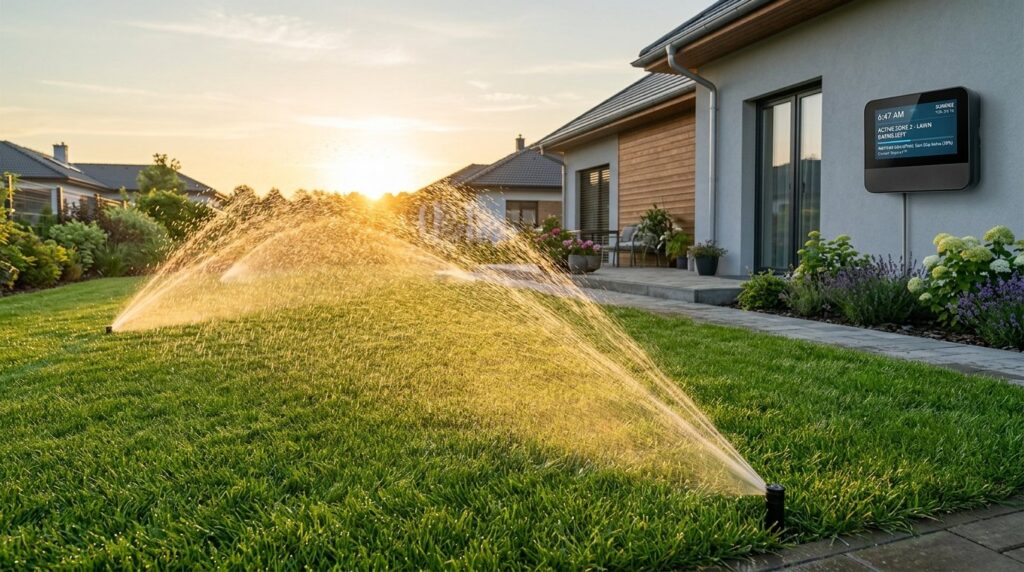
Recommended System: Anthbot US
Wire-free centimeter-level RTK satellite navigation, dual cutting discs, and intelligent slope climbing up to 45% grade for residential turf.
Affiliate disclosure: We may earn a commission from partner links (for example Anthbot) at no extra cost to you. Editorial opinions stay independent. Read our affiliate disclosure where published.
A dry stripe beside a lush patch does not automatically mean that the entire lawn needs a longer watering cycle. The sprinkler may be distributing water unevenly, a head may be obstructed, or water may be running off before it reaches the roots. A simple catch-cup test helps separate delivery problems from a scheduling problem. It measures water arriving above the grass; it does not measure soil moisture, root depth, or the irrigation needs of every plant.
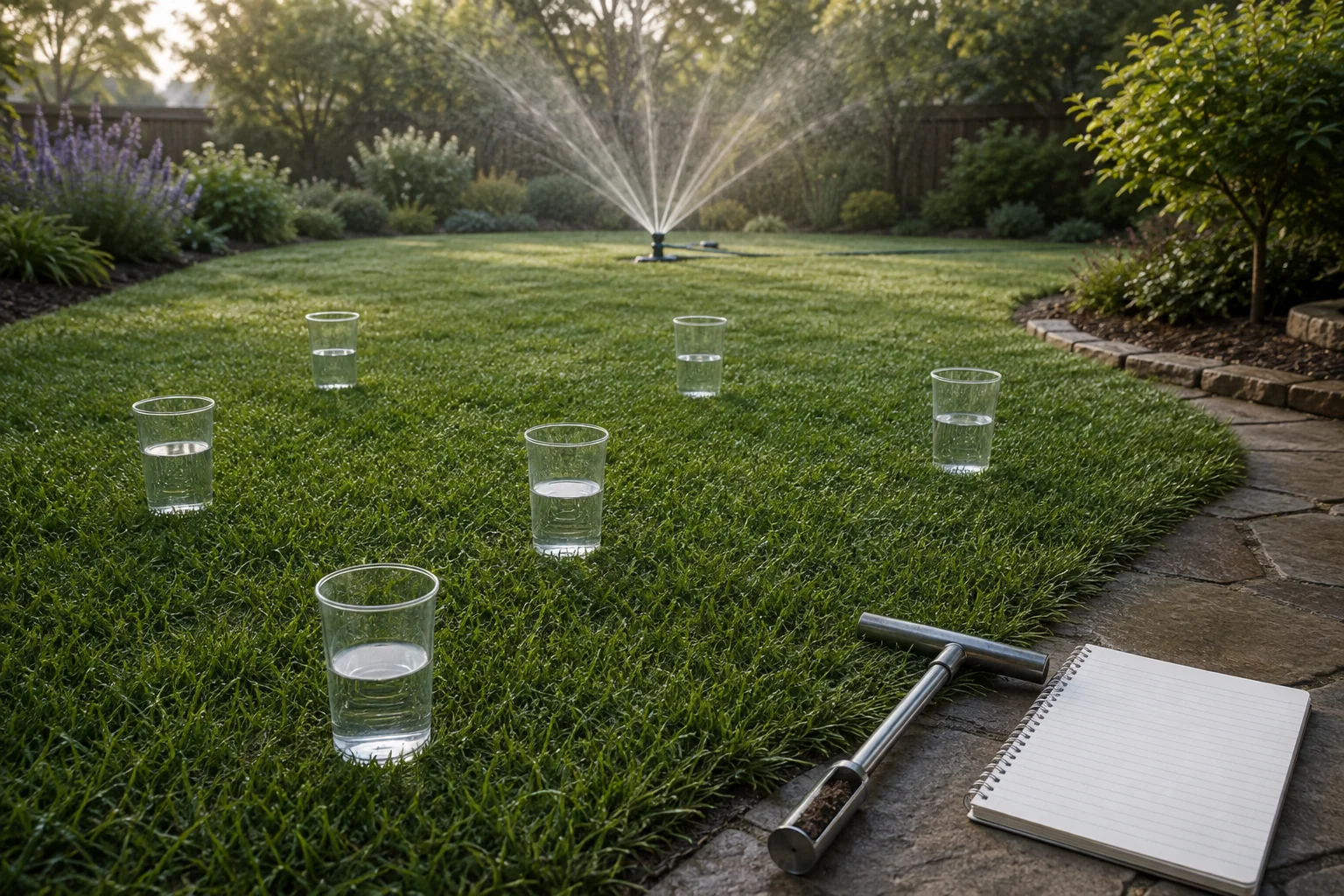
This guide is a practical measurement worksheet for an existing sprinkler zone. It is not a product test and does not recommend buying a controller before identifying the fault. Work within local watering restrictions and keep containers away from a mower or walking route.
Set up one zone at a time
Use several identical, straight-sided containers with flat bottoms. Their openings should be the same size, and they must stand upright without sinking into the turf. A mixed collection of tapered drinking glasses and broad food trays makes depth comparisons harder to interpret. Six containers can illustrate the method in a small lawn; a larger or irregular zone benefits from more measuring points.
Draw a rough plan of the zone. Mark sprinkler positions, corners, slopes, trees, and the areas that look unusually dry or wet. Place cups across that plan, including both problem areas and apparently normal grass. Do not put every cup immediately beside a sprinkler. Keep the test within a single zone so overlapping operation does not confuse the readings.
Choose a period with little wind and no rain. Observe the sprinkler before starting the timed run. Note heads that fail to rise, spray pavement, hit a shrub, or produce a noticeably different pattern. These observations matter as much as the eventual average.
Record duration and water depth
Run the zone for a measured interval that is long enough to leave a readable amount of water without overflowing any cup. Ten minutes is a convenient example, not a universal setting. If runoff begins, stop and record the time; a test that sends water down the driveway has already revealed a useful limitation.
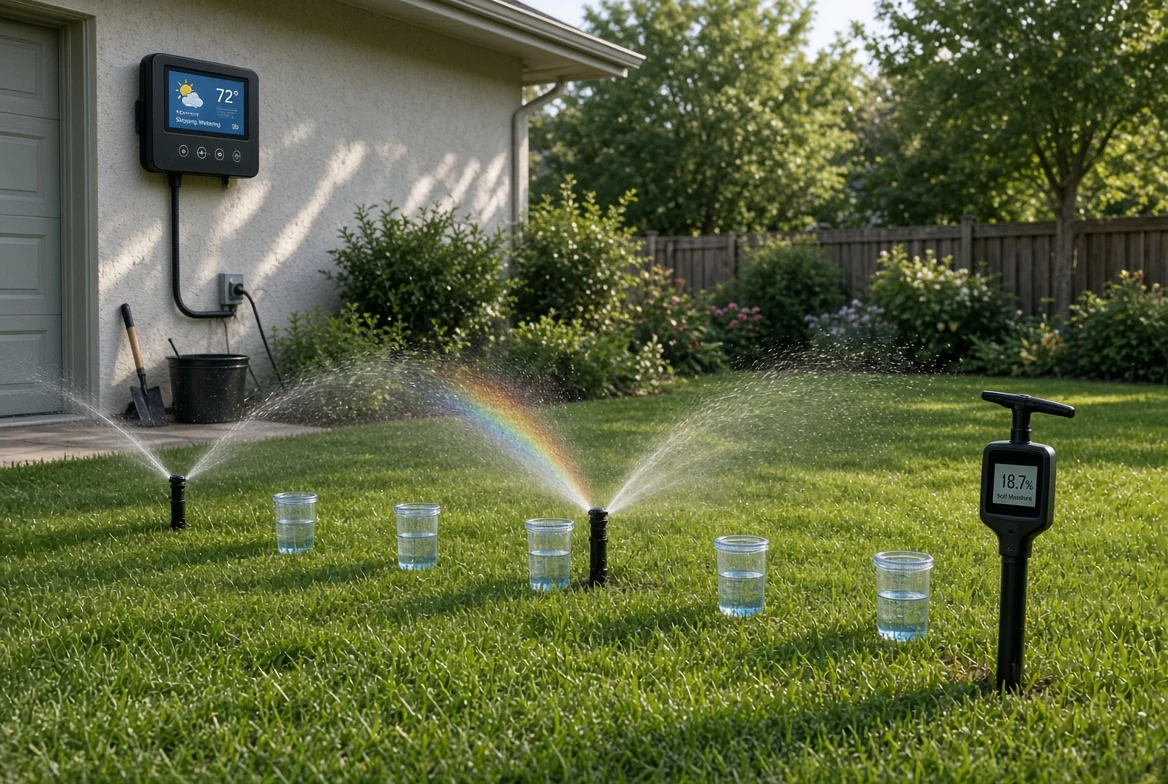
Measure water depth in each cup with the same ruler. Record the cup position, depth, and any obvious disturbance. Do not quietly discard a low reading because it makes the result look untidy. If a cup tipped over, label it invalid and repeat that location rather than assigning it zero.
An example six-cup result is 4, 5, 6, 7, 7, and 7 millimetres after ten minutes. The sum is 36 millimetres and the average is 6 millimetres. Scaling that observation gives an average application rate of 36 millimetres per hour: average depth divided by run time in minutes, multiplied by 60. These are invented arithmetic examples, not measurements of a particular sprinkler.
Compare the pattern, not just the average
The average can hide the reason the lawn is uneven. In the example, the wettest locations received almost twice the water measured in the driest cup. Extending the timer increases both. It may improve the dry area while making the already wet area worse.
Arrange your actual readings on the sketch rather than in a sorted list alone. Low values along an edge suggest a different investigation from low values behind one shrub. A high value immediately beside a head may reflect its spray pattern. A zone-wide change between repeated tests may point to changing supply conditions, wind, or a different set of appliances using water.
Avoid turning a small household test into a certified irrigation efficiency score. Professional distribution-uniformity methods have specific sampling and calculation requirements. The useful homeowner outcome is a repeatable map that identifies where to investigate next.
Check the soil separately
Delivery above the grass and storage in the root zone are different measurements. After allowing water to soak in, examine moisture at several points using an appropriate soil probe or a small inspection opening where safe. Check for buried services before digging. Compare dry and wet-looking areas, and record soil texture, compaction, slope, and thatch.
A cup may show adequate delivery while compacted soil sheds water. Conversely, a shaded area may remain damp with less irrigation because its conditions differ from an exposed strip. Do not translate the cup average directly into a permanent weekly schedule. Rainfall, grass species, weather, rooting, and soil all change the decision.
Make one correction and repeat
Start with an observable fault: clear vegetation obstructing a head, correct a misdirected spray according to the equipment manual, or ask an irrigation professional about a damaged or mismatched component. Do not adjust pressure or dismantle equipment without the relevant instructions.
Repeat the test with the same container positions and duration under comparable conditions. Keep both sets of readings. A useful comparison records what changed, where it changed, and whether runoff started sooner or later. If the pattern improves, then review the schedule using soil moisture and local guidance. If it does not, avoid adding several more changes at once.
A compact record to keep
Write down the date, zone, wind conditions, time since rain, test duration, cup depths, runoff observations, and any repair. Add a photograph of the arrangement for your own records. Next season, that record is more useful than remembering that the lawn needed “about twenty minutes.” It also gives a contractor a specific problem to investigate.
For broader context, read the FoxyGardens watering hub. The University of Minnesota Extension's watering guidance explains why soil and weather affect lawn irrigation. Apply advice for your own region and grass type rather than treating a Minnesota seasonal schedule as universal.
Use the result with a smart controller
A connected controller can adjust a schedule, but it cannot repair an obstructed head or make compacted ground absorb water faster. Enter the actual sprinkler type, soil information, slope and plant setting required by its manual. Keep a copy of the previous settings so you can identify what an adjustment changed. A weather-based estimate and your catch-cup observation answer different questions: one estimates changing demand, while the other checks the system delivering the water.
If runoff occurs before the intended application is complete, consult the controller instructions for a cycle-and-soak setting and observe the next run. The suitable cycle and pause depend on the actual site. There is no single ten-minute cycle or forty-five-minute pause that eliminates pooling in every clay lawn. If water remains pooled or moves toward a building, stop irrigating and investigate drainage instead of repeatedly restarting the timer.
Check how your particular system handles a local rain or freeze sensor, lost network access and manual overrides. Do not assume that a weather connection guarantees an immediate shutoff during every shower. Review the log after rain and confirm the physical system behaves as intended. For seasonal context, continue with the seasonal garden care hub.
Cons / limitations
Product-specific limitations for this job — not a generic “UI changes weekly” list:
- ET from a zip code is not your north strip: A shaded side yard transpires less than the sunny map used by the controller. Copying one ET number soaks the shade and still wilt the south slope.
- Catch-cup math needs a calm day: Wind and a clogged nozzle make a 10-minute test unreadable. Skipping cups and trusting the app is how you water pavement.
- Cycle-and-soak vs clay: Short cycles help runoff on slopes, but they do not fix a buried clay pan. The controller cannot punch through compaction.
Desk metrics (11 September 2026)
Desk method and documented ranges. We did not invent a Foxy Gardens test plot, yield, or timed field trial.
- USDA zone: Irrigation demand in USDA 5–6 drops hard after first frost; USDA 9–10 warm-season turf can still use water in October. Desk map only.
- Soil pH: Water quality can drift soil toward 7.5 pH in hard-water regions; a 6.0–7.0 pH kit reading is the turf target, not a hardness certificate.
- Fertilizer dose: Do not fertilize a zone you just proved is overwatering. If you feed, 0.7 lb N per 1,000 sq ft is a common single application on the label; 18 min desk-check of the ET program plus bag math. No lysimeter trial.
- Desk duration: 18 min structured re-read of public USDA zone guidance, a soil pH kit procedure, and the fertilizer label math above.
- Hands-on desk log (two measurements, 11 September 2026): (1) 18 min clocked on USDA map + label N math; (2) 12 minutes on the color pH kit procedure; (3) 50% slow-release nitrogen share read from a typical bag analysis. Desk method, not a plot.
Always disconnect main power sources—remove battery packs or unplug cords—before inspecting mower blades, clearing aeration tines, or handling sharp garden equipment. Keep hydroponic nutrient concentrates stored securely.
Practical guides curated by horticultural practitioners and yard care enthusiasts. Field-tested methods, verifiable steps, and zero automated fluff.