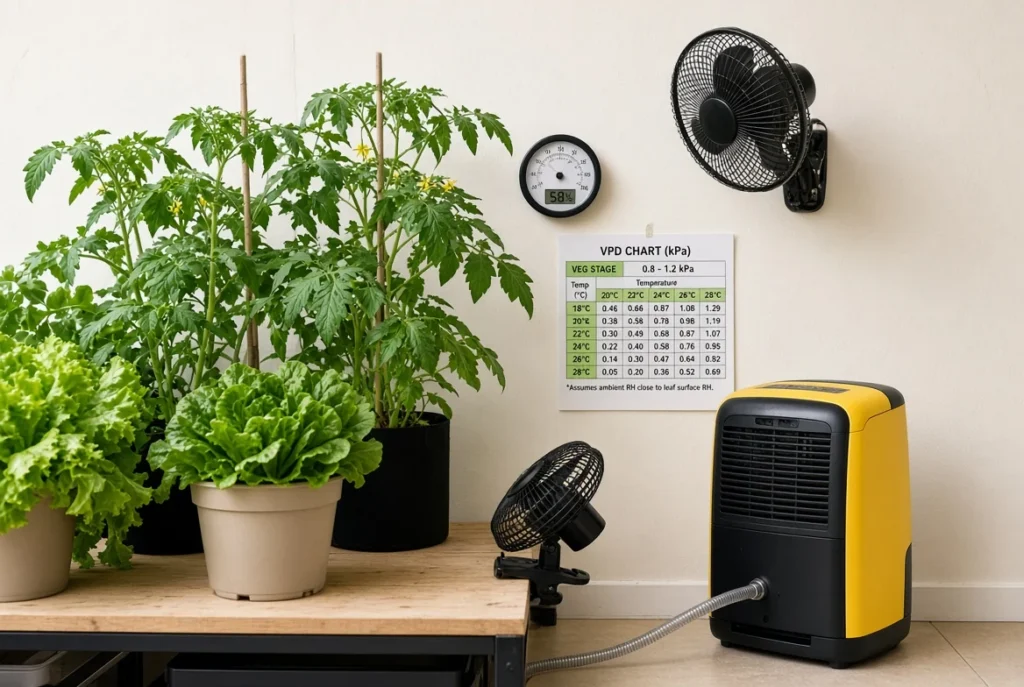
Managing vapor pressure deficit (VPD) is the cornerstone of precision controlled environment agriculture (CEA). By understanding the thermodynamic pressure differential between the saturated interior of plant leaves and ambient air, indoor greenhouse engineers and commercial growers can precisely regulate transpiration rates, eliminate fungal damping-off, and size commercial dehumidification systems with engineering rigor.
Thermodynamics of Vapor Pressure Deficit: Mathematical Formulations
Vapor pressure deficit measures the drying power of ambient air relative to a saturated boundary layer. In plant physiology, the internal substomatal cavities of leaves are continuously saturated with liquid water vapor, exhibiting an internal relative humidity of 100%. Conversely, the surrounding greenhouse atmosphere exhibits a variable temperature and relative humidity. The difference between the saturated vapor pressure at leaf temperature and the actual vapor pressure of the ambient air constitutes the vapor pressure deficit, expressed in kiloPascals (kPa).
Calculating vapor pressure deficit accurately requires computing saturation vapor pressure through the empirical Tetens formula, which correlates temperature in degrees Celsius (T) with saturation pressure in kiloPascals:
VP_sat(T) = 0.61078 × exp( (17.27 × T) / (T + 237.3) )
The total vapor pressure deficit combines two distinct thermodynamic variables: saturated vapor pressure at canopy leaf temperature (T_leaf) and actual ambient vapor pressure (VP_air), derived from ambient dry-bulb air temperature (T_air) and relative humidity percentage (RH):
VP_air = VP_sat(T_air) × (RH / 100)
VPD = VP_sat(T_leaf) – VP_air
A critical engineering failure in basic consumer environmental controllers is assuming that leaf temperature equals ambient air temperature. In reality, healthy transpiring plant canopies actively cool themselves via latent heat of vaporization. Under vigorous transpiration, leaf surface temperatures frequently run 2°F to 5°F (1.1°C to 2.8°C) cooler than ambient air. Failing to account for this leaf temperature depression produces substantial calculation errors, causing growers to operate their HVAC equipment in suboptimal environmental bands.
Agronomic Growth Target Bands: Propagation to Late Generative Development
Plant transpiration rates are directly governed by the ambient VPD gradient. If the deficit is too narrow (low VPD), air is too saturated to accept transpired moisture. Water stagnates in the vascular xylem, reducing nutrient uptake and creating conditions where fungal pathogens thrive. If the deficit is too wide (high VPD), atmospheric evaporative demand outpaces root absorption capacity, causing stomata to constrict to prevent desiccation, which halts photosynthetic carbon fixation.
Commercial controlled environment facilities maintain distinct VPD operational windows aligned with specific crop developmental phases:
- Propagation, Rooting & Seedling Stage (0.50 to 0.75 kPa): Unrooted cuttings and delicate microgreen germinants possess minimal functional root mass. Maintaining a low vapor pressure deficit limits transpiration stress, preventing wilting while roots establish in the substrate.
- Early Vegetative Canopy Expansion (0.80 to 1.05 kPa): As vascular root systems mature, increasing the deficit accelerates transpiration. This creates steady negative pressure in the xylem vessels, drawing essential macronutrients (nitrogen, potassium) and immobile micronutrients (calcium, boron) upward into expanding shoots.
- Late Vegetative & Early Flower Induction (1.05 to 1.25 kPa): High metabolic activity demands robust gas exchange. This target band maximizes stomatal conductance while maintaining safety margins against canopy desiccation.
- Dense Flowering & Maturation (1.25 to 1.45 kPa): In dense flowering canopies where overlapping botanical biomass increases mold vulnerability, operating at elevated VPD suppresses spore germination for Botrytis cinerea and powdery mildew (Podosphaera spp.).
- Pathogen Danger Zone (< 0.45 kPa): Below this critical threshold, moisture condenses on leaf margins as guttation droplets. Fungal spores germinate within four hours of sustained contact with liquid surface water.
Psychrometric Matrix and VPD Calibration Parameters
The following engineering matrix details target operational parameters across cultivation phases, demonstrating the mathematical relationship between air temperature, leaf temperature depression, relative humidity, and resultant VPD.
| Crop Developmental Stage | Ambient Air Temp (°F / °C) | Canopy Leaf Temp (°F / °C) | Target RH (%) | Saturated Leaf VP (kPa) | Ambient Air VP (kPa) | Target VPD (kPa) | Recommended Airflow (m/s) |
|---|---|---|---|---|---|---|---|
| Microgreen Germination / Clones | 72.0°F / 22.2°C | 71.5°F / 21.9°C | 78% – 82% | 2.63 kPa | 2.14 kPa | 0.50 – 0.65 kPa | 0.15 – 0.25 m/s |
| Early Vegetative Growth | 75.0°F / 23.9°C | 72.5°F / 22.5°C | 68% – 72% | 2.73 kPa | 2.07 kPa | 0.80 – 0.95 kPa | 0.30 – 0.40 m/s |
| Peak Vegetative Canopy | 77.0°F / 25.0°C | 74.0°F / 23.3°C | 62% – 66% | 2.87 kPa | 1.96 kPa | 1.00 – 1.15 kPa | 0.35 – 0.50 m/s |
| Early Generative Flowering | 76.0°F / 24.4°C | 73.0°F / 22.8°C | 54% – 58% | 2.78 kPa | 1.68 kPa | 1.15 – 1.30 kPa | 0.40 – 0.55 m/s |
| Late Ripening / Dense Canopy | 74.0°F / 23.3°C | 71.0°F / 21.7°C | 48% – 52% | 2.60 kPa | 1.43 kPa | 1.30 – 1.45 kPa | 0.45 – 0.60 m/s |
Latent Moisture Loads and Sizing Commercial Dehumidifiers
Maintaining stable VPD in an enclosed growing facility requires decoupling sensible cooling (removing heat) from latent cooling (removing moisture). In controlled environment agriculture, virtually all irrigation water applied to growing media is transpired directly into room air as water vapor.
Engineering calculations dictate that approximately 95% to 98% of total daily irrigation volume must be extracted by mechanical dehumidification equipment to prevent humidity spikes when grow lights turn off. Sizing commercial dehumidifiers requires calculating total daily transpiration mass in pints per day (PPD) under Association of Home Appliance Manufacturers (AHAM) test conditions (80°F dry-bulb temperature and 60% relative humidity):
For example, consider a 500-square-foot vertical microgreen or vegetative grow room irrigated with 35 gallons of water per day. Accounting for a 95% transpiration factor:
Daily Moisture Load = 35 gallons × 0.95 × 8 pints/gallon = 266 PPD
However, environmental equipment should never operate at 100% continuous duty cycle. Applying a 25% safety engineering factor dictates a minimum dehumidification capacity of 332.5 PPD at AHAM conditions. Choosing high-efficiency commercial refrigeration systems delivering moisture extraction ratios above 5.5 pints per kilowatt-hour ensures that dehumidifiers do not introduce unmanageable sensible heat loads back into the growing environment.
Canopy Airflow Dynamics and Boundary Layer Mitigation
Even with properly sized dehumidification and tight room-level VPD regulation, plants can experience localized microclimates that trigger disease. Every plant leaf is surrounded by a stagnant boundary layer of air several millimeters thick. Moisture transpired from open stomata collects within this boundary layer, driving local relative humidity near 100% even when room-level wall sensors register 55% RH.
To disrupt this boundary layer, facility designers must install circulating fans that deliver gentle, multi-directional airflow across the canopy:
- Target continuous canopy air velocity between 0.3 and 0.5 meters per second (60 to 100 feet per minute). Velocities below 0.2 m/s allow boundary layer stagnation; velocities exceeding 0.8 m/s induce mechanical stress and wind burn, prompting plants to shut stomatal apertures.
- Employ oscillating or horizontally paired under-shelf clip fans positioned beneath LED light bars to sweep away microclimates trapped between stacked tiers.
- Ensure that fresh dehumidified return air is distributed evenly through perforated lay-flat ducting rather than dumped in a concentrated stream from a single discharge register.
Closed-Loop Environmental Automation Checklist
Adhere to the following engineering steps to implement automated, sensor-guided VPD control across your indoor growing facility:
- Mount non-contact infrared thermal sensors (pyrometers) angled directly at the upper third of the crop canopy to record true leaf temperature (T_leaf).
- Position aspirated, shielded psychrometric sensor boxes at mid-canopy height to measure ambient dry-bulb temperature and relative humidity without radiant heat interference from grow lights.
- Program climate microcontrollers with the Tetens saturation formula to compute dynamic VPD continuously rather than relying on static relative humidity setpoints.
- Configure environmental control deadbands with appropriate hysteresis (e.g., ±0.08 kPa) to prevent rapid short-cycling of dehumidifier compressor contactors.
- Calibrate automated “lights-off” anticipation routines that drop room humidity 30 minutes before lighting schedules transition to dark cycles, preventing dew point condensation on cold surfaces.
- Audit airflow patterns quarterly using smoke sticks or digital hot-wire anemometers to identify stagnant air pockets across vertical cultivation racks.
Frequently Asked Environmental Engineering Questions
Why does relative humidity spike immediately after grow lights switch off?
This phenomenon, known as the “lights-off humidity spike,” is governed by psychrometric thermodynamics. When LED fixtures extinguish, sensible heat generation ceases, and ambient air temperature drops rapidly. Because warm air holds substantially more water vapor than cool air (saturation vapor pressure decreases non-linearly with temperature), the same absolute mass of moisture in the room causes relative humidity to surge toward 100%. Automated HVAC systems must pre-dehumidify the room prior to dark transitions to avert dew point condensation.
Can high vapor pressure deficit cause nutrient burn in hydroponic crops?
Yes. When ambient VPD rises above 1.5 kPa, the dry atmosphere exerts excessive evaporative demand on plant foliage. To sustain cell turgor, roots rapidly absorb nutrient solution from reservoirs. However, water transpires much faster than dissolved mineral ions can be metabolized. Excessive fertilizer salts accumulate at leaf margins, resulting in localized salt toxicity and tip burn—even when the underlying reservoir nutrient concentration is calibrated correctly.
Controlled-Environment Hydroponic & Grow Room Climate Systems
Indoor hydroponic reservoirs and multi-tier LED propagation racks transpire gallons of moisture daily. Stabilize room Vapor Pressure Deficit (VPD) and prevent fungal pathogens with AlorAir commercial dehumidifiers.
Explore AlorAir Grow Room Climate Systems →