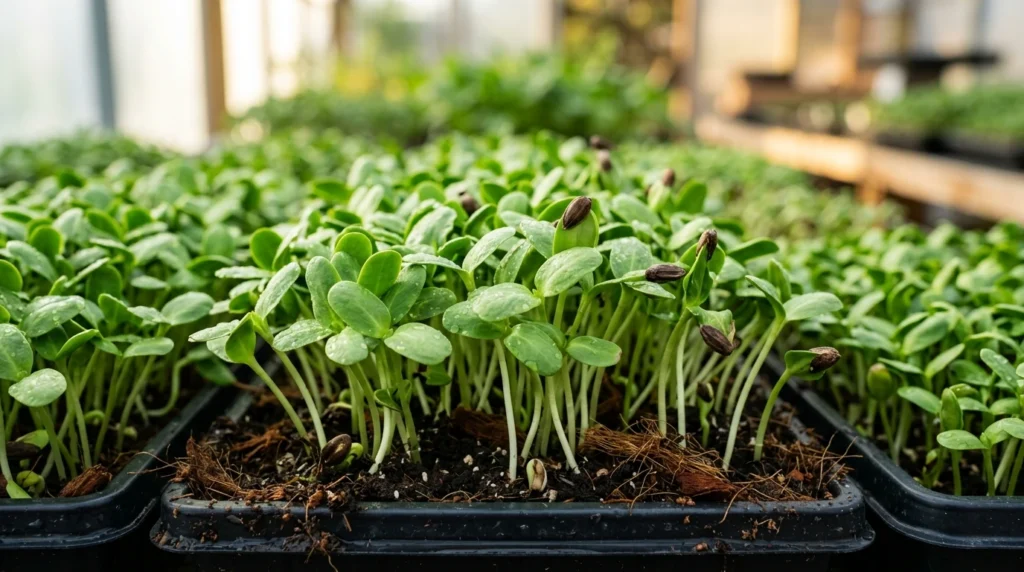
Calibrating precise dry seed density and biomass conversion ratios is the single most critical agronomic factor governing profitability and pathogen prevention in commercial microgreen production. This technical manual and reference tool establishes exact mathematical models for seed mass distribution, canopy air resistance, and expected fresh cut harvest yields across standard 1020 propagation trays.
Mathematical Foundations of Seeding Density in Controlled Environment Agriculture
The standard commercial propagation tray in North America, universally designated as the 1020 flat, features interior rim dimensions of approximately 10.8 inches by 21.25 inches. This geometry yields a usable horizontal cultivation footprint of 229.5 square inches, equivalent to 0.148 square meters (1,480 square centimeters). Achieving optimal crop yield requires balancing seed density so that the germinated hypocotyl canopy maximizes light capture without exceeding the biological threshold where stagnant humidity induces fungal damping-off.
When dry seed mass is distributed across this 229.5 square inch boundary, seed geometry and individual seed mass dictate population counts. For small-seeded brassica cultivars such as broccoli (Brassica oleracea var. italica), individual seed weights average 2.8 to 3.2 milligrams, yielding approximately 310 to 350 seeds per gram. Distributing 28 grams of dry broccoli seed across a 1020 flat results in approximately 9,000 viable seedlings, producing an initial density of 39 seeds per square inch.
Conversely, large-seeded legumes like speckled peas (Pisum sativum) exhibit an average seed mass of 220 to 260 milligrams, yielding only 4 to 5 seeds per gram. A standard commercial seeding rate of 280 grams introduces approximately 1,260 seeds to the tray, representing a density of roughly 5.5 seeds per square inch. Attempting to seed peas at brassica population densities causes rapid overcrowding, mechanical lodging, and total crop failure due to oxygen depletion in the root rhizosphere.
Biomass Yield Multipliers and Cut-Weight Mathematical Formulations
Commercial vertical farm planning relies on empirical biomass conversion factors, designated as the fresh harvest yield multiplier (Y_m). This dimensionless coefficient defines the relationship between initial dry seed mass and final harvestable shoot fresh weight:
Harvested Fresh Weight (grams) = Dry Seed Input (grams) × Y_m
Under optimized horticultural environments—maintaining daily light integrals (DLI) between 12 and 15 moles per square meter per day, relative humidity between 50% and 60%, and ambient temperatures between 68°F and 72°F (20°C to 22.2°C)—each crop family exhibits distinct biomass conversion coefficients.
Brassicas (broccoli, kale, red acre cabbage) exhibit exceptional conversion efficiency, displaying yield multipliers ranging from 11.5 to 14.5. This high conversion occurs because the tiny seed functions primarily as a genetic blueprint, with over 90% of final harvested biomass consisting of water and photosynthetic carbohydrates synthesized during the 8 to 11-day vegetative growth window. Radish cultivars (Raphanus sativus) display multipliers between 8.0 and 10.5, benefiting from rapid hypocotyl elongation and substantial cellular water uptake.
In contrast, large-seeded oilseeds and legumes store significant cotyledon reserves and require lower conversion ratios. Speckled peas produce yield multipliers between 3.2 and 4.0, while black oil sunflowers (Helianthus annuus) yield multipliers between 4.2 and 5.5. Because pea and sunflower seeds represent a substantial fraction of total production costs, small changes in seeding precision exert an outsized impact on facility profit margins.
Commercial Microgreen Room Dehumidification: AlorAir
Eliminate canopy damping-off and Botrytis mold across high-density 1020 propagation racks with high-airflow commercial dehumidifiers.
Explore AlorAir Grow Room Dehumidifiers →1020 Flat Cultivar Calibration and Production Matrix
The following authoritative reference matrix outlines empirical calibration targets for standard commercial cultivars grown on shallow 1020 flats with bottom drainage perforations using sterile inert coconut coir or woven hemp media.
| Crop Cultivar | Dry Seed Mass (Grams) | Soaking Protocol | Blackout Window (Hours) | Harvest Day Range | Average Cut Yield (Grams) | Average Cut Yield (Ounces) | Yield Multiplier (Y_m) |
|---|---|---|---|---|---|---|---|
| Waltham 29 Broccoli | 26 – 30 g | No soaking | 72 – 84 hrs | Day 9 – 11 | 340 – 420 g | 12.0 – 14.8 oz | 13.0× – 14.0× |
| Rambo Radish | 38 – 45 g | No soaking | 60 – 72 hrs | Day 7 – 9 | 360 – 450 g | 12.7 – 15.9 oz | 9.5× – 10.0× |
| Red Acre Cabbage | 28 – 32 g | No soaking | 72 – 96 hrs | Day 10 – 12 | 330 – 400 g | 11.6 – 14.1 oz | 11.8× – 12.5× |
| Black Oil Sunflower | 120 – 140 g | 8 – 10 hrs soak | 72 – 84 hrs | Day 8 – 10 | 550 – 700 g | 19.4 – 24.7 oz | 4.5× – 5.0× |
| Speckled Dun Pea | 260 – 300 g | 10 – 12 hrs soak | 72 – 84 hrs | Day 9 – 12 | 850 – 1,050 g | 30.0 – 37.0 oz | 3.2× – 3.5× |
| Slow Bolt Cilantro | 45 – 55 g | Crush split / 4 hr | 96 – 120 hrs | Day 16 – 21 | 220 – 290 g | 7.8 – 10.2 oz | 4.8× – 5.3× |
| Genovese Basil | 12 – 16 g | No soaking (gel) | 96 – 120 hrs | Day 18 – 24 | 160 – 210 g | 5.6 – 7.4 oz | 13.0× – 13.5× |
Environmental Variables Modulating Harvest Biomass and Cut Quality
While seed mass establishes the theoretical maximum plant count, environmental parameters dictate whether individual stems develop thick structural cell walls or succumb to etiolation. Three physical variables exert measurable control over final cut weight:
1. Daily Light Integral (DLI) and Photoperiod Dynamics: Horticultural LED arrays must deliver a minimum Photosynthetic Photon Flux Density (PPFD) of 150 to 220 micromoles per square meter per second (μmol/m²/s) across an active 16-hour photoperiod. This configuration delivers an accumulated DLI of 8.6 to 12.7 mol/m²/day. If DLI drops below 6.5 mol/m²/day, seedlings stretch excessively, producing weak cell walls with low dry-matter ratios. Although fresh harvest volume may appear substantial, post-harvest shelf life declines by over 50% due to rapid cell lysis.
2. Airflow Velocity and Boundary Layer Resistance: High seedling density creates a micro-canopy that traps stagnant, humid air at the stem base. Unless under-shelf circulating fans deliver continuous horizontal airflow between 0.3 and 0.5 meters per second across the tray surface, boundary layer resistance inhibits transpiration. Stifled transpiration blocks calcium transport through the xylem to expanding leaf tips, causing marginal leaf necrosis and providing entry pathways for necrotrophic fungal pathogens such as Botrytis cinerea.
3. Electrical Conductivity (EC) of Irrigation Solutions: For crops with growth cycles under 12 days (radish, brassicas, peas), irrigating with municipal or RO water balanced at an EC of 0.4 to 0.8 mS/cm and a pH of 5.8 to 6.2 produces optimal fresh biomass. Introducing high-salinity nutrient solutions (EC exceeding 1.8 mS/cm) during early vegetative stages creates osmotic stress that retards hypocotyl expansion, reducing fresh cut yield by 15% to 22%.
Financial Modeling: Calculating Cost of Goods Sold (COGS) per Harvested Ounce
Precision seeding density data allows commercial farm managers to construct accurate unit economics models. The true variable Cost of Goods Sold (COGS) for a single 1020 flat breaks down into four direct components:
- Seed Input Cost: Calculated as dry seed mass multiplied by bulk wholesale purchase cost per gram. For broccoli purchased at $18.00 per pound ($0.0396 per gram), a 28-gram seeding rate represents a direct seed cost of $1.11. For sunflower seed at $3.50 per pound ($0.0077 per gram), a 130-gram rate represents $1.00.
- Substrate Cost: Pre-cut coco coir mats or food-grade unbleached jute pads average $0.55 to $0.85 per flat in commercial volumes. Loose bulk coco coir hydrated and packed into trays reduces medium cost to approximately $0.22 per flat.
- Electrical Energy Consumption: Operating a standard 4-tier vertical rack equipped with two 40W LED bars per tier (320W total array) across a 16-hour daily schedule consumes 5.12 kilowatt-hours (kWh) per day. Distributing this electrical draw across 16 active trays equates to 0.32 kWh per tray day. Over a 10-day cycle at a commercial utility rate of $0.14 per kWh, energy cost totals $0.45 per tray.
- Water and Sanitation Chemistry: Reverse osmosis filtration, bottom-irrigation water, and certified food-safe peracetic acid or hydrogen peroxide tray sterilization add approximately $0.08 per production cycle.
Summing these direct inputs yields a baseline production cost between $1.86 and $2.49 per tray. For a broccoli flat yielding 13.5 ounces of cut microgreens, direct material cost equals approximately $0.15 to $0.18 per ounce. In commercial restaurant supply channels commanding wholesale prices of $1.25 to $2.00 per ounce, maintaining strict seeding density directly protects gross margins exceeding 85%.
Operational Seeding and Calibration Protocol Checklist
To eliminate tray-to-tray yield variances, commercial operators should enforce the following standardized operating procedure during each planting cycle:
- Tolerate seed scale variances no greater than plus or minus 0.5 grams using a calibrated digital bench scale before seeding.
- Ensure grow medium moisture is fully equilibrated to field capacity with bottom saturation prior to seed application; never sow on dry substrate.
- Utilize mechanical perforated shaker boxes or precision air seeders to achieve uniform spatial dispersal, completely eliminating clustered seed mounds.
- Verify soaking temperatures for large seeds (sunflower, peas) remain strictly between 62°F and 68°F (16.6°C to 20°C) to prevent anaerobic fermentation during the hydration phase.
- Apply a consistent mechanical stacking weight of 4 to 8 pounds per tray during the initial 72-hour blackout period to force robust root anchoring into the grow pad.
- Record harvested fresh weight immediately upon cutting using sanitized stainless steel harvest blades elevated 0.25 inches above the medium surface.
Frequently Asked Agronomic Questions
Why does over-seeding a 1020 flat often result in lower total harvest weight?
When seed density surpasses the biological carrying capacity of the tray, individual seedlings compete aggressively for available light and root oxygen. Rather than producing thick, sturdy hypocotyls rich in cellular water, overcrowded seedlings produce spindly, etiolated stems with minimal structural mass. Additionally, the restricted airflow within an over-seeded canopy triggers stem damping-off, forcing growers to cull necrotic patches and ultimately reducing marketable cut weight below that of a correctly seeded tray.
Should microgreen seeds be soaked in warm or cold water before planting?
Large seeds with thick pericarp shells (sunflower, speckled peas) should be soaked in clean, dechlorinated water maintained at cool room temperature (65°F to 68°F / 18°C to 20°C). Using warm water above 75°F (24°C) dramatically accelerates bacterial multiplication, leading to sour odorous water and fungal spore activation before the seeds even reach the germination rack. Small brassica seeds should never be soaked, as their seed coats become mucilaginous upon contact with water, making uniform broadcast impossible.
Always wear eye protection and protective gloves when calibrating granular fertilizer spreaders or handling concentrated hydroponic nutrients. Before servicing robotic mower blades or irrigation heads, ensure main battery packs or power supplies are completely disconnected.
Data-driven soil, irrigation, and yard automation calculators developed in accordance with university agricultural extension standards and empirical field testing.