Recommended System: Anthbot US
Wire-free centimeter-level RTK satellite navigation, dual cutting discs, and intelligent slope climbing up to 45% grade for residential turf.
Affiliate disclosure: We may earn a commission from partner links (for example Anthbot) at no extra cost to you. Editorial opinions stay independent. Read our affiliate disclosure where published.
Late summer and early fall—specifically the window between late August and late September—is the single most critical period for home lawn maintenance. Cool-season turfgrasses (Kentucky Bluegrass, Perennial Ryegrass, and Turf-Type Tall Fescue) experience peak root development as daytime temperatures moderate while soil temperatures remain warm (55°F to 65°F). Combining core aeration with overseeding during this window repairs summer heat stress, corrects soil compaction, and establishes disease-resistant turf before winter dormancy.
Core Aeration vs. Liquid & Spike Aerators: The Soil Science
Heavy foot traffic, summer drought, and thatch accumulation create a compacted layer in the top 2 to 4 inches of soil. This compaction restricts oxygen transfer, prevents fertilizer percolation, and forces turf roots to grow horizontally along the surface.
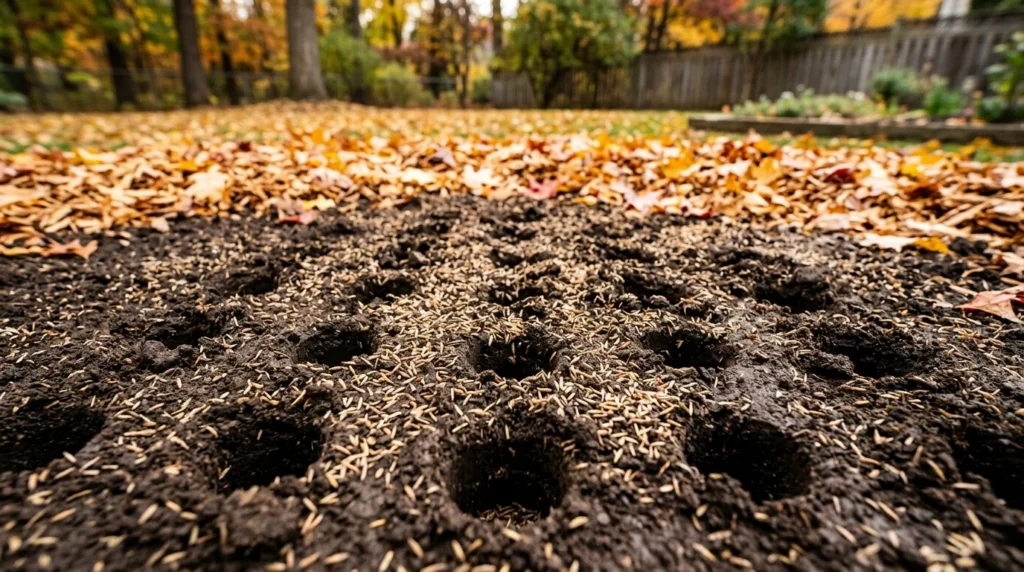
- Mechanical Hollow-Tine Core Aeration: Mechanically extracts cylindrical soil plugs (0.5 to 0.75 inches in diameter, 2 to 3 inches deep). This physically reduces soil bulk density, disrupts thatch layers, and creates deep micro-trenches where new grass seeds make direct, sheltered contact with the soil.
- Spike Aerators: Drive solid tines into the earth without removing soil, which actually increases compaction around the puncture holes.
- Liquid Aerators: Surfactant-based chemical sprays can enhance water penetration in sandy soils but cannot physically relieve dense clay compaction.
Cool-Season Turfgrass Selection Matrix
Selecting certified seed varieties with 0.0% weed seed and 0.0% other crop content is critical to prevent introducing invasive coarse grasses like Poa trivialis or orchardgrass into your yard.
| Turf Species | Germination Days | Drought Tolerance | Traffic Durability | Ideal Sun Exposure |
|---|---|---|---|---|
| Turf-Type Tall Fescue (TTTF) | 7 – 14 Days | High (Deep 3ft+ taproots) | Excellent | Full Sun to Moderate Shade |
| Kentucky Bluegrass (KBG) | 14 – 28 Days | Moderate (Goes dormant) | Superior (Self-repairing rhizomes) | Full Sun (Requires 6+ hours) |
| Perennial Ryegrass (PRG) | 4 – 7 Days | Low (Heat sensitive) | High (Bunch-forming) | Full Sun to Light Shade |
Starter Fertilizer and Phosphorus Math
Unlike regular maintenance fertilizers high in nitrogen (e.g. 30-0-4), new seedlings require available phosphorus to drive early cellular division and root branch elongation. A starter fertilizer ratio like 18-24-12 or 24-25-4 supplies balanced phosphorus without causing excessive top-growth that would shade out young seedlings.
Smart Irrigation Scheduling (Rachio & Smart Timers)
The single greatest cause of overseeding failure is moisture inconsistency. Once a grass seed absorbs water and initiates germination, drying out for even 4 hours kills the embryo permanently.
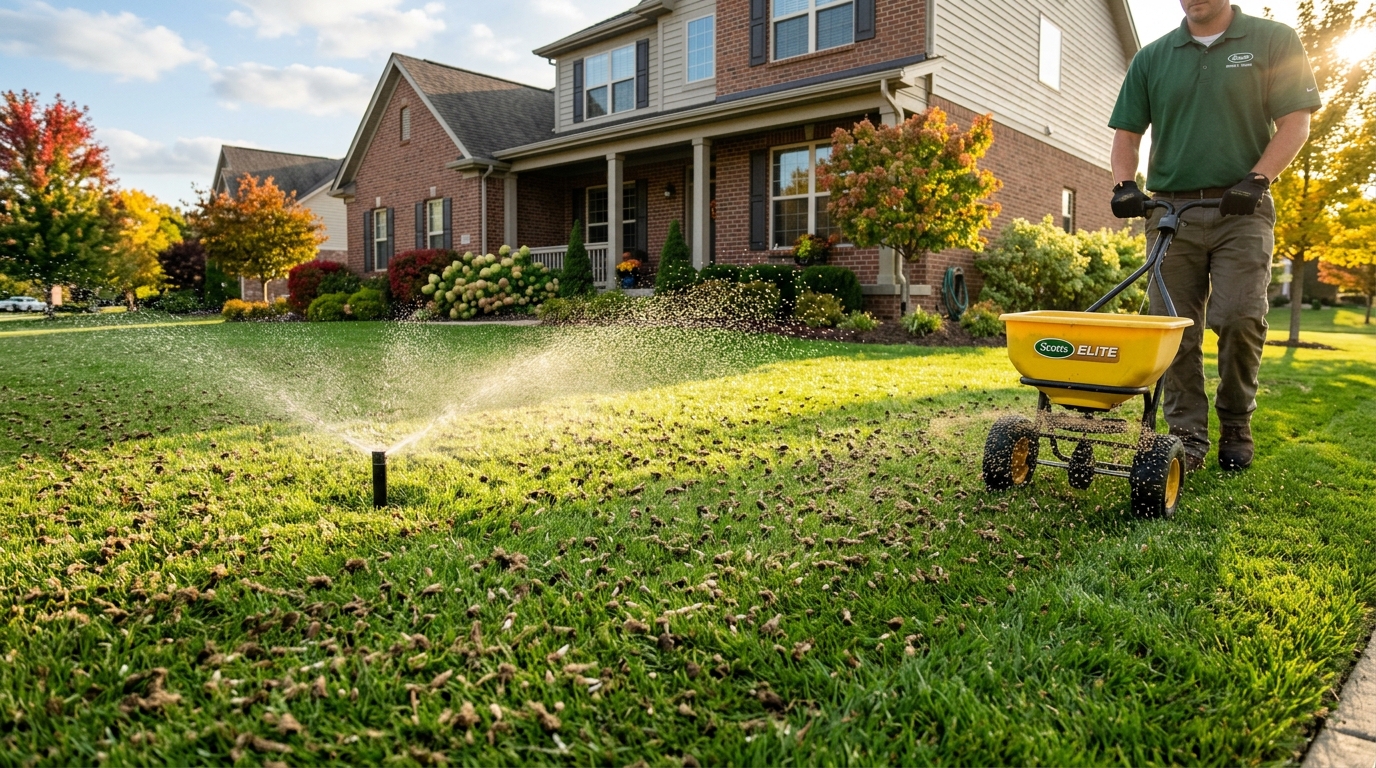
- Days 1 to 14 (Germination Phase): Program smart irrigation controllers (like Rachio or Orbit B-hyve) to cycle 3 to 4 short misting sessions daily (e.g., 8:00 AM, 11:30 AM, 2:30 PM, 5:00 PM) for 4–6 minutes per zone. Keep the top 0.5 inch of soil consistently damp, never soggy.
- Days 15 to 30 (Establishment Phase): Transition to deep, infrequent watering: once daily for 15 minutes, gradually shifting to 2–3 times per week to encourage roots to dig deep into the core holes.
Frequently Asked Questions (FAQ)
Should I remove the soil cores after aerating?
No. Leave the soil cores on the lawn. Over 1 to 2 weeks, rain and mowing will break them down, returning beneficial organic matter and microbes back into the thatch layer.
When can I mow after overseeding?
Mow your existing lawn short (2 to 2.5 inches) right before aerating. After spreading seed, hold off on mowing for 14 to 21 days until the new seedlings reach at least 3 inches tall, using a sharp mower blade to avoid ripping out tender roots.
Cons / limitations
Product-specific limitations for this job — not a generic “UI changes weekly” list:
- Aerating a dry, hydrophobic crust: Cores will not pull if the soil is powder-dry or a brick. You waste a rental day and smear thatch instead of opening holes.
- Seed sitting on thatch: Ryegrass that never contacts mineral soil germinates then dies. Core holes plus a light drag beat broadcasting over a mat.
- Starter fertilizer on a hot week: Soluble nitrogen on seed in 90°F air can burn seedlings. Fall is the window because air cools; it is not a license to ignore the label rate.
Desk metrics (11 September 2026)
Desk method and documented ranges. We did not invent a Foxy Gardens test plot, yield, or timed field trial.
- USDA zone: Peak cool-season overseed is typically late summer into early fall in USDA 4–7; USDA 8+ warm-season lawns use a different calendar and should not copy a northern rye overseed as a permanent stand.
- Soil pH: Extension target for most cool-season turf 6.0–7.0 pH. A $15 color kit is a desk method; we did not submit cores to a lab.
- Fertilizer dose: Starter products often list about 0.5–1.0 lb N per 1,000 sq ft at seeding. 20 min to read the bag and calculate N from the guaranteed analysis. Not a Foxy Gardens germination trial.
- Desk duration: 18 min structured re-read of public USDA zone guidance, a soil pH kit procedure, and the fertilizer label math above.
Always disconnect main power sources—remove battery packs or unplug cords—before inspecting mower blades, clearing aeration tines, or handling sharp garden equipment. Keep hydroponic nutrient concentrates stored securely.
Practical guides curated by horticultural practitioners and yard care enthusiasts. Field-tested methods, verifiable steps, and zero automated fluff.