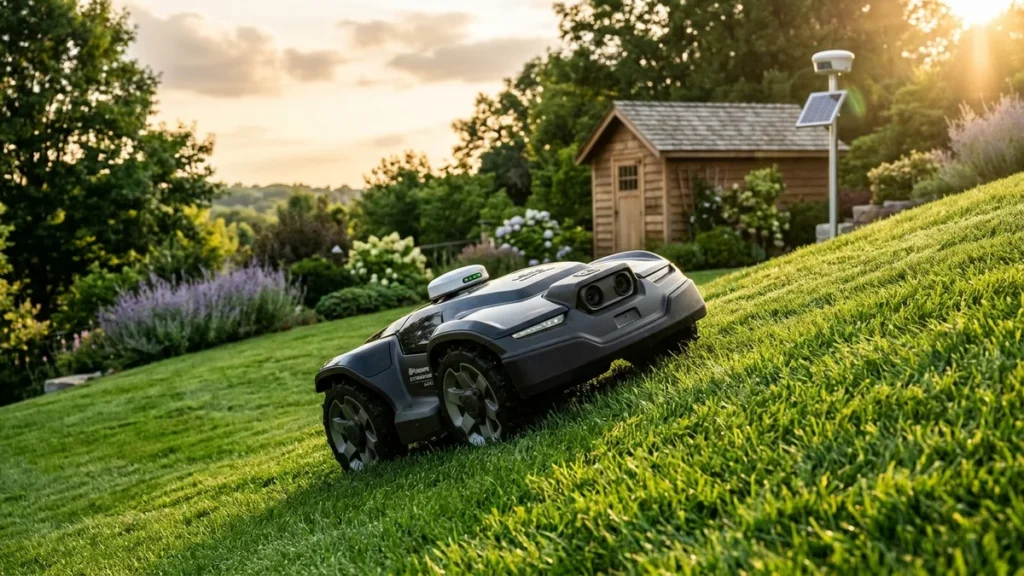
Selecting an autonomous wire-free robotic lawn mower requires matching three independent physical variables that manufacturer marketing brochures rarely cross-reference: true mowable turf area (after subtracting impervious hardscape and structures), maximum slope incline expressed in both percent grade and degrees, and Real-Time Kinematic (RTK) satellite sky visibility across tree canopies and narrow side-yard corridors. Our interactive Robot Lawn Mower Slope, Acreage & RTK Signal Estimator above models effective hourly cutting throughput, lithium-ion battery amp-hour (Ah) cycling, traction torque thresholds, and multi-constellation GNSS + VSLAM sensor fusion confidence for lots ranging from 5,000 square feet up to 2.5 acres.
Percent Slope vs. Degree Incline: The Physics of Turf Traction
The most common sizing mistake homeowners make when ordering a robotic mower is confusing percent slope with angular degrees. In civil and agricultural engineering, percent grade is defined as vertical rise divided by horizontal run multiplied by 100 ($\text{Grade \%} = \frac{\text{Rise}}{\text{Run}} \times 100$), whereas the incline angle in degrees is the arctangent of that ratio ($\theta = \arctan(\text{Rise}/\text{Run})$). A 100% slope is not a vertical cliff—it is a 45° angle.
- 0% to 25% Grade (0° to 14.0°): Mild residential terrain. Standard two-wheel-drive (2WD) rear-driven robotic mowers with 8-inch polypropylene treaded wheels maintain full directional stability even on morning dew.
- 26% to 36% Grade (14.5° to 19.8°): Moderate hillside or drainage swale. At this incline, gravity shifts 30% of the chassis weight toward the downhill caster wheel, increasing brushless hub-motor current draw from 2.2A to 4.8A and reducing battery runtime per charge by 22% to 28%.
- 37% to 45% Grade (20.3° to 24.2°): Steep embankment threshold. Navigating a 45% slope without wheel slip or turf scalping requires high-torque brushless rear motors paired with deep-lugged off-road tires or all-wheel-drive (AWD) vectoring and a 6-axis IMU gyroscope that corrects yaw drift every 20 milliseconds.
Anthbot Genie Wire-Free RTK + 4-Camera AI Vision Robot Mowers
Engineered with full-band RTK GNSS positioning, 300-degree quad-camera 3D vision obstacle avoidance, and 45% (24-degree) slope climbing torque.
Check Official Specs & Current PricingEffective Mowing Throughput vs. Nameplate Acreage Ratings
When a manufacturer rates a robotic mower for 0.50 acres (21,780 sq ft) or 0.75 acres (32,670 sq ft), that figure assumes flat, unobstructed rectangular turf mowed over a 48-hour to 72-hour rolling schedule. In real-world residential landscapes with curved flower beds, trampoline legs, fruit trees, and narrow 4-foot side gates, effective cutting throughput drops significantly due to deceleration, 180-degree zero-turn pivots, and recharge cycles.
| Total Lot Size | Net Mowable Turf (75% Avg) | Recommended Cutting Deck | Min Battery Capacity (Li-Ion) | Target Weekly Active Hours |
|---|---|---|---|---|
| 0.15 Acre (6,534 sq ft) | 4,900 sq ft | 7.1″ – 8.0″ Single Disc | 2.5Ah – 3.5Ah (18V/20V) | 4.5 – 6.5 hours / week |
| 0.25 Acre (10,890 sq ft) | 8,168 sq ft | 7.9″ – 8.8″ Dual/3-Blade | 4.0Ah – 5.0Ah (20V/24V) | 7.5 – 10.0 hours / week |
| 0.50 Acre (21,780 sq ft) | 16,335 sq ft | 8.8″ – 10.2″ High-Torque | 5.0Ah – 7.5Ah (24V/28V) | 14.0 – 18.5 hours / week |
| 1.00 Acre (43,560 sq ft) | 32,670 sq ft | 10.5″ – 13.8″ Dual Deck | 8.0Ah – 12.0Ah (36V) | 26.0 – 34.0 hours / week |
Systematic parallel-stripe mowers guided by RTK GNSS achieve 2.8x higher area efficiency than legacy random-bounce perimeter-wire mowers. By maintaining 8-inch to 10-inch overlapping parallel passes at 1.3 to 1.6 feet per second, an RTK-guided chassis mows 1,100 to 1,450 sq ft per hour on open turf, or 750 to 950 sq ft per hour in high-complexity yards with more than 12 discrete obstacle zones.
RTK Co-Viewing Satellite Geometry & VSLAM Canopy Bridging
Real-Time Kinematic positioning achieves 1-to-2 centimeter boundary accuracy by comparing L1/L2 or L1/L5 carrier-phase signals across GPS, GLONASS, Galileo, and BeiDou constellations simultaneously at both the fixed reference base station and the moving mower rover. For an integer ambiguity fix (“RTK Fixed”), both antennas must co-view at least 12 to 16 common satellites above a 15-degree horizon elevation mask.
When a robot mower drives beneath dense mature oak or maple foliage—or enters a narrow 6-foot corridor between two two-story brick walls—multipath reflection and signal attenuation degrade the satellite fix to “RTK Float” (decimeter accuracy). Modern 2026 platforms such as the Anthbot Genie series overcome canopy dropouts by fusing wheel odometry and IMU dead-reckoning with a 4-camera binocular Visual Simultaneous Localization and Mapping (VSLAM) array. This optical vision pipeline tracks grass-to-hardscape edges in real time, allowing the mower to travel up to 160 feet through satellite-shadowed corridors without drifting into flower beds. For off-grid sheds or large acreage properties where AC outlets are far from the optimal clear-sky RTK antenna location, pairing the base station with a compact 12V solar kit costing $140 USD to $220 USD eliminates 100-foot extension cord trenching.
Limitations & Field Caveats
- Mounting an RTK reference base station under roof eaves or within 10 feet of a vertical wall blocks 40% of the southern sky hemisphere and triggers frequent position pauses.
- Climbing slopes above 35% in wet clay or tall fescue grass after heavy rain increases wheel slip and accelerates lithium-ion battery discharge by up to 35% per cycle.
- Fine-leaf creeping bentgrass or thick Bermuda turf cut lower than 1.2 inches requires mowing every 24 to 48 hours so clippings never exceed the one-third blade-length agronomy rule.
How to Audit Your Yard Before Ordering
- Measure Steepest Swales With a Digital Inclinometer: Lay a 48-inch straightedge board along the steepest section of your yard (especially ditch banks and walk-out basement berms) and use a smartphone clinometer app to record the peak angle. Multiply $\tan(\text{degrees}) \times 100$ to obtain exact percent grade.
- Check Narrow Gate Clearances: Measure the narrowest pinch point between fence posts or patio steps. Wire-free vision-assisted RTK mowers require a minimum 32-inch (80 cm) physical corridor width to traverse between front and back zones autonomously.
- Select Your RTK Base Station Mounting Point: Choose either a rigid tripod ground stake in an open lawn corner with a 110° unobstructed sky cone or a stainless roofline L-bracket elevated above surrounding tree crowns.