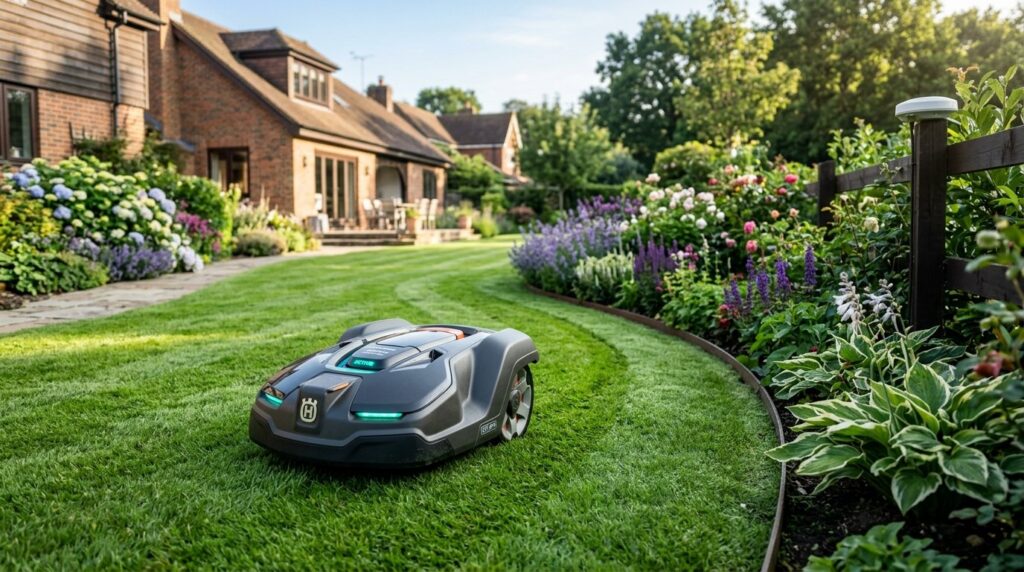
Recommended System: Anthbot
Wire-free centimeter-level RTK satellite navigation, dual cutting discs, and intelligent slope climbing up to 45% grade for residential turf.
The North American residential lawn care sector is undergoing an accelerated technological migration as perimeter-free robotic lawn mowers achieve widespread commercial maturity. In suburban master-planned developments across Texas, California, and Ontario, property owners are replacing traditional buried boundary wires with Real-Time Kinematic (RTK) GNSS satellite navigation.
The Death of the Perimeter Wire Trench
For more than two decades, robotic mowing required burying low-voltage wire loops around lawn borders, flowerbeds, and driveways. Homeowners routinely faced wire cut failures caused by spring aeration, string trimmers, and frost-heave soil movement. Modern wire-free systems like the Anthbot N8 RTK Mower utilize dual-frequency satellite constellations to map properties virtually via smartphone app, reducing setup time from a grueling weekend project to less than 30 minutes.
| Metric | Perimeter Wire Mowers | Wire-Free RTK GNSS Mowers |
|---|---|---|
| Initial Setup Time | 6 to 10 Hours (Manual trenching) | 20 to 45 Minutes (App walk-through) |
| Boundary Adjustment | Re-dig and splice wire | Edit digital vector in app |
| Aeration Safety | High wire severance risk | 100% Core aeration safe |
| Cutting Pattern | Random bounce (Inefficient) | Systematic parallel lines |
Optical VSLAM and Multipath Correction
Early RTK systems struggled with signal multipath distortion caused by tall two-story brick walls and dense tree foliage. The latest 2026 hardware models integrate optical Visual Simultaneous Localization and Mapping (VSLAM) cameras, allowing the robot to seamlessly navigate shaded alleys and under dense tree canopies without losing positioning coordinates.
Always disconnect main power sources—remove battery packs or unplug cords—before inspecting mower blades, clearing aeration tines, or handling sharp garden equipment. Keep hydroponic nutrient concentrates stored securely.
Practical guides curated by horticultural practitioners and yard care enthusiasts. Field-tested methods, verifiable steps, and zero automated fluff.
Frequently asked questions
Why are homeowners moving away from buried boundary wires?
Buried wires frequently break during aerating, edging, rodent burrowing, or garden shovel work, requiring expensive troubleshooting meters. Virtual RTK boundaries eliminate physical wire failures completely.
How accurate is satellite RTK positioning on suburban lawns?
Centimeter-level RTK positioning achieves ±1.5 to 2.0 cm accuracy by utilizing real-time differential corrections between a stationary base station and orbiting GNSS satellites.