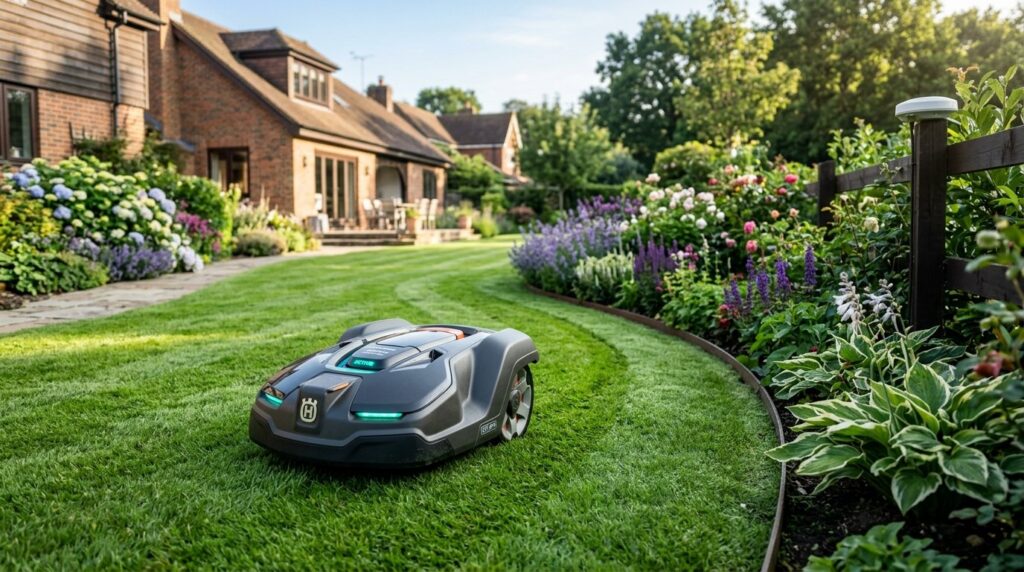
Recommended System: Anthbot
Wire-free centimeter-level RTK satellite navigation, dual cutting discs, and intelligent slope climbing up to 45% grade for residential turf.
While wire-free RTK satellite robotic mowers excel on open residential turf, properties surrounded by mature oak, maple, and pine canopies have presented unique positioning challenges. Understanding how satellite signals interact with biological canopies and physical structures is critical for configuring reliable autonomous navigation.
The Physics of GNSS Multipath Error
GNSS satellites orbit approximately 12,500 miles above Earth, transmitting radio signals in the L1 and L2 microwave bands. In suburban residential environments, these signals bounce off brick exterior walls, metallic gutters, and dense tree canopies before reaching the robot’s receiver antenna—a phenomenon known as multipath interference.
When multipath reflections reach the mower, the receiver miscalculates signal travel time, causing position drift of several feet. Premium autonomous systems like the Anthbot N8 Wire-Free Mower resolve this through multi-constellation RTK (utilizing GPS, Galileo, GLONASS, and BeiDou simultaneously) paired with optical 3D stereo vision.
| Canopy Density | Pure RTK Fix Rate | Hybrid RTK + Vision Fix Rate | Recommended Fix |
|---|---|---|---|
| Open Sky (<10% cover) | 99.2% Fix | 99.9% Fix | Standard ground antenna stake |
| Moderate Canopy (10%–35%) | 84.5% Fix | 97.8% Fix | Elevate base antenna to roof roofline |
| Dense Woodland (>35% cover) | 58.0% Fix (Frequent stall) | 94.2% Fix (Continuous cut) | Optical VSLAM sensor fusion mandatory |
Base Station Mast Elevation Rules
Field data confirms that elevating the RTK base reference antenna by just 8 feet—such as mounting it to an exterior roof fascia board—dramatically improves satellite geometric dilution of precision (GDOP), enabling reliable navigation on residential lots previously deemed incompatible with satellite mowers.
Always disconnect main power sources—remove battery packs or unplug cords—before inspecting mower blades, clearing aeration tines, or handling sharp garden equipment. Keep hydroponic nutrient concentrates stored securely.
Practical guides curated by horticultural practitioners and yard care enthusiasts. Field-tested methods, verifiable steps, and zero automated fluff.
Frequently asked questions
Why do wet tree leaves disrupt satellite RTK reception?
Dense foliage laden with rainwater absorbs high-frequency microwave radio signals emitted by GPS and GLONASS satellites, attenuating signal strength and causing satellite lock loss.
Where is the best location to mount an RTK base station?
Mount the RTK base antenna on the highest exterior roof gable or fascia board, free from overhangs and at least 6 feet above any metal roof flashing, to provide an unobstructed 360-degree view of the sky.