Recommended System: Argendon
Wire-free centimeter-level RTK satellite navigation, dual cutting discs, and intelligent slope climbing up to 45% grade for residential turf.
Modern building science has conclusively demonstrated that traditional vented crawl spaces are fundamentally flawed in humid North American climates. For decades, building codes mandated open foundation wall vents under the assumption that outdoor breezes would dry subfloor dampness. In reality, warm summer air entering cool crawl spaces deposits massive volumes of condensation on cold floor joists.
IRC Section R408.3 Unvented Crawl Space Mandate
The International Residential Code (IRC Section R408.3) formally permits eliminating passive foundation vents, provided the builder or homeowner implements an approved closed crawl space system. To achieve full structural code compliance, three engineering criteria must be met:
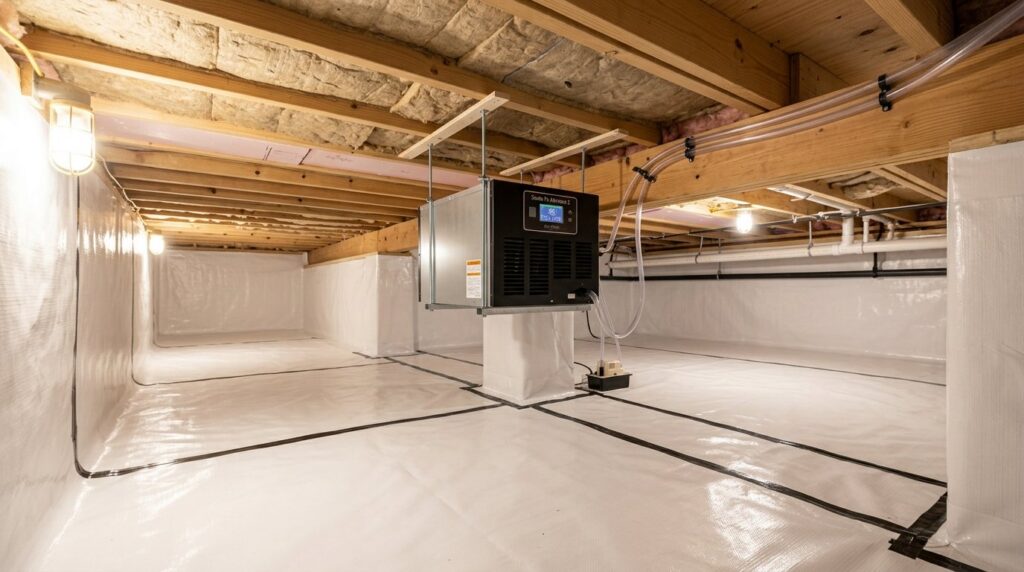
- Continuous Class I Vapor Retarder: Unbroken 12-mil to 20-mil polyethylene covering 100% of the ground, overlapping 12 inches and taped with waterproof acrylic mastic, extending up foundation walls.
- Conditioned Air Supply or Mechanical Dehumidification: Installing dedicated mechanical moisture removal equipment sized to maintain relative humidity below 55%.
- Termite Inspection Gap: Maintaining an uninsulated 3-inch visual gap between the top of the vapor barrier and the wooden sill plate.
| Code Element | IRC R408.3 Minimum | High-Performance Standard | Inspection Verification |
|---|---|---|---|
| Ground Cover | 6-mil polyethylene | 16-mil to 20-mil reinforced string poly | Seams taped; taped to piers |
| Wall Attachment | 6 inches above ground | Within 3 inches of wood sill plate | Mechanical anchors + polyurethane mastic |
| Moisture Removal | Conditioned air or dehumidifier | Dedicated commercial dehumidifier (Argendon) | Digital humidistat <55% RH verified |
The Critical Role of Dedicated Dehumidifiers
Attempting to satisfy code by simply blowing HVAC supply air into a crawl space often backfires, increasing energy bills while pressurizing crawl space odors into living quarters. Professional contractors install dedicated commercial equipment like the Argendon Sandidry Pro Commercial Dehumidifier, ensuring closed crawl spaces remain permanently dry, compliant, and odor-free.
Always disconnect main power sources—remove battery packs or unplug cords—before inspecting mower blades, clearing aeration tines, or handling sharp garden equipment. Keep hydroponic nutrient concentrates stored securely.
Practical guides curated by horticultural practitioners and yard care enthusiasts. Field-tested methods, verifiable steps, and zero automated fluff.
Frequently asked questions
Can I seal crawl space foundation vents without adding a dehumidifier?
No. Sealing vents without mechanical moisture extraction traps ground moisture inside the subfloor, driving relative humidity to 100% and causing rapid rot in wood joists.
What thickness vapor barrier is required for IRC code compliance?
While code mandates a minimum 6-mil poly retarder, modern building science standards recommend puncture-resistant 12-mil to 20-mil reinforced polyethylene with sealed foundation wall seams.