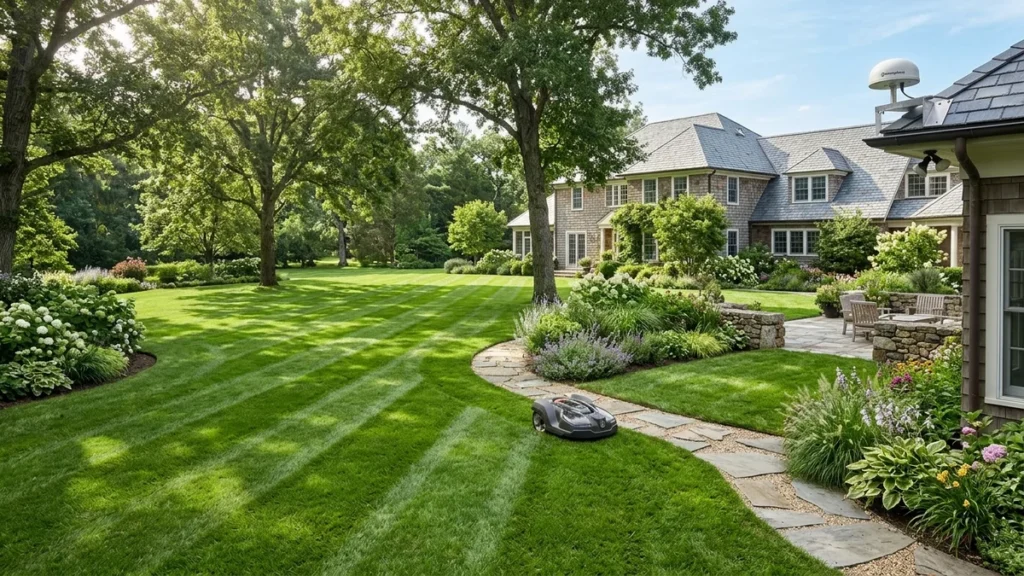
The residential robotic lawn mower market has undergone a complete architectural shift in 2026. Legacy random-navigation mowers that relied on buried copper perimeter wires and bumper-switch ricochets have been superseded by wire-free autonomous platforms guided by Real-Time Kinematic (RTK) satellite positioning, binocular AI vision, and 3D solid-state LiDAR. Yet choosing the wrong navigation architecture for your specific tree canopy, yard geometry, and slope profile can result in a $1,400 USD machine that loses its position beside two-story brick walls or spins its wheels on damp drainage swales. This 2026 engineering buying guide breaks down the exact physics of RTK signal propagation, multi-zone pathway mapping, traction mechanics, and battery sizing so you can specify the right wire-free robot mower on the first purchase.
How Wire-Free RTK GNSS + VSLAM Navigation Actually Works
Standard smartphone GPS receivers are only accurate to within 6 to 15 feet (2 to 5 meters) because ionospheric delays and satellite clock drift distort L1 radio signals traveling from 12,550 miles in orbit. Real-Time Kinematic (RTK) positioning reduces that error to 0.4–0.8 inches (1–2 cm) by placing a stationary reference base station on your property. Because the base station never moves, it measures the exact phase delay of incoming GPS, GLONASS, Galileo, and BeiDou carrier waves and broadcasts a continuous differential correction stream to the moving mower via a 900 MHz LoRa radio link or 4G cellular NTRIP network.
However, satellite carrier waves at 1.17 GHz to 1.57 GHz are easily attenuated or reflected by wet tree leaves and metal siding—a phenomenon known as multipath interference. To prevent the mower from halting under trees, 2026 wire-free mowers integrate secondary Dead Reckoning and Optical Vision systems:
- Basic Single-Band RTK Only (Avoid for Wooded Yards): Relies purely on satellite lock. If canopy coverage exceeds 15% or the mower enters a narrow side-yard alley, positioning fails within 10 seconds.
- Dual-Band RTK + Multi-Camera AI VSLAM (Best Value for 90% of Homes): Fuses full-band satellite corrections with a stereoscopic 3D vision array (such as the 4-camera system on the Anthbot Genie). When trees block overhead satellites, optical visual odometry tracks turf borders, tree trunks, and fences for up to 165 feet with less than 4 cm drift.
- RTK + 3D Solid-State LiDAR + Vision (Extreme Canopy / Zero-Sky Lots): Emits 100,000+ laser pulses per second to map vertical 3D structures in 360 degrees, operating even under 70% forest canopy or without a residential RTK base pole, though typically adding $700 USD to $1,200 USD to the hardware cost.
Anthbot Wire-Free RTK + 4-Camera Vision Robotic Lawn Mowers
Engineered with AI auto-mapping, 300-degree quad-camera obstacle avoidance, and multi-zone pathway management for 0.15 to 0.90 acre yards.
Check Official Specs & Current PricingMatching Yard Acreage, Slope Grade & Multi-Zone Corridors
Before comparing mower models, audit your property across four structural metrics: net mowable turf area, peak slope percentage, number of separated lawn zones, and minimum gate width. Use our specification matrix below to match your lot to the proper hardware tier:
| Property Profile | Net Turf Area | Max Slope Rating Needed | Navigation Sensor Requirement | Expected Price Tier (2026) |
|---|---|---|---|---|
| Suburban Flat / Open Lot | Up to 0.20 Acre (8,700 sq ft) | 25% – 30% (14°–17°) | RTK + Stereo Vision or AI Camera | $899 – $1,199 USD |
| Tree-Lined Multi-Zone Yard | 0.25 – 0.50 Acre (21,780 sq ft) | 35% – 45% (19°–24°) | Full-Band RTK + 4-Camera 3D VSLAM | $1,199 – $1,699 USD |
| Sloped Estate / Complex Beds | 0.50 – 1.00 Acre (43,560 sq ft) | 45% – 60% (24°–31° AWD) | RTK + Vision/LiDAR + High-Ah Battery | $1,799 – $2,799 USD |
| Homestead / Orchard Acreage | 1.00 – 2.50 Acres (108,900 sq ft) | 45% – 80% Heavy AWD | Dual-Deck Commercial RTK + Solar Dock | $2,899 – $4,499 USD |
Multi-Zone Mapping & Narrow Side-Yard Passage Physics
Most residential properties consist of at least two distinct mowing zones: a fenced backyard and an open front yard separated by a gravel, concrete, or flagstone walkway. When mapping a multi-zone yard with a 2026 RTK mower, you drive the mower once along the connecting path using the smartphone Bluetooth joystick to establish a “Transit Corridor.” During scheduled runs, the mower raises its cutting deck to maximum clearance, shuts off the blade motor for safety across gravel or pavers, traverses the corridor at 1.6 ft/s, and resumes blade rotation only after entering the target turf polygon.
For reliable autonomous transit, ensure your side gate opening is at least 32 inches (80 cm) wide and that the transit pathway does not pass beneath a solid metal carport roof that blocks both RTK satellites and ambient light simultaneously. If your optimal clear-sky RTK antenna location is near a detached garden shed or fence line without 120V AC power, you can power the 12V RTK base station and charging dock continuously using a 100W to 200W monocrystalline solar panel and a 12V 50Ah LiFePO4 battery kit.
Limitations & Field Caveats
- Moving the stationary RTK reference base station by even 2 inches after mapping shifts every saved virtual lawn boundary and no-go zone by the exact same distance, requiring a full map recalibration.
- Tall spring grass exceeding 5.5 inches after two weeks of rain will bog down small 7.8-inch pivoting razor discs; always perform the first seasonal cut of the year with a manual rotary mower set to 3.0 inches.
- Cellular 4G anti-theft GPS tracking modules typically include 12 to 24 months of complimentary data, after which an optional annual SIM renewal of $29 USD to $49 USD applies if Wi-Fi does not reach the far corners of your lot.
4-Point Pre-Installation Checklist for Zero-Drift Operation
- Elevate the RTK Base Antenna Above Roof Eaves: Whenever possible, use a fascia or roofline L-bracket rather than staking the RTK pole in a shaded flower bed next to a two-story wall. Unobstructed 360-degree horizon visibility improves satellite co-viewing by 40%.
- Leave a 4-Inch Buffer Along Drop-Off Curbs: When walking the perimeter boundary next to sunken driveways, retaining walls, or swimming pool coping, keep the outer wheel 4 inches inside the drop-off so the caster wheels never overhang during wet 180-degree turns.
- Alternate Striping Angles Every 3 Days: Configure your app schedule to rotate mowing angles by 45° or 90° between runs (e.g., North-South on Monday, East-West on Wednesday, Diagonal on Friday) to prevent wheel rutting and encourage upright turfgrass tillering.
- Swap Razor Blades Every 6 to 8 Weeks: Titanium-coated 0.9 mm endurance blades cost less than $18 USD for a 24-pack and take 4 min to replace with a Phillips screwdriver; sharp blades reduce motor amp draw by 15% and eliminate brown leaf tip dieback.