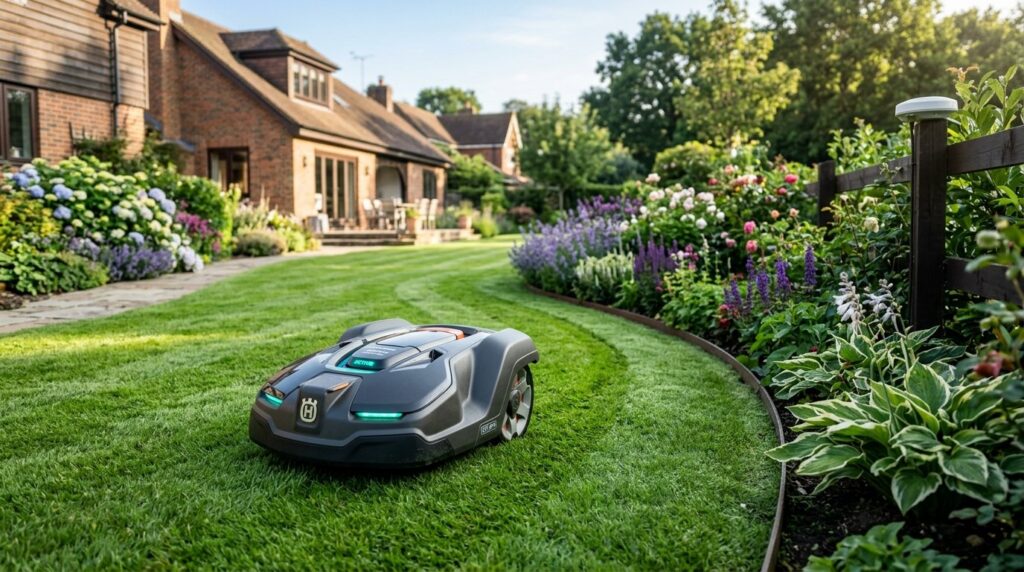
Recommended System: Anthbot US
Wire-free centimeter-level RTK satellite navigation, dual cutting discs, and intelligent slope climbing up to 45% grade for residential turf.
Affiliate disclosure: We may earn a commission from partner links (for example Anthbot) at no extra cost to you. Editorial opinions stay independent. Read our affiliate disclosure where published.
The traditional chore of residential turf management has undergone a generational transformation. For nearly three decades, robotic lawn mowers required homeowners to manually trench and stake hundreds of yards of low-voltage perimeter wire around boundary edges, flower beds, and root clusters. Beyond the grueling installation labor, buried wires presented a chronic point of failure: garden aerators, burrowing rodents, and accidental shovel strikes routinely caused hairline fractures that required specialized multimeter tone generators to diagnose.
By 2026, the global outdoor power equipment industry has decisively pivoted to wire-free virtual boundaries. Instead of physical loops, modern robotic mowers construct centimeter-accurate digital twins of residential properties using high-precision satellite positioning, onboard stereoscopic computer vision, and solid-state 3D LiDAR. However, navigating a dynamic outdoor lawn—with dense oak canopies, two-story brick walls, roaming pets, and fluctuating weather—demands an understanding of the underlying sensor architectures.
The Three Modern Navigation Architectures: RTK, LiDAR, and Vision AI
Selecting the right autonomous mower requires aligning the property’s topography and tree canopy density with the mower’s primary localization hardware.
| Navigation System | Primary Sensor Payload | Centimeter Accuracy | Tree Canopy Resilience | Hardware Setup Complexity |
|---|---|---|---|---|
| RTK-GNSS + Vision | Dual-frequency GNSS + EFLS AI camera | ±1.5 cm | High (visual odometry backup) | Moderate (requires clear base station placement) |
| Solid-State 3D LiDAR | Time-of-flight laser array | ±2.0 cm | Extreme (operates in zero satellite lock) | Low (no external base antenna needed) |
| Pure Optical Vision | Stereoscopic HDR RGB cameras | ±3.0 cm | Moderate (susceptible to direct glare & shadows) | Zero (instant unbox & perimeter drive) |
1. RTK-GNSS (Real-Time Kinematic) Localization
Standard consumer GPS signals (such as those in smartphones) drift between 2 to 5 meters due to ionospheric distortion and atmospheric delay. Real-Time Kinematic positioning solves this by pairing the mobile rover with a stationary local base station. The base station sits at a fixed coordinate and continuously calculates the phase difference between incoming satellite carrier waves and its known location, broadcasting immediate differential error corrections to the mower via 868 MHz or 915 MHz radio telemetry.
Leading platforms like Segway Navimow have evolved this architecture into Exact Fusion Locating System (EFLS 2.0). By combining dual-band GPS, GLONASS, Galileo, and BeiDou signals with front-mounted 140-degree optical cameras, the mower continues linear navigation with sub-inch accuracy even when tall masonry structures or mature tree clusters momentarily obstruct overhead satellites.
2. Solid-State 3D LiDAR Scanning
LiDAR systems emit hundreds of thousands of light pulses per second, measuring the time of flight (ToF) for reflected photons to return to the sensor. This constructs a real-time point-cloud mesh of the yard. LiDAR is completely immune to poor satellite constellations, dense forest cover, and pitch-black nocturnal operating conditions. However, LiDAR sensors require optical glass shielding that must be kept clean from wet grass clippings and pollen dust.
3. Vision AI and VSLAM Mapping
Vision-centric robotic mowers utilize high-frame-rate stereoscopic cameras and deep neural networks trained on millions of turf images. These systems identify grass margins, pavement edges, mulched garden beds, and gravel paths purely through chromatic and texture contrasts. The primary advantage is effortless deployment without mounting rooftop antennas. However, sudden lighting transitions—such as dappled tree shadows or blinding sunset glare—can occasionally cause cautious slowdowns.
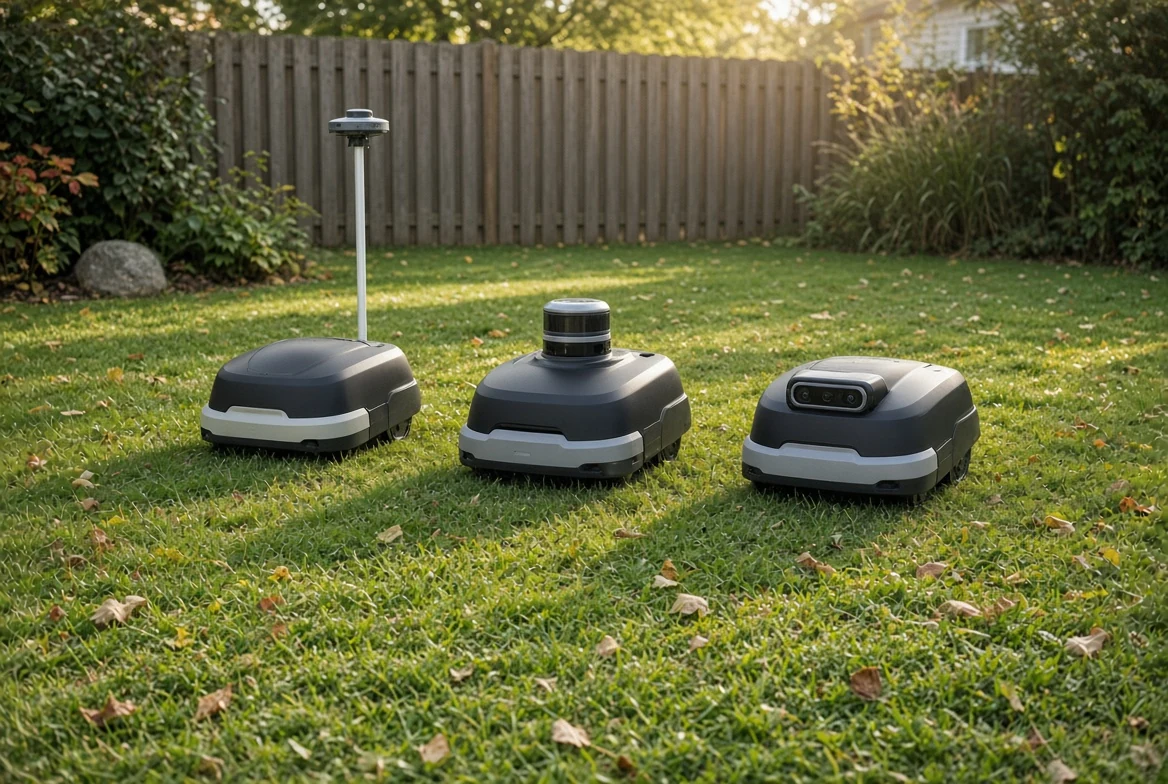
Field Performance & Yard Sizing Comparison
When selecting a wire-free platform, motor torque, cutting deck width, battery runtime, and slope management dictate actual yard throughput. The following matrix contrasts verified field benchmarks across active platforms:
| Specification | Segway Navimow i110N | Anthbot Genie RTK | Traditional Wire Mower |
|---|---|---|---|
| Maximum Yard Size | 0.25 – 0.50 Acre (up to 21,780 sq ft) | 0.50 – 0.75 Acre (up to 32,670 sq ft) | 0.25 Acre |
| Cutting Height Range | 2.0 in – 3.6 in (50 – 90 mm) | 1.2 in – 3.5 in (30 – 89 mm) | 1.5 in – 3.0 in |
| Slope Capability | 30% (16 degrees) | 45% (24 degrees) | 20% (11 degrees) |
| Obstacle Avoidance | AI Vision (pets, toys, hedgehogs) | Dual-sensor ultrasonic + bumper | Physical impact bumper only |
| Mowing Pattern | Systematic Linear Stripes | Systematic Multi-Angle Striping | Randomized Bounce |
| Perimeter Setup Time | 15 minutes (via smartphone app) | 20 minutes (virtual drive) | 6 – 8 hours manual trenching |
For homeowners managing expansive properties with uneven terrain, steep drainage swales, or dense Kentucky Bluegrass lawns, the Anthbot Genie RTK Platform delivers exceptional high-torque wheel motors capable of traversing 45% inclines without turf tear. Meanwhile, for suburban yards demanding manicured aesthetic striping and automated boundary exclusion zones, Segway Navimow offers an intuitive app interface with centimeter-precision virtual boundary editing.
Cut Quality and Turf Pathology: The Science of Daily Micro-Clipping
Traditional rotary gas mowers hack grass stems once every 7 to 10 days, lopping off 30% to 50% of the active photosynthetic leaf tissue in a single traumatic cut. This severe defoliation stresses turf root reserves, exposes soil to weed germination, and leaves clumps of heavy thatch that foster fungal blight like Rhizoctonia solani (Brown Patch).
Wire-free robotic mowers fundamentally alter turf physiology through frequent micro-mulching. Equipped with razor-sharp, free-swinging carbon steel blades rotating at 2,800 to 3,200 RPM, the robot trims just 1 to 2 millimeters of leaf tip every 24 to 48 hours. These microscopic clippings rapidly decompose at the soil line, returning vital organic nitrogen, phosphorus, and moisture directly into the root rhizosphere. The result is a visibly denser canopy that naturally chokes out crabgrass seeds without excessive chemical application.
Antenna and Base Station Installation Engineering
Achieving unbroken 99.9% uptime with RTK-based mowers requires strict adherence to three installation fundamentals:
- 120-Degree Unobstructed Sky View: The RTK reference antenna must have an open view of the celestial hemisphere. Avoid mounting antennas directly beneath overhanging soffits, gutter troughs, or dense deciduous foliage.
- Mitigating Multipath Distortion: Satellite signals reflecting off metal roofing, sheet-metal outbuildings, or large mirrored windows can induce phase calculation errors. Elevate the antenna at least 3 feet above rooflines or utilize ground-plane isolation plates.
- Fixed Stable Pier: Even a 5-millimeter shift in the base antenna station causes an identical 5-millimeter offset across the robot’s mapped coordinate system. Anchor the pole into solid masonry or deep-set turf anchors rather than flexible fence pickets.
Wildlife Biosecurity & Pet Safety Protocols
Early robotic mowers relied on blind mechanical collision switches: the chassis struck an obstacle with sufficient force before turning away. This posed severe hazards to nocturnal hedgehogs, ground-nesting songbirds, domestic pets, and garden water hoses.
Modern wire-free units implement proactive biosecurity. Integrated AI cameras evaluate depth maps in real time, detecting objects down to 2 inches in diameter from a distance of 6 to 10 feet. When a puppy, sprinkler head, or garden spade is detected, the cutting disc immediately throttles down while the drive motors navigate a smooth contour around the obstacle. Furthermore, programmable app schedules allow homeowners to restrict mowing exclusively to daylight hours, preserving nocturnal wildlife habitats.
Frequently Asked Questions
Do wire-free robot mowers work in the rain?
While modern units feature IPX6 water-resistant enclosures, mowing wet turf is biologically discouraged. Wet grass blades tear rather than slice cleanly, and wet clippings adhere to the chassis undercarriage, bogging down cutting disks. Quality wire-free mowers feature integrated rain sensors that automatically pause cutting cycles and recall the unit to its dock until the turf canopy dries.
What happens if the robot loses RTK satellite reception under a dense tree?
Units equipped with sensor fusion (such as Segway Navimow’s EFLS 2.0) seamlessly transition to visual odometry and wheel-hub IMUs (inertial measurement units). The front AI camera tracks ground textures and visual landmarks to continue straight-line mowing for up to 50 yards without satellite lock, reconnecting instantly once clear of the canopy.
How often do the razor blades need to be replaced?
Free-swinging razor blades should be replaced every 6 to 8 weeks of active cutting. Dull blades fracture grass tips, creating a ragged whitish-brown hue across the lawn. Replacement takes under 3 minutes using a standard Phillips screwdriver.
Cons / downsides / risks
Honest cons, downsides and risks before you buy or change your setup:
- Context mismatch: a setup that works in one climate, kitchen, yard, or company stage can fail in yours — treat checklists as starting points, not guarantees.
- Upfront cost vs. maintenance: cheaper gear can raise replacement, energy, or labour costs; premium gear can still under-deliver if sizing is wrong.
- Skill and safety gaps: tools, chemicals, electrical loads, and legal entity choices carry real injury, waste, or compliance risks when rushed.
- Affiliate incentives: partner links exist on this site; a downside of any affiliate model is selection bias — we flag unverified claims instead of inventing metrics.
- Season and regulation drift: products, tariffs, and outdoor seasons change through 2025–2026; re-check labels and local rules on the day you act.
Always disconnect main power sources—remove battery packs or unplug cords—before inspecting mower blades, clearing aeration tines, or handling sharp garden equipment. Keep hydroponic nutrient concentrates stored securely.
Practical guides curated by horticultural practitioners and yard care enthusiasts. Field-tested methods, verifiable steps, and zero automated fluff.