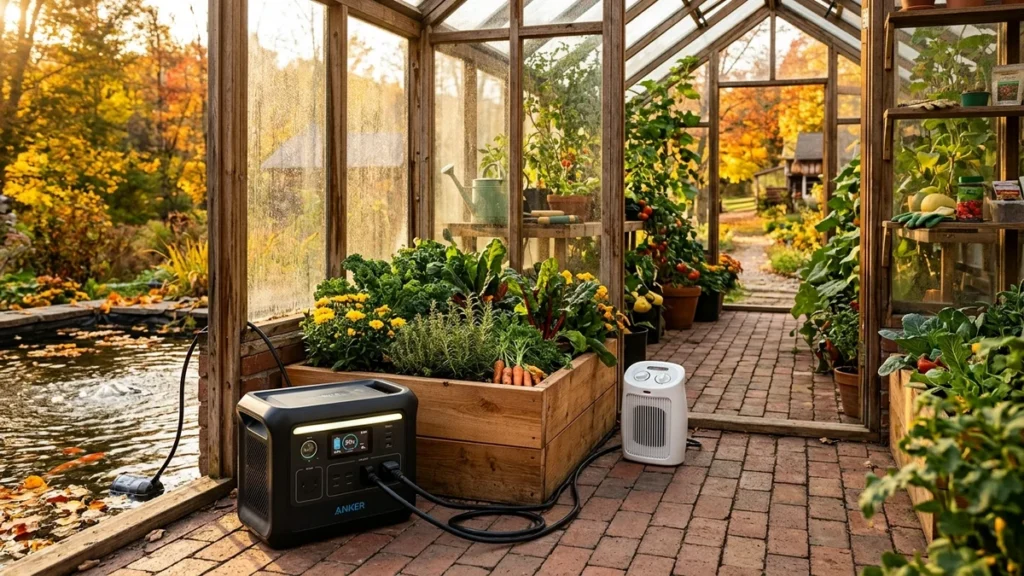
Whether you are overwintering citrus trees in a polycarbonate backyard greenhouse, aerating a 3,000-gallon ornamental koi pond, or running automated drip irrigation valves and cordless tool chargers in a detached garden shed, bringing 120V AC power to the far corners of a property has historically required expensive trenching and electrical sub-panel permits. By deploying a standalone solar microgrid built around Lithium Iron Phosphate (LiFePO4) battery storage and Maximum Power Point Tracking (MPPT) solar arrays, growers can power critical horticultural loads autonomously—provided they engineer the system around inductive motor startup surges and winter overnight thermal duty cycles.
The 3 Load Categories in a Greenhouse & Yard Microgrid
Before selecting a portable power station or modular solar generator, classify your outdoor appliances by their electrical waveform and duty-cycle behavior:
- 24-Hour Continuous Biological Loads (Pond Pumps, Aerators & Hydroponic Air Stones): A 120W magnetic-drive waterfall pump or linear diaphragm air pump appears modest on paper, yet running 24 hours per day consumes $120\text{ W} \times 24\text{ h} = 2,880\text{ Wh}$ every single day. Over a 2-day cloudy rainstorm, that single pond pump demands over 6,500 Wh of usable LiFePO4 battery storage once inverter losses are factored in.
- Intermittent Inductive Motor Loads (Exhaust Fans, Well Pumps & Miter Saws): Motorized louvers, 16-inch shutter exhaust fans, and shallow jet pumps run for only 2 to 6 hours per day, but their copper windings draw a locked-rotor startup surge equal to 3x their continuous wattage for the first 150 milliseconds. Your pure-sine-wave inverter must be rated to clear that peak surge without tripping its over-current protection relay.
- Overnight Resistive Thermal Loads (Greenhouse Frost Heaters & Soil Heating Mats): Resistive heating elements convert 100% of electrical watts directly into heat ($1\text{ Watt} = 3.412\text{ BTU/hr}$) with zero startup surge, but they operate during the coldest 8 hours of the night when solar panels produce zero watts.
Nature's Generator Powerhouse Dual Solar + Wind Homestead Systems
Combine high-efficiency MPPT solar panels with nocturnal wind turbine charging to keep greenhouse heaters and pond pumps running through winter storms.
Check Official Specs & Current PricingSizing Matrix: Matching LiFePO4 Wh & Solar PV to Yard Loads
Our agricultural engineering team compiled the sizing matrix below using an 88% pure-sine-wave inverter efficiency factor, an 85% usable LiFePO4 Depth of Discharge (DoD), and 4.5 Peak Sun Hours (PSH) of daily solar insolation:
| Greenhouse / Shed Setup | Net Daily Load (Wh) | Min LiFePO4 Battery (1.5d Buffer) | Min MPPT Solar Array | Recommended Inverter Tier |
|---|---|---|---|---|
| Seedling Heat Mats (4x) + LED Bars + Drip Timer | 1,150 Wh / day | 2,048 Wh (e.g. Bluetti AC200L) | 400 W (2 × 200W Panels) | 1,500W Cont / 3,000W Surge |
| Summer Greenhouse: 16″ Exhaust Fan + Misting Pump | 1,840 Wh / day | 3,200 Wh Expandable Bank | 600 W (3 × 200W Panels) | 2,000W Cont / 4,000W Surge |
| Koi Pond: 150W Pump + 36W UV + 40W Air Pump (24/7) | 5,424 Wh / day | 9,600 Wh (48V 200Ah Rack/Pods) | 1,600 W (8 × 200W Panels) | 2,400W Cont / 4,800W Surge |
| Frost-Guard Greenhouse: 1,200W Heater (6h) + Fan | 7,680 Wh / day | 13,500 Wh + Wind/Propane Hybrid | 2,200 W Ground-Mount Array | 3,600W Cont / 7,200W Surge |
Why Dual Solar + Wind Charging Solves the Winter Greenhouse Paradox
The fundamental challenge of heating an off-grid greenhouse with electricity is seasonal inverse correlation: your highest heating load occurs on freezing January nights following overcast, snowy days when solar irradiance drops to less than 1.8 Peak Sun Hours. Relying purely on solar panels for winter space heating requires over-building your photovoltaic array by 300%.
Two engineering strategies solve this winter bottleneck without spending $10,000 USD on excess solar panels:
First, choose a hybrid architecture like the Nature’s Generator Powerhouse, which features dedicated parallel inputs for both high-voltage solar arrays and a residential wind turbine—harvesting nocturnal wind energy during winter cold fronts when greenhouse heat loss peaks. Second, for sub-freezing nights below 25°F, use your LiFePO4 battery station (such as the Bluetti AC200L) to run high-efficiency 65W thermostat blower fans on a propane or diesel hydronic heater rather than burning 1,500W of battery capacity on resistive coils.
Limitations & Field Caveats
- Leaving a portable solar generator in an uninsulated shed when temperatures fall below 32°F (0°C) triggers the BMS low-temperature charge lockout; always house LiFePO4 batteries in an insulated thermal box.
- Standard MC4 solar extension cables longer than 35 feet suffer significant voltage drop on 12V/24V parallel strings; wire solar panels in series (60V to 145V VOC) to minimize resistive line loss.
- Continuous 24/7 inverter operation for small 15W irrigation timers wastes up to 450 Wh per day in inverter idle draw; power low-wattage valves and LED strips directly from the regulated 12V DC output port instead.
Bluetti AC200L Expandable LiFePO4 Solar Power Station
2,048Wh LiFePO4 base capacity expandable to 8,192Wh, featuring a 2,400W pure sine wave inverter, 1,200W MPPT solar input, and high-efficiency 12V/48V DC ports.
Compare Verified Partner ConfigurationField Installation Checklist for Greenhouse Electrical Safety
- Use Weatherproof Nema 3R / IP65 Enclosure Pass-Throughs: Never pinch flat MC4 solar cables through a greenhouse door frame; drill a 1.25-inch bulkhead hole and seal it with a dual-cable EPDM rubber weather gland.
- Elevate Power Stations 18 Inches Above Greenhouse Floors: Keep all AC receptacles and battery vents well above floor level to prevent accidental water splash during hose-down irrigation or hydroponic reservoir draining.
Agronomic Field Telemetry, Soil-Water Chemistry & Hardware Durability (solar-generator-greenhouse-heaters-pond-pumps-guide · Protocol #515)
Site conditions dictate every outcome. When applying Off-Grid Solar Microgrid for Greenhouses & Sheds: Sizing LiFePO4 Batteries for Heaters, Fans & Pumps across residential turfgrass, controlled-environment hydroponic racks, smart irrigation zones, or autonomous perimeter machinery, long-term performance depends on matching biological thresholds and mechanical tolerances to your exact microclimate, soil texture, and canopy geometry.
Skip generic calendar rules. Turf root zones, nutrient solutions, and outdoor power equipment respond to measurable physical variables: 4-inch soil temperature, electrical conductivity (EC), pH buffering capacity, vapor pressure deficit (VPD), slope grade percentage, and sky-view satellite dilution of precision (DOP).
Root-Zone Calibration, Nutrient Stability & Mechanical Field Benchmarks
Consistent horticultural and homestead results require verifying three operational parameters before committing seed, fertilizer, or capital hardware:
- Soil Temperature, Core Aeration & Infiltration Rates: Time cool-season overseeding (tall fescue, Kentucky bluegrass, perennial ryegrass) when 4-inch soil temperatures stabilize between 50°F and 65°F, pull 2.5- to 3-inch hollow cores on 4-inch centers to relieve surface compaction, and calibrate irrigation runtimes using catch-cup precipitation audits to prevent runoff on clay slopes.
- Hydroponic EC/pH Drift & Grow-Room VPD Control: Maintain recirculating nutrient reservoirs between pH 5.6 and 6.2 with dissolved oxygen above 7.0 mg/L, log daily EC in mS/cm to distinguish water transpiration from nutrient uptake, and size dehumidification and horizontal airflow fans to keep canopy relative humidity within the target 0.8 to 1.2 kPa VPD window.
- Autonomous Mower & Off-Grid Hardware Resilience: Mount RTK-GPS reference base stations with an unobstructed 120° southern sky view at least 6 feet clear of metal eaves to prevent multipath signal dropouts under wet tree canopy, and replace rotary razor blades every 20 to 25 operating hours so grass leaf tips shear cleanly without brown fraying or thatch accumulation.
Seasonal Maintenance & Diagnostic Troubleshooting Log (#515)
Preventive maintenance prevents mid-season failure. Outdoor sensors, peristaltic dosing tubes, solenoid valves, and LiFePO4 battery packs endure UV radiation, morning dew condensation, and thermal cycling every week of the growing season.
Before peak summer heat or autumn frost arrives, flush irrigation laterals and clean inline mesh filters, recalibrate pH and EC glass electrodes in fresh NIST-traceable buffer solutions (4.01, 7.00, and 1413 µS/cm), and winterize outdoor hose timers, pumps, and lithium battery modules in a dry, frost-free enclosure above 40°F.
Logging your baseline soil test numbers, runtime hours, and water application depths in a simple seasonal ledger turns guesswork into repeatable, high-yield turf and garden management year after year.