Recommended System: Anthbot US
Wire-free centimeter-level RTK satellite navigation, dual cutting discs, and intelligent slope climbing up to 45% grade for residential turf.
Affiliate Disclosure: This guide contains affiliate links. We may earn a commission if you make a purchase through these links, supporting our independent research at no additional cost to you.
Introduction to Soil Chemistry and Physical Structure
Precision agriculture and advanced landscaping require strict adherence to chemical and physical soil metrics. Modifying your growing medium is an exact science rooted in pH balancing, NPK ratios, bulk density stabilization, and physical compaction metrics. Maintaining appropriate conditions ensures maximum nutrient bioavailability, optimal water retention, and deep root penetration for high-yield garden beds. Successful baseline preparations establish the mechanical framework necessary for biological processes to occur at peak efficiency.
Automating the maintenance of your surrounding lawn while you focus on precise soil chemistry in garden beds increases overall operational efficiency. Integrating robotic solutions like the Anthbot US robotic mower keeps turf manicured without manual labor. This automation allows operators to dedicate their time and resources to monitoring soil health parameters, executing physical amendment strategies, and conducting chemical panels without operational distraction.
The Chemistry of Soil pH: Target Metrics and Bioavailability
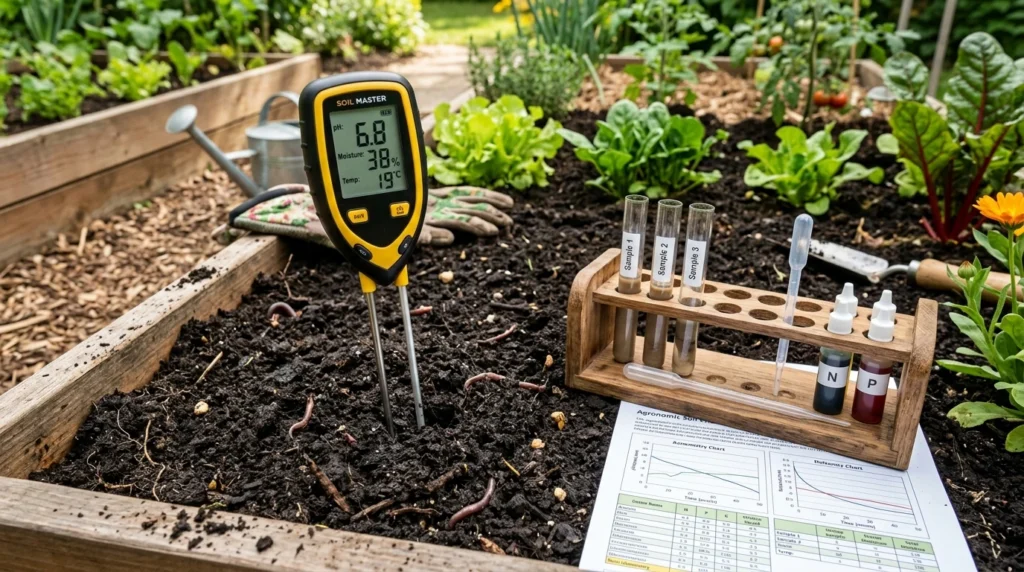
Soil pH acts as the master regulator of nutrient solubility. The target pH range for 85% of standard horticultural crops falls strictly between 5.5 and 7.0. At this specific logarithmic interval, primary macronutrients—Nitrogen (N), Phosphorus (P), and Potassium (K)—remain structurally unbound and accessible to root hairs via the soil solution.
If the pH drops below 5.5, the concentration of soluble aluminum (Al3+) and manganese (Mn2+) increases exponentially, often reaching phytotoxic levels that inhibit cellular division in root tips. When the pH exceeds 7.5, calcium bonds with phosphorus to create insoluble calcium phosphate. This precipitation strips the soil solution of available phosphorus and leads to acute nutrient lockout, requiring immediate corrective action.
Adjusting pH Numerically
To shift pH, specific volumes of amendments are required based on soil texture and current buffering capacity. For example, raising the pH of heavy clay soil by 1.0 unit requires approximately 10 pounds of agricultural limestone per 100 square feet. Conversely, lowering the pH by 1.0 unit in the same surface area requires roughly 2 pounds of elemental sulfur. Testing your baseline pH using a calibrated digital meter or submitting core samples for laboratory analysis is a mandatory step before applying any chemical adjustments. Guessing pH requirements frequently leads to severe elemental imbalances.
Macronutrients: NPK Ratios and Organic Matter Baseline
A balanced NPK profile is mandatory for cellular growth, energy transfer, and osmotic regulation in plant tissues. A standard baseline application for depleted agricultural soils is a 10-10-10 or 5-5-5 NPK ratio. This designation means the mixture contains equal percentages by weight of Nitrogen, Phosphorus (measured as P2O5), and Potassium (measured as K2O). Different crop cycles demand variations in this ratio, but a balanced baseline is required for initial soil rehabilitation.
Furthermore, maintaining soil organic matter (SOM) between 5.0% and 8.0% by weight is required for stabilizing these applied nutrients and improving the cation exchange capacity (CEC). Soils with less than 2.0% SOM exhibit poor water retention, low microbial activity, and rapid nutrient leaching rates during heavy precipitation events.
Volume Calculations for Soil Amendments
To increase organic matter by 1.0% in the top 6 inches of a 1,000 square foot garden bed, you must incorporate approximately 3.1 cubic yards of finished compost. Applying this precise volume requires accurate measurement and homogenous distribution. The standard mathematical formula for amendment volume calculation is:
Volume (cubic yards) = (Area in sq ft × Depth in inches) / 324
Mechanical Properties: Soil Compaction and Aeration
Physical structure is equally critical to chemical balance. Soil compaction directly limits root expansion, restricts water percolation, and inhibits gaseous exchange. When measuring compaction, technicians deploy a dynamic cone penetrometer to read resistance in pounds per square inch (PSI).
A healthy, aerated root zone should measure below 200 PSI at a depth of 12 inches. If mechanical resistance exceeds 300 PSI, root penetration halts entirely. This extreme bulk density severely restricts oxygen diffusion rates, causing anaerobic microbial respiration that produces toxic byproducts like hydrogen sulfide. Such conditions mandate immediate mechanical aeration or deep tillage using subsoilers to break the hardpan.
Integrating organic matter directly reduces bulk density and compaction PSI. The following diagram illustrates the procedural sequence for mitigating high compaction and restoring chemical balance.
A[Conduct Baseline Penetrometer Test > 300 PSI] –> B[Mechanical Aeration / Deep Tillage]
B –> C[Apply 3.1 cu yds Compost per 1000 sq ft]
C –> D[Incorporate to 6-inch Depth]
D –> E[Retest Compaction: Target F[Conduct Chemical Panel for pH and NPK]
F –> G[Adjust pH to 5.5 – 7.0 Range]
Organic vs. Synthetic Soil Amendments
When selecting materials to adjust NPK ratios and soil structure, growers must choose between organic and synthetic formulations. Each category presents distinct characteristics regarding release rates, elemental concentration, and secondary physical benefits.
| Amendment Type | Nitrogen Source | Release Profile | Impact on Organic Matter % |
|---|---|---|---|
| Organic (e.g., Blood Meal, Compost) | Complex proteins | Slow (requires microbial breakdown) | Increases SOM |
| Synthetic (e.g., Urea, Ammonium Nitrate) | Ammonium/Nitrate ions | Rapid (immediately soluble) | Zero impact on SOM |
Pros and Cons Analysis
Organic Amendments
- Pros: Improves physical soil structure, increases water holding capacity, sustains beneficial microbial populations, presents a very low risk of chemical root burn.
- Cons: Highly variable and unpredictable NPK ratios, expensive per pound of actual elemental nitrogen, release rates are strictly dependent on soil temperature and moisture.
Synthetic Amendments
- Pros: Precise and verifiable NPK metrics, immediate elemental availability to the plant, highly cost-effective for treating large acreages or severe deficiencies.
- Cons: High risk of osmotic root burn if misapplied, prone to rapid environmental leaching, contributes zero material to soil physical structure or carbon reserves.
Frequently Asked Questions
What is the most accurate method for testing soil pH?
Digital pH meters calibrated with standardized buffer solutions (pH 4.0 and 7.0) provide the most accurate onsite readings. Chemical dye kits are less precise and often misread by up to 0.5 pH units, which can result in incorrect limestone or sulfur application calculations, leading to suboptimal nutrient availability.
How long does it take for agricultural limestone to raise pH?
Standard pulverized agricultural limestone requires 3 to 6 months to fully react and neutralize soil acidity depending on soil moisture and temperature. For faster reactions within 2 to 4 weeks, utilize hydrated lime or finely pelletized limestone, though these products require stricter application controls to avoid overshooting the target pH range.
Can I apply too much organic matter to a garden bed?
Yes. Pushing organic matter percentages above 10% by weight can create excessive water retention, leading to anaerobic soil conditions and severe root rot. Additionally, importing composts with high salt content can rapidly increase the electrical conductivity (EC) of the soil to levels that desiccate and damage delicate root tissue.
Conclusion
Effective soil preparation relies on strict numerical management rather than approximation. By targeting a pH between 5.5 and 7.0, verifying NPK inputs, maintaining organic matter at 5.0% to 8.0%, and keeping compaction below 200 PSI, operators guarantee a growing medium optimized for maximum cellular development and crop yield. Consistently applying these empirical metrics eliminates environmental variables, reduces failure rates, and establishes a highly predictable agricultural baseline for any planting operation.
Always disconnect main power sources—remove battery packs or unplug cords—before inspecting mower blades, clearing aeration tines, or handling sharp garden equipment. Keep hydroponic nutrient concentrates stored securely.
Practical guides curated by horticultural practitioners and yard care enthusiasts. Field-tested methods, verifiable steps, and zero automated fluff.