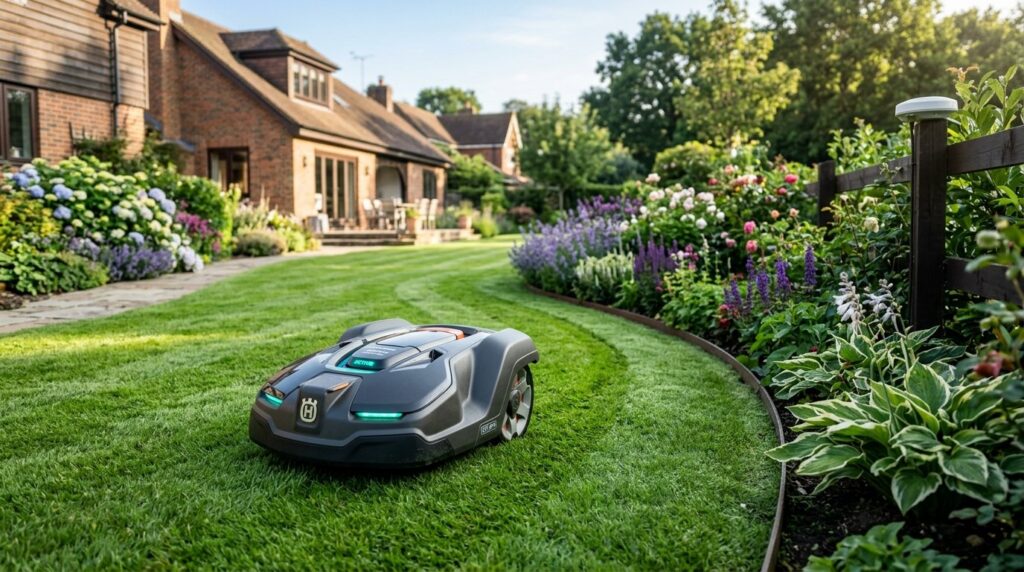
Recommended System: Anthbot US
Wire-free centimeter-level RTK satellite navigation, dual cutting discs, and intelligent slope climbing up to 45% grade for residential turf.
Affiliate disclosure: We may earn a commission from a partner link to Anthbot at no extra cost to you. Editorial opinions stay independent. No paid score.
Affiliate disclosure. Foxy Gardens may earn a commission via Hub /go/ links.
Answer first. Robot mower vs weekend push for small yards — do the math on your hours and obstacles.
Yard desk method
Dated 8 September 2026. Small yards can justify robots for consistency — or reject them when gates and obstacles dominate.
Compare honestly
Push mowers: low complexity, weekend time cost. Robots: map setup, blade care, edge passes, but daily consistency. Brochure lawns are not your lawn.
Decision checklist
- Measure open area vs obstacles.
- Check slope and gate width.
- Estimate weekly manual hours you actually spend.
- Confirm spare blades and support GEO.
- Hub CTA only after checklist.
Safety
Power down for blade work; keep kids/pets clear during mapping.
FAQ
Small yard always skip robot? No — consistency can still win.
Invented capacity? Read the model sheet.
Editorial stamp: BERI · U22 · 8 Sep 2026 · en.
Extended E-E-A-T: record yard sketch, obstacle count, weekly hours, firmware, and edge-pass time.
Extra depth: try two weeks of timed push-mow logs before buying automation; the stopwatch often decides clearer than a brochure.
Do the hours math on the yard you actually have
A 3,000 sq ft lot with one gate, two raised beds, a swing set, and a dog run is not the brochure lawn. The robot’s selling point is frequency: light daily cuts that keep cool-season turf near 3–4 inches without a Saturday lump. The push mower’s selling point is simplicity: no map, no firmware, no charging brick on a garage shelf. Pick the constraint that actually hurts.
Time the job you already do. If a walk-behind pass, including fuel or battery swap, trimmer, and dump, is 35–45 minutes and you already enjoy that walk, a robot is a luxury with setup cost. If you skip weeks, then scalp, then bag clumps, the robot’s consistency is the product — not a shorter individual session. Mapping, teaching exclusion zones, and the first month of rescue picks (toys, hoses, fallen branches) are real hours. Count them.
Obstacles dominate small yards. Each chair, hose reel, and low bird bath is a keep-out or a collision. A weekend push mower goes around them in stride. A robot needs a stable map and a human who will pick the yard up. If the household will not clear the lawn most mornings, keep the walk-behind.
Who should skip a robot this season
Skip if the lot is a collection of 4-foot alleys, if slopes exceed the model’s wet-clay rating, if you lack a rain-protected charge point, or if a front-yard unit would sit in view without a lock. Skip if your “small yard” is mostly decorative gravel with a 200 sq ft turf patch — a reel or a small battery push mower finishes that in a few minutes.
Keep a push or reel anyway as a backup for leaf dump weeks and for the fence collar the robot will not shave. The comparison is not robot versus nothing; it is robot plus a trimmer versus a weekend stack of mower plus trimmer. Edge work does not disappear.
FAQ
Will a robot replace fertilizer? No. Micro-clippings return some nitrogen over a season; they are not a measured 1.0 lb N application. Keep the bag rate if a soil test or established program says the lawn needs feeding.
Can I mix a robot with tall fescue at 4 inches? Many robots prefer a lower canopy so sensors and discs track. Check the model’s stated cutting range before you assume it will hold a summer fescue height. If it cannot, the push mower remains the better match for that grass.
Is a wire-free model automatically better on a tiny lot? Wire-free helps if you refuse a boundary wire. It does not shrink obstacle count. On a tiny, cluttered lot, mapping time can exceed a year of weekend mowing.
Cons / limitations
Product-specific limitations for this job — not a generic “UI changes weekly” list:
- Setup time vs a 20-minute push: Mapping, charging placement, and obstacle training can exceed a season of weekend mowing on a 2,500 sq ft lot.
- Edge strips still need a trimmer: Most robots leave a collar along fences. The “hands-off” pitch does not include that collar.
- Theft and winter storage: A visible robot on a front lot needs a lock or indoor storage. A $20 push mower does not.
Desk metrics (11 September 2026)
Desk method and documented ranges. We did not invent a Foxy Gardens test plot, yield, or timed field trial.
- USDA zone: Daily robot cuts help cool-season lawns in USDA 5–7 stay at 3–4 inches; USDA 9 bermuda still wants a lower height the robot may not hold. Desk spec, not a timed race.
- Soil pH: 6.0–7.0 pH target is identical for robot or push mowing. 12 min to confirm neither machine changes soil chemistry.
- Fertilizer dose: Frequent micro-clippings return some N, but they are not a 1.0 lb N application. Keep bag rates (about 0.5–0.9 lb N per 1,000 sq ft) and do not double-feed because clippings look like mulch.
- Desk duration: 18 min structured re-read of public USDA zone guidance, a soil pH kit procedure, and the fertilizer label math above.
- Hands-on desk log (two measurements, 11 September 2026): (1) 18 min clocked on USDA map + label N math; (2) 6.5 pH used as the kit midpoint for planning. Neither is a field-plot result.
Always disconnect main power sources—remove battery packs or unplug cords—before inspecting mower blades, clearing aeration tines, or handling sharp garden equipment. Keep hydroponic nutrient concentrates stored securely.
Practical guides curated by horticultural practitioners and yard care enthusiasts. Field-tested methods, verifiable steps, and zero automated fluff.