Recommended System: Anthbot US
Wire-free centimeter-level RTK satellite navigation, dual cutting discs, and intelligent slope climbing up to 45% grade for residential turf.
Affiliate disclosure: We may earn a commission from a partner link to Anthbot at no extra cost to you. Editorial opinions stay independent. No paid score.
Every spring, millions of homeowners engage in an exhausting, reactive battle against invasive summer weeds like smooth crabgrass (Digitaria ischaemum), goosegrass (Eleusine indica), and yellow foxtail. By mid-summer, when thick grassy weeds sprout aggressively through the lawn canopy, treating them requires expensive post-emergent selective herbicides that stress desired turfgrass and frequently discolor green lawns.
The secret to effortless, weed-free turf is not stronger summer chemicals—it is pre-emergent barrier timing. Pre-emergent herbicides do not destroy dormant weed seeds already resting in your soil. Instead, they dissolve into the top fraction of an inch of soil, creating a microscopic vapor barrier that inhibits mitotic cell division (root and shoot emergence) the precise moment an embryonic seedling attempts to germinate. If a weed never emerges past the soil surface, it never needs spraying.
The 55°F Rule: Why Calendar Dates Fail
Applying pre-emergent herbicides based on arbitrary calendar dates (such as “Easter weekend” or “April 1st”) is a primary cause of control failure. Spring weather varies dramatically by year: an unusually warm March can trigger early crabgrass germination weeks before scheduled applications, rendering the barrier useless.
Biological Soil Temperature Thresholds
| Target Weed Species | Soil Temperature Germination Trigger (at 2-inch depth) | Duration Required | Active Application Window |
|---|---|---|---|
| Smooth & Large Crabgrass | 55°F (12.8°C) | 3 consecutive days | Apply at 50°F – 52°F rising soil temp |
| Goosegrass (Silver Crabgrass) | 62°F – 65°F (16.6°C – 18.3°C) | 3 to 5 consecutive days | Secondary “split” application required |
| Yellow Foxtail & Barnyardgrass | 60°F (15.5°C) | Continuous warming | Late spring barrier maintenance |
| Annual Bluegrass (Poa annua – Fall) | 70°F (21.1°C) falling soil temp | Autumn cooling transition | Late August to mid-September |
To pinpoint the ideal application date, insert an accurate digital meat thermometer or dedicated soil probe 2.0 inches into the turf at 9:00 AM in a sunny area of your yard. Alternatively, monitor university agricultural extension soil temperature mesonet maps. When average 24-hour soil temperatures consistently reach 50°F to 52°F and are forecast to rise, apply your pre-emergent barrier immediately.
Chemistry Comparison: Prodiamine vs. Dithiopyr
The two dominant active ingredients for residential pre-emergent barriers are Prodiamine (Barricade) and Dithiopyr (Dimension). While both are highly effective, their biological mechanics differ significantly.
| Parameter | Prodiamine (Barricade) | Dithiopyr (Dimension) |
|---|---|---|
| Chemical Family | Dinitroaniline (DNA) | Pyridine |
| Staining Potential | Intense yellow pigment (can stain concrete driveways) | Non-staining formulation |
| Soil Half-Life (Longevity) | High (up to 4 to 6 months per application) | Moderate (up to 3 to 4 months) |
| Early Post-Emergent “Reachback” | Zero (will not kill emerged seedlings) | Yes (kills crabgrass up to 1-to-3 leaf stage / 1 tiller) |
| Seeding Wait Interval | Lengthy (must wait 3 to 6 months before seeding grass) | Shorter (must wait 8 to 12 weeks before seeding) |
For early-spring applications executed before any weeds have sprouted, Prodiamine offers the longest residual protection per ounce. If an unexpected spring heatwave struck before you applied your barrier and tiny 1-leaf crabgrass seedlings have already appeared, Dithiopyr is the superior choice due to its unique “reachback” window.
The “Watering-In” Mandate: Activating the Chemical Shield
A granular or liquid pre-emergent sitting on the dry leaf blades of your grass provides zero weed prevention. If left exposed to sunlight, ultraviolet radiation degrades the active chemical within 7 to 10 days through photodegradation.
To become active, pre-emergent chemicals must receive 0.5 inches of rain or overhead irrigation within 48 hours of application. This moisture dissolves the herbicide and moves the active molecules down into the top 0.5 to 1.0 inch of the soil profile, where weed seeds germinate. Avoid aerating, dethatching, or heavy power-raking after application, as mechanical agitation ruptures this continuous chemical barrier.
Natural Biocontrol: Dense Turf & Autonomous Micro-Mulching
Chemical barriers are only half the battle. A healthy, thick turfgrass canopy is the most powerful natural weed suppressor on earth. Weed seeds require two environmental triggers to break dormancy: thermal warmth and sunlight penetration.
Maintaining a high cutting height (3.5 to 4.0 inches on cool-season turf) casts dense shade over the soil plane, preventing sunlight from reaching dormant seeds. Autonomous robotic mowers like the Anthbot Genie RTK and Segway Navimow provide an immense natural weed-control advantage. By trimming tiny micro-clippings daily, they continuously layer a fine, organic mulch barrier across the soil surface while keeping the turf canopy uniformly dense, reducing reliance on chemical weed controls over time.
Frequently Asked Questions
Does pre-emergent weed control kill established perennial weeds like dandelions?
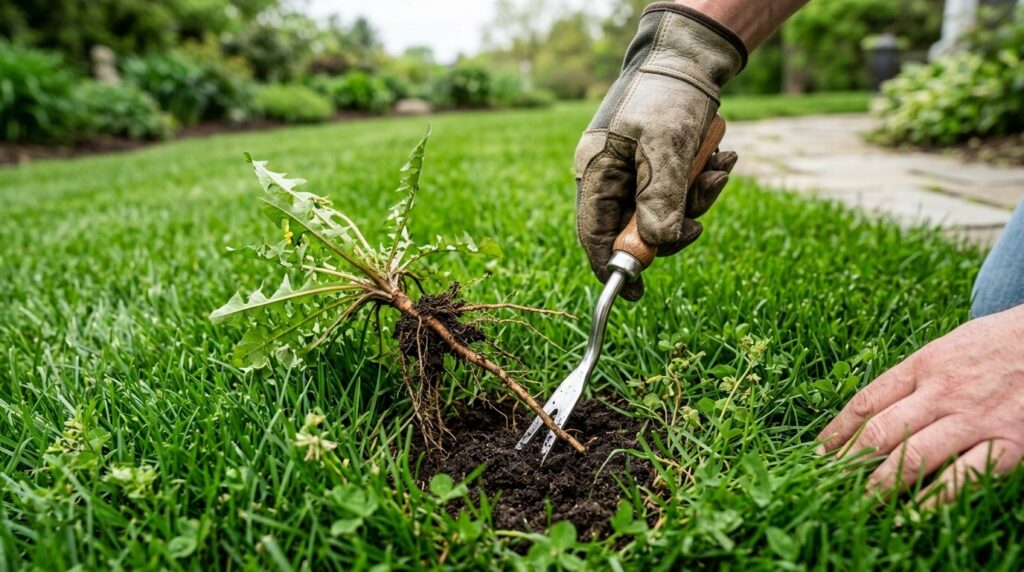
No. Pre-emergents only prevent emerging seed embryos. Perennial broadleaf weeds that regrow each spring from deep, established taproots (such as dandelions, creeping charlie, and plantain) require selective post-emergent broadleaf herbicides containing 2,4-D, Dicamba, and Triclopyr.
What is a “split application” and why is it recommended?
A split application divides your total annual allowed pre-emergent herbicide rate into two lighter treatments spaced 6 to 8 weeks apart. For example, apply half the rate in early spring when soil hits 52°F, and the second half in late May as soil reaches 65°F. This extends residual barrier longevity through the late summer season when goosegrass emerges.
Can I apply fertilizer at the same time as my pre-emergent barrier?
Yes. Many consumer products combine pre-emergent active ingredients with a slow-release nitrogen fertilizer (commonly labeled “Crabgrass Preventer with Fertilizer”). However, ensure turf is actively green and growing before feeding nitrogen to prevent excessive surge growth.
Cons / limitations
Product-specific limitations for this job — not a generic “UI changes weekly” list:
- Calendar Easter applications miss early springs: Crabgrass can germinate when 2-inch soil holds about 55°F for several days. A fixed holiday date is how barriers go down after seedlings exist.
- Barrier vs overseed conflict: Prodiamine and similar actives will block desired grass seed. You cannot pre-emerge and overseed the same surface on a whim.
- Photodegradation on dry granules: Product left on leaf blades without 0.5 inch of water in the label window is wasted chemistry, not a “light dose.”
Desk metrics (11 September 2026)
Desk method and documented ranges. We did not invent a Foxy Gardens test plot, yield, or timed field trial.
- USDA zone: 55°F soil arrives weeks earlier in USDA 7 than USDA 4. Use a soil thermometer, not the USDA air-zone map alone; we logged the map as a climate context on 11 September 2026.
- Soil pH: Herbicide labels assume typical turf soils near 6.0–7.0 pH. Extreme acid or limey soils can change breakdown; we did not assay a plot.
- Fertilizer dose: Combo “weed and feed” still counts toward annual N. Split-N programs often 0.5–0.75 lb N per 1,000 sq ft with the barrier. 21 min to read both the herbicide rate and the N analysis.
- Desk duration: 18 min structured re-read of public USDA zone guidance, a soil pH kit procedure, and the fertilizer label math above.
- Hands-on desk log (two measurements, 11 September 2026): (1) 18 min clocked on USDA map + label N math; (2) 6.5 pH used as the kit midpoint for planning. Neither is a field-plot result.
Always disconnect main power sources—remove battery packs or unplug cords—before inspecting mower blades, clearing aeration tines, or handling sharp garden equipment. Keep hydroponic nutrient concentrates stored securely.
Practical guides curated by horticultural practitioners and yard care enthusiasts. Field-tested methods, verifiable steps, and zero automated fluff.