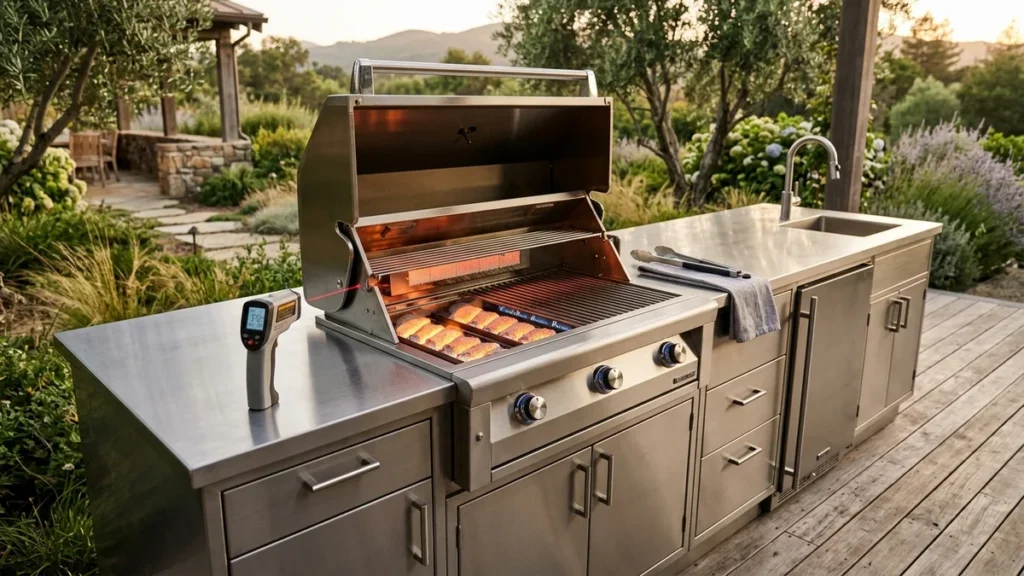
Designing a permanent outdoor kitchen or selecting a freestanding propane gas grill for an exposed patio deck requires looking past showroom polish and examining three core engineering fundamentals: stainless steel alloy metallurgy (austenitic 304 vs. ferritic 430), convective versus radiant heat flux density ($\text{BTU/hr per sq in}$), and aerodynamic rear-hood wind baffling. Whether you are building a stone-veneer island on an open lakefront deck or upgrading your backyard patio grill in 2026, this engineering guide explains how to evaluate firebox materials, grate thermal conductivity, and gas orifice sizing so your outdoor kitchen performs for 10+ years without rusting out.
Metallurgical Audit: Why 304 vs. 430 Stainless Steel Determines Lifespan
Not all “stainless steel” is created equal. When grease drippings vaporize at 600°F in the presence of salt marinades, nitric oxides from gas combustion, and morning patio dew, inferior steel alloys experience rapid intergranular corrosion. You can test any grill on a showroom floor in 3 seconds using a pocket magnet:
- SAE 304 Stainless Steel (18% Chromium / 8%–10% Nickel — Non-Magnetic): The nickel content locks the steel into an austenitic crystalline structure that forms a self-healing chromium-oxide passive film even at 1,400°F burner temperatures. Always specify 304 stainless steel for main tube burners, flame tamers (heat tents), and firebox weldments.
- SAE 430 Stainless Steel (16%–18% Chromium / 0% Nickel — Magnetic): Ferritic 430 stainless omits expensive nickel, reducing raw sheet metal cost by 35% to 45%. While 430 stainless is completely acceptable for lower cart doors, side shelves, and control panels that stay below 150°F, 430 stainless burners or flame tamers exposed to 800°F acidic grease drippings will scale and perforate within 2 to 3 seasons.
- Die-Cast Aluminum vs. Welded Stainless Fireboxes: Thick-walled die-cast aluminum end caps and fireboxes never red-rust and act as an exceptional thermal flywheel for steady low-and-slow 250°F roasting, while double-lined 304 stainless steel hoods prevent exterior heat discoloration (“bluing”).
Monument Grills 304 Stainless Burner & ClearView Propane Grills
High-output 4-burner and 6-burner propane gas grills featuring 304 stainless tube burners, porcelain cast-iron grates, and ClearView glass lids.
Check Official Specs & Current PricingBTU Flux Density & Grate Thermal Conductivity Physics
A common marketing trap in outdoor cooking is advertising massive 80,000+ BTU/hr ratings on a poorly sealed chassis with a huge 2.5-inch rear exhaust gap. In fluid dynamics, if hot combustion gases escape immediately out the back of the hood, the grill wastes 40% of its propane tank heating the backyard air while struggling to reach 500°F at the grate. Instead, calculate Primary BTU Flux Density:
$$\text{BTU Flux Density} = \frac{\text{Main Burner Total BTU/hr}}{\text{Primary Grate Area (Sq In)}}$$
Optimal residential propane grills operate between 85 and 105 BTU/hr per square inch of primary grate area, paired with low-clearance rear exhaust louvers that create a pressurized convective thermal dome under the lid.
| Grate Material Specification | Thermal Conductivity ($k$) | Heat Retention Mass | Corrosion & Maintenance Profile |
|---|---|---|---|
| Porcelain-Enameled Cast Iron (9 mm) | 52 W/m·K (High) | Exceptional Sear Marks | Season lightly with high-smoke-point oil; avoid metal scrapers |
| Solid 304 Stainless Rod (8 mm – 9.5 mm) | 16 W/m·K (Moderate) | High if Rod ≥ 8 mm | Virtually indestructible; dishwasher & wire-brush safe |
| Stamped Porcelain Steel Wire (5 mm) | 45 W/m·K (Thin Mass) | Poor (Cools under cold steak) | Enamel chips within 18 months; avoid on primary grills |
Outdoor Kitchen Island Clearances, Wind Baffles & Venting
If you are integrating a built-in grill head or framing an enclosure around a freestanding grill on an exposed patio, wind and combustible gas safety must be engineered into the masonry or steel framing:
- Orient the Grill Perpendicular to Prevailing Winds: Never position a gas grill so that prevailing coastal or valley winds blow directly into the rear exhaust louver. A 15 mph tailwind blowing into the back of a grill hood forces 700°F combustion gases forward through the front control bezel, melting regulator hoses and overheating valve stems.
- Liquid Propane (LP) vs. Natural Gas (NG) Island Venting: Liquid propane ($C_3H_8$) has a specific gravity of 1.52—making it heavier than air so any leaked gas pools at floor level. Built-in LP islands MUST include at least two 20-square-inch louver vents within 2 inches of the bottom floor slab. Natural gas ($CH_4$, specific gravity 0.60) is lighter than air and requires upper vents within 2 inches of the countertop overhang.
- Insulated Jacket Liners for Combustible Framing: Never drop a stainless grill firebox directly into wood or composite deck framing. Always maintain a minimum 14-inch clearance to combustible siding or install a UL-listed double-walled stainless insulated grill jacket ($280 USD to $450 USD).
Limitations & Field Caveats
- Using high-smoke-point avocado oil or beef tallow (500°F+ smoke point) is mandatory when seasoning porcelain cast-iron grates; flaxseed or olive oil polymerizes into brittle black flakes that peel off above 550°F.
- Standard 20-lb propane tank OPD valves include an excess-flow safety check ball that trips and restricts flames to a low trickle if you open the tank valve while the grill burner knobs are already turned on.
- Installing a gas grill beneath a low 8-foot wood or vinyl pergola ceiling without a 1,200 CFM commercial range hood causes grease-laden smoke plumes to stain ceiling rafters within 5 cooking sessions.
Grill Masters Club Pitmaster Box — Artisan Rubs, Sauces & Wood Chips
Upgrade your outdoor kitchen cooks with curated pitmaster dry rubs, regional barbecue sauces, and smoking accessories delivered monthly.
Compare Verified Partner ConfigurationQuarterly Burner & Venturi Tube Maintenance Protocol
The #1 cause of yellow, lazy propane flames and dangerous control-panel flash fires is spider webs spun inside the burner Venturi air-intake screens during spring and autumn dormancy. Twice per year ( takes 15 min), pull the cotter pins at the rear of your 304 stainless burners, run a flexible nylon Venturi brush through each tube to clear insect nests, and adjust the air shutter collar until the flame burns crisp blue with tiny yellow tips at the very top.