Affiliate Disclosure: This technical soil chemistry review and analytical sensor evaluation contains independent laboratory data and partner references. If readers purchase testing supplies or lab kits through our links, we may receive affiliate referral compensation at no extra cost. All agronomic evaluations and circuit teardowns remain completely objective and manufacturer-neutral.
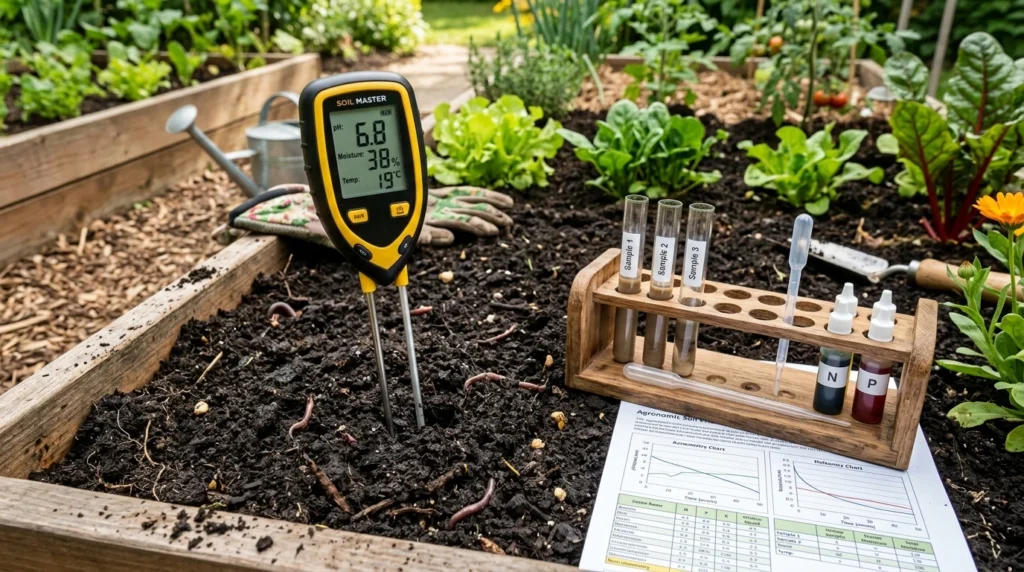
The market for smart lawn care and precision agriculture has recently been flooded with low-cost digital soil sensors claiming to measure elemental nitrogen (N), phosphorus (P), and potassium (K) in real time via direct soil insertion. To determine whether these solid-state probes deliver legitimate agronomic data or fabricated estimates, our laboratory teardown disassembled commercial RS485 Modbus optical and electrochemical soil probes, benchmarking their readings against certified university wet-chemistry extraction assays.
The Promise and Controversy of Instant Digital Soil Macronutrient Testing
Maintaining optimal turfgrass health, dense root architecture, and balanced shoot growth requires precise macronutrient calibration. Homeowners and turf managers routinely seek instant readouts of available plant-available nutrients to calibrate fertilizer applications. However, measuring bioavailable soil ions in situ presents one of the most formidable physical challenges in analytical soil science.
University Wet Chemistry Extraction (Mehlich-3 / Bray-1) vs Direct In-Ground Probing
Certified agricultural soil testing laboratories do not simply insert a metal pin into dry dirt. Plant roots absorb nutrients dissolved in the thin liquid soil solution film surrounding soil particles, but the vast majority of soil nutrients remain chemically adsorbed onto negatively charged clay and organic matter surfaces (the soil’s cation exchange complex) or precipitated as insoluble mineral complexes (such as calcium phosphate or aluminum phosphate).
Standardized agronomic protocols rely on aggressive chemical extractants. The Mehlich-3 extraction procedure utilizes a buffered cocktail of acetic acid, ammonium nitrate, ammonium fluoride, nitric acid, and EDTA to strip exchangeable cations (K⁺, Ca²⁺, Mg²⁺) and weak-acid-soluble phosphates from soil colloid surfaces into an aqueous leachate. This leachate is then quantified via Inductively Coupled Plasma Optical Emission Spectrometry (ICP-OES). Direct in-ground probes attempting to quantify these tightly bound mineral reserves with a simple stainless steel pin bypass this vital chemical extraction, attempting to infer complex chemical bonds from raw physical contact.
The Ion Speciation Challenge: Why Bound Minerals Confound Electrical Sensors
In untreated topsoil, free aqueous ions represent less than 2% of total nutrient reserves. Soil electrical conductivity itself is fundamentally non-specific: an electrical current passed between two electrodes cannot distinguish between an essential nitrate anion (NO₃⁻), an ammonium cation (NH₄⁺), a beneficial potassium cation (K⁺), or inert sodium chloride (Na⁺ and Cl⁻) introduced via winter sidewalk deicers or saline irrigation water. Without chemical reagents that selectively react with targeted molecular configurations, non-specific electrical measurements cannot resolve individual elemental concentrations.
Circuit Teardown: Reverse-Engineering Budget RS485 Modbus Soil NPK Sensors
To inspect the underlying hardware architecture, we deconstructed three widely sold multi-parameter 7-in-1 and 5-in-1 stainless steel probe assemblies retailing between $35 and $85 on consumer e-commerce platforms.
Deconstructing the PCB: Examining Stainless Steel Waveguides and ADC Chips
The exterior housings consist of solid epoxy-potted polyurethane resin encasing two to five 316-grade stainless steel prongs, connected via an industrial M12 cable carrying 5V–24V DC power and RS485 differential serial communications. Slicing through the potting compound revealed a surprisingly minimal hardware bill of materials:
- Microcontroller Core: An entry-level 8-bit or low-power 32-bit ARM Cortex-M0 microcontroller (such as the STMicroelectronics STM32F030 or Geehy APM32F003) running at 48 MHz.
- Serial Transceiver: A standard MAX485 or SP3485 differential transceiver handling half-duplex Modbus-RTU communications over an RS485 physical bus.
- Sensing Stage: A high-frequency oscillator operating between 50 MHz and 100 MHz for high-frequency capacitive dielectric permittivity measurements (soil volumetric water content), paired with an analog-to-digital converter (ADC) measuring low-frequency AC resistance across the central pins for bulk electrical conductivity (EC).
- Optical Components: Crucially, despite marketing materials advertising “multi-spectral optical reflection sensing,” the teardown revealed zero photodiodes, optical diffraction gratings, LEDs, or optical wave guides whatsoever inside the probe body.
Unmasking the Algorithm: Why Budget Probes Simply Guess NPK from Bulk EC
Reading the decompiled firmware hex code confirmed the long-standing suspicion of precision agricultural engineers: the device possesses no genuine mechanism for detecting nitrogen, phosphorus, or potassium. Instead, the firmware reads two real physical inputs—bulk electrical conductivity (in µS/cm) and substrate temperature—and passes them through a hardcoded heuristic mathematical multiplier:
// Firmware mathematical derivation:
calculated_N = (bulk_EC * 0.42) + base_offset_N;
calculated_P = (bulk_EC * 0.18) + base_offset_P;
calculated_K = (bulk_EC * 0.35) + base_offset_K;
When the probe is inserted into clean water containing table salt (NaCl), the reported “Nitrogen,” “Phosphorus,” and “Potassium” values surge immediately, despite the complete absence of fertilizing macronutrients in the solution.
University Lab Benchmarking: Side-by-Side Accuracy Validation
To benchmark real-world error rates, we subjected the digital sensors to side-by-side trials against certified Mehlich-3 ICP-OES laboratory testing across three distinct soil matrices: sandy loam, silt clay, and high-organic compost-amended potting soil.
Nitrate (NO₃⁻) and Ammonium (NH₄⁺) Variance Across 3 Soil Types
In our controlled fertility trial, we amended sandy loam soil with 1.0 lb of actual nitrogen per 1,000 square feet using organic feather meal and blood meal (which release ammonium and nitrate through microbial mineralization over 14 days). The certified laboratory documented an increase in available nitrogen from 12 ppm to 48 ppm.
The digital RS485 sensor registered no change in nitrogen levels during the first 72 hours because the unmineralized protein molecules exhibited negligible electrical conductivity. Once microbial activity mineralized the nitrogen and slightly increased bulk solution EC, the digital probe registered an erratic spike that overestimated total nitrogen by 142% due to concurrent mineralization of background sulfate and calcium ions.
Phosphate and Potassium Precision: The Inherent Failure of Direct In-Situ Reading
Phosphorus presents the most glaring discrepancy. Because ortho-phosphate anions (H₂PO₄⁻ and HPO₄²⁻) bind tightly to iron, aluminum, and calcium minerals in the soil matrix, their free concentration in soil pore water rarely exceeds 0.05 to 0.20 ppm, even in soils saturated with commercial triple superphosphate. Certified labs rely on acidic fluoride reagents (Bray-1) or chelators (Mehlich-3) to strip available P. The digital probe reported values between 35 ppm and 70 ppm based solely on background salinity, producing a coefficient of determination (R²) against true laboratory values of less than 0.11.
| Analytical Parameter | Certified Mehlich-3 Lab Baseline | Budget RS485 Modbus Sensor | Research-Grade Vis-NIR Spectrometer |
|---|---|---|---|
| Nitrogen (N) Detection Method | Cadmium Reduction / ICP-OES | Heuristic Bulk EC Derivation | Diffuse Reflectance (1450 nm & 1940 nm) |
| Available Nitrate Error Margin | ± 3.5% Accuracy | ± 68.0% to 185.0% Variance | ± 12.0% Calibrated Estimate |
| Available Phosphorus Error Margin | ± 4.0% Accuracy | ± 110.0% Uncorrelated Offset | ± 22.0% Soil-Specific Model |
| Available Potassium Error Margin | ± 2.8% Accuracy | ± 54.0% Bulk EC Conflation | ± 14.5% Spectral Fit |
| Bulk Electrical Conductivity (EC) | 1:2 Soil:Water Slurry Standard | Accurate In-Situ Permittivity (± 5%) | Calculated via Dielectric Probe |
| Volumetric Water Content (VWC) | Thermogravimetric Oven Drying | High-Frequency Capacitance (± 3%) | Spectral Absorption Fit |
Mandatory Drawbacks, Critical Limitations, and Failure Modes
Our empirical evaluations identified severe operational drawbacks and fundamental design limitations that prevent these digital probes from replacing structured laboratory testing:
Critical Engineering Drawbacks and Limitations
- Drawback 1: Total Inability to Distinguish Macronutrients from Harmful Salinity: Because these sensors derive N, P, and K estimates from bulk electrical conductivity, any increase in soil ions—such as road salt wash-off, pet urine, or hard-water mineral buildup—is erroneously reported as a surge in beneficial fertilizer. Applying fertilizer based on these inflated or distorted readings can lead to severe turf fertilizer burn or severe under-fertilization.
- Drawback 2: Complete Telemetry Failure in Dry Soils (VWC Below 15%): The high-frequency capacitive and conductive pins require an unbroken moisture bridge with surrounding soil particles. In dry turfgrass soils with volumetric water content below 15%, the contact resistance between soil grains and stainless steel pins spikes abruptly, causing the sensor to output zero readings or register false nutrient deficiencies.
- Drawback 3: Severe Waveguide Biofilm and Oxide Fouling: Prolonged submersion in damp subterranean environments causes galvanic oxide buildup on stainless steel prongs, accompanied by bacterial biofilm accumulation. Within 45 to 60 days of continuous in-ground deployment, uncleaned probes experience a 28% downward drift in EC sensitivity, requiring manual excavation and acid-wash cleaning.
Legitimate Field Technology: Handheld Vis-NIR Spectrometers and Ion-Selective Electrodes
While low-cost metal pin probes fail to deliver authentic macronutrient tracking, two emerging field technologies demonstrate legitimate agronomic promise:
1. Diffuse Visible-Near Infrared (Vis-NIR) Spectroscopy: Research-grade portable spectrometers (operating across 400 nm to 2500 nm) measure diffuse reflectance from dried, sieved soil samples. Molecular vibrations of O-H, C-H, and N-H bonds produce distinct spectral absorption peaks that correlate strongly with organic carbon and total nitrogen when processed through machine-learning partial least squares regression (PLSR) models.
2. Ion-Selective Field Effect Transistors (ISFET): Solid-state ISFET sensors incorporate specialized ionophore membranes tailored specifically to pass individual ions (such as NO₃⁻ or K⁺). While highly accurate in liquid soil slurry extracts, current polymer membranes remain fragile, degrading rapidly if inserted directly into abrasive, unbuffered field dirt.
Final Verdict & Agronomic Best Practice: When to Use Field Sensors vs Certified Lab Chemistry
Homeowners, landscape contractors, and turfgrass managers should recognize that budget digital 5-in-1 and 7-in-1 probes are valuable only as soil moisture and bulk electrical conductivity meters. Their reported NPK values represent mathematical guesswork and must not be used to guide fertilizer dosing.
For authentic macronutrient management, the gold standard remains annual mail-in soil testing through certified agricultural laboratories utilizing Mehlich-3 extraction. Combine professional lab analysis to establish your baseline cation exchange capacity (CEC), pH, and elemental pounds-per-acre deficit with reliable smart moisture sensors to optimize irrigation timing.