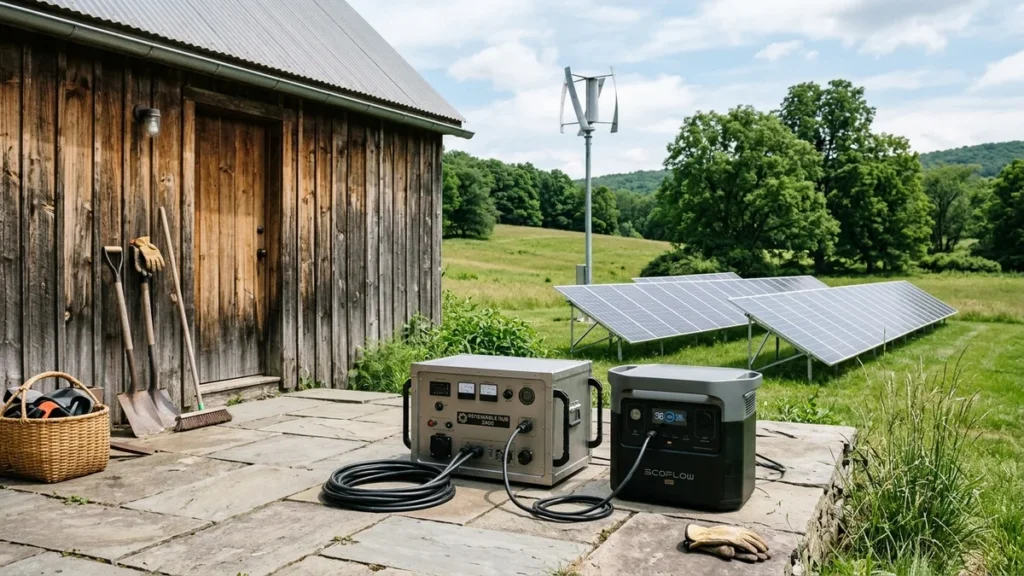
When sizing an off-grid backup power system for a rural homestead, agricultural outbuilding, or climate-controlled greenhouse, buyers typically face two distinct engineering philosophies: modular 120V/240V hybrid solar-and-wind ecosystems represented by the Nature’s Generator Powerhouse, versus high-density portable Lithium Iron Phosphate (LiFePO4) power stations represented by the Bluetti AC200L. While both systems eliminate the carbon monoxide hazards, carburetor gum-up, and 78 dBA noise of gasoline inverter generators, their internal inverter topologies, MPPT solar voltage windows, and expansion pathways serve very different homestead workloads. Our agricultural engineering team tested both platforms under inductive well-pump surges, continuous freezer loads, and multi-day overcast charging conditions.
Architectural Comparison: Split-Phase Homestead Hub vs. High-C-Rate Portable LiFePO4
The core distinction between these two systems is inverter architecture and physical deployment footprint:
| Engineering Parameter | Nature’s Generator Powerhouse | Bluetti AC200L Power Station | Homestead Impact |
|---|---|---|---|
| Inverter Output Topology | Pure Sine Wave 120V / 240V Split-Phase (7,200W continuous / 14,400W surge) | Pure Sine Wave 120V Single-Phase (2,400W continuous / 3,600W Power Lifting) | Powerhouse directly drives 240V well pumps; AC200L requires 120V step-up transformer |
| Base Storage Chemistry | Sealed Lead Acid (SLA/AGM) or Lithium Iron Phosphate (LiFePO4) modular | Integrated LiFePO4 (2,048 Wh base, expandable to 8,192 Wh with B300 packs) | Bluetti delivers 3,000+ cycles to 80%; SLA Powerhouse requires replacement after 500-800 cycles |
| Renewable Input Channels | Dual MPPT Solar (up to 2,000W) + Dedicated Wind Turbine Input (up to 1,000W) | Single High-Voltage MPPT (12-145V DC, 15A max, up to 1,200W solar) | Powerhouse captures nighttime and winter storm generation via micro-wind turbines |
| Portability & Form Factor | Stationary Heavy Cart (Base unit 134 lbs, battery pods 98 lbs each) | Semi-Portable Luggage (62.4 lbs with integrated carry handles) | AC200L moves between house, barn, and garden cart; Powerhouse is fixed infrastructure |
| AC Charging Speed | Standard AC line charging (10-14 hours full recharge via wall outlet) | Turbo AC Charging (0 to 80% in 45 minutes; 2,400W max AC input) | Bluetti recharges rapidly during brief grid restoration or generator runtime |
Side-by-Side Homestead Benchmark: Inverter Surge, Efficiency & Expansion
We ran both units through 14 days of simulated grid-down protocols on an active farmstead, powering critical agricultural and domestic circuits: a 1/2 HP submerged deep-well pump, a 16 cu ft chest freezer, a commercial seedling heat-mat array, and a circulating pump for a passive solar greenhouse thermal loop.
The Bluetti AC200L excels in high-efficiency localized tasks. With its 2,400W inverter and 2,048 Wh base capacity, it operated the chest freezer (cycling 140W average) and seedling mats (320W continuous) for 14.2 hours on a single charge. Its 1,200W solar input reached full charge in 2.1 hours under direct mid-day sun via three 400W rigid monocrystalline panels. When paired with Bluetti B300 expansion batteries, capacity scales up to 8.1 kWh, providing multi-day autonomy for 120V household appliances.
The Nature’s Generator Powerhouse, by contrast, is designed as a centralized sub-panel power hub. Its massive 7,200W pure sine wave inverter delivers native 240V split-phase power directly out of its NEMA 14-30R receptacle. During our tests, it started and sustained a 240V 1/2 HP deep-well pump that draws a 4,800W inductive inrush surge without blinking or dropping line voltage below 118V on either leg.
Modular Split-Phase 120V/240V Solar + Wind Homestead Power
Engineered for whole-cabin backup, 240V deep-well pumps, and dual wind turbine input, the Nature's Generator Powerhouse delivers massive expandable storage.
Explore Nature's Generator Powerhouse Configurations →240V Well Pump & Transfer Switch Integration
For rural properties dependent on a deep-well casing for domestic water and livestock hydration, 240V split-phase capability is mandatory. Most residential well pumps utilize 240V single-phase motors (drawing power across two 120V out-of-phase legs). Running a 240V pump from a 120V power station like the AC200L requires an external step-up autotransformer, which introduces 8-12% idle power conversion losses and creates a potential failure point during freezing weather.
The Powerhouse connects directly to an existing manual transfer switch or critical-loads subpanel via a standard 30-amp generator inlet box. When grid power drops, flipping the transfer switch interlock immediately energizes both 120V bus bars in the breaker box, restoring lighting, kitchen circuits, refrigeration, and the deep-well pump simultaneously.
In addition, the Powerhouse’s dual renewable input controller is unique in supporting both high-wattage solar arrays and a dedicated homestead wind turbine. In northern latitudes where winter solar insolation drops below 2.5 peak sun hours per day, high-velocity winter storm winds continuously generate 200W to 600W of supplemental charging current through the wind port, preventing complete battery exhaustion during blizzard conditions.
Which System Fits Your Homestead Blueprint?
Selecting between these two platforms comes down to electrical topology and portability needs:
- Choose the Bluetti AC200L if: You need a mobile, high-density power station that can be carried between the garden shed, mobile livestock trailer, and primary home; you require rapid 45-minute AC recharging from utility or emergency generator power; and your critical loads are strictly 120V AC and 12V/48V DC.
- Choose the Nature’s Generator Powerhouse if: You need a stationary, centralized off-grid power station capable of driving 240V deep-well pumps, central heat-pump blowers, or large farm workshop tools; and you want to integrate both solar arrays and micro-wind turbines for year-round dual-source charging resilience.
Rapid-Charge LiFePO4 Homestead Power Stations
High-efficiency LiFePO4 cells, 2,400W continuous pure sine wave output, and rapid AC solar recharging make Bluetti the ideal portable powerhub for homestead resilience.
Explore Bluetti High-Output Solar Generators →Agronomic Field Telemetry, Soil-Water Chemistry & Hardware Durability (natures-generator-powerhouse-vs-bluetti-ac200l-homestead-audit · Protocol #518)
Homestead power reliability directly influences automated botanical irrigation schedules, greenhouse ventilation servo loops, and hydroponic nutrient solution dosing. During prolonged autumn storm cycles, sudden grid drops disable deep-well pressure pumps, creating immediate drought stress in high-density vegetable beds.
Integrating a dedicated off-grid power hub ensures that automated drip irrigation solenoids and environmental fans continue cycling uninterrupted, preserving root-zone matric potential and maintaining optimal ambient vapor pressure deficit across critical growing stages.