Recommended System: Anthbot US
Wire-free centimeter-level RTK satellite navigation, dual cutting discs, and intelligent slope climbing up to 45% grade for residential turf.
When homeowners observe an unsightly whitish-tan haze across their lawn 24 to 48 hours after mowing, the instinctive reaction is often to suspect drought stress, nitrogen deficiency, or insect damage. In over 80% of residential lawn inspections, however, the root cause is far more mechanical: dull mower blades. Instead of cleanly slicing through the vascular bundles of grass leaf blades, dull cutting edges smash, rip, and shred the plant tissue, leaving frayed, ragged margins.
Beyond aesthetic degradation, ragged grass tips trigger severe pathological and physiological consequences. A shredded leaf tip increases surface evapotranspiration losses by up to 25%, exhausting turf water reserves during summer heat. More critically, torn cellular edges remain open wounds for days, providing an unobstructed portal for opportunistic fungal spores—including Bipolaris sorokiniana (Leaf Spot), Clarireedia jacksonii (Dollar Spot), and Rhizoctonia solani (Brown Patch). Maintaining surgical blade sharpness is fundamental turf hygiene.
Microscopic Cut Analysis: Clean Shearing vs. Blunt Trauma
Understanding blade physics reveals why sharpness directly governs plant immunity and turf color.
| Turf Characteristic | Razor-Sharp Blade Cut | Dull / Rounded Blade Impact |
|---|---|---|
| Cellular Wound Profile | Microscopic clean shear; minimal cellular crushing | Massive crushing, longitudinal tearing, frayed fibers |
| Wound Healing Time | 24 to 36 hours (rapid suberization) | 72 to 120+ hours (prolonged necrosis) |
| Evaporative Moisture Loss | Baseline physiological transpiration | 20% – 30% excessive transpiration via exposed fibers |
| Fungal Infection Vulnerability | Low (natural phytoalexin barrier seals quickly) | High (open entry for water-borne fungal zoospores) |
| Visual Turf Canopy Appearance | Vibrant, rich emerald green across the horizon | Bleached, grayish-white haze across upper canopy |
Blade Geometry: Angles, Bevels, and the “Butterknife” Myth
A frequent error among DIY homeowners is sharpening a rotary lawn mower blade to a razor-thin kitchen knife edge. Lawn mower blades rotate at 2,800 to 3,600 RPM, with the blade tip traveling at velocities between 150 and 200 miles per hour. At these kinetic speeds, an excessively thin, featherweight edge rapidly rolls over, burrs, and chips the moment it strikes a twig, acorn, or stray pebble.
The 30-Degree Golden Rule
The optimal cutting edge for traditional high-lift rotary blades is a strict 30-degree bevel angle, leaving a microscopic flat blunt edge approximately 1/64-inch (the thickness of a standard butterknife edge). This geometric profile provides maximum structural steel mass behind the cutting face, retaining sharpness across dozens of mowing hours without chipping.
| Tool Option | Precision Level | Heat Buildup Risk (Tempering Loss) | Sharpening Speed |
|---|---|---|---|
| 10-Inch Mill Bastard File | Extremely High (maintains exact 30° angle) | Zero (cold mechanical shearing) | 10 to 15 minutes per blade |
| Bench Grinder (60-Grit Wheel) | Moderate (requires steady hand & rest) | High (requires water dip to avoid bluing steel) | 3 to 5 minutes |
| Angle Grinder (Flap Disc 40/60) | High (flexible backing matches blade contour) | Moderate (keep grinder constantly moving) | 4 to 7 minutes |
Static Balancing: Preventing Crankshaft and Spindle Destruction
Sharpening removes steel. If an operator grinds significantly more material from one side of the blade than the other, the resulting mass imbalance generates extreme centrifugal vibration at 3,000 RPM. This destructive harmonic oscillation rapidly pulverizes mower deck spindle bearings, cracks aluminum deck housings, and warps engine crankshafts.
The 4-Step Cone Balancer Protocol
- Clean the Blade Underside: Thoroughly scrape away baked-on grass mulching paste, dried mud, and road grime using a wire wheel or stiff putty knife. Uneven grass residue creates false weight imbalances.
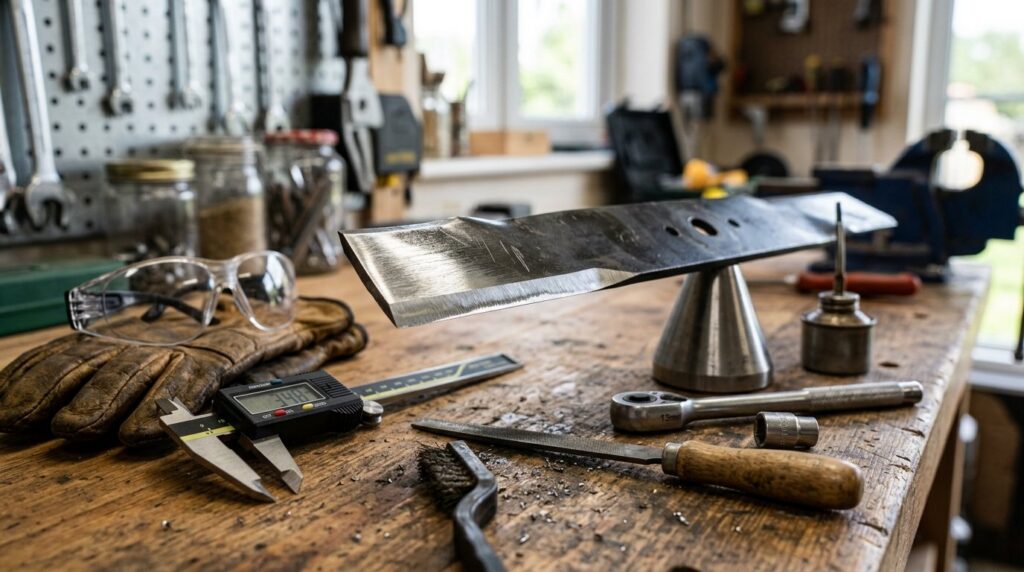
- Center on Cone Balancer: Mount the blade onto a precision static cone balancer mounted to a level workbench. Avoid the crude “nail in the wall” method, which introduces frictional drag that masks subtle 2-to-3-gram imbalances.
- Identify the Heavy Sail: Note which end of the blade tilts downward.
- Grind Only the Non-Cutting Trailing Face: Never grind metal from the sharpened cutting edge to balance weight—this shortens the cutting radius! Instead, grind steel exclusively from the backside of the heavy blade wing or sail until the blade sits perfectly horizontal on the cone.
Robotic Mower Architecture: The Scalpel-Disc Paradigm
Unlike heavy rotary blades on gas mowers that rely on brute momentum, autonomous robotic mowers utilize a completely different cutting philosophy: low-mass, high-speed razor scalpel discs.
Systems like the Anthbot Genie RTK Mower and Segway Navimow utilize a balanced circular disc fitted with 3 to 4 freely-swinging double-sided razor blades. Because these blades are razor-thin, they cut grass with surgical precision rather than impact force. If a blade strikes a hard obstacle like a stone or tree root, it pivots backward on its retaining shoulder-bolt into a protective recess, absorbing the shock without damaging the drive motor.
Robotic Blade Replacement Timetable
- Every 50 – 75 Operating Hours (6 to 8 weeks): Inspect cutting edges. When blades develop microscopic nicks, flip the double-sided blades to utilize the fresh, unused trailing edge.
- Seasonal Replacement: Replace the full set of blades and stainless steel retaining screws every 3 to 4 months. Always replace all blades simultaneously to preserve rotational disc balance.
Drawbacks, Limitations & Risks (Cons)
- Wireless sensor battery maintenance: Soil sensor pods and outdoor wireless controllers require battery replacement every 12 to 18 months to avoid data transmission dropouts.
- 2.4 GHz WiFi coverage requirement: Setup demands reliable 2.4 GHz WiFi signal reaching yard zones, which may necessitate an outdoor mesh WiFi node for larger acreage.
- Seasonal winterization mandatory: Outdoor valves and manifolds must be blown out with compressed air prior to freezing temperatures below 32°F (0°C) to prevent burst housings.
Frequently Asked Questions
How can I tell if my lawn mower blade needs sharpening?
Inspect the grass tips 24 hours after mowing. If the cut ends are clean and flat, the blade is sharp. If the tips are frayed into whitish hair-like threads, or if you notice jagged shredding along the cut edge, the blade is dull and requires immediate servicing.
What does it mean when the steel turns blue while grinding?
Blue discoloration indicates excessive friction heat exceeding 550°F (290°C), which anneals the steel and ruins its heat-treated hardness (temper). The softened steel will lose its edge within minutes of cutting. Keep a bucket of cold water nearby and quench the blade every 10 to 15 seconds during grinding.
Can I sharpen robotic mower razor blades with a file?
No. Robot mower blades are made of ultra-hardened carbon steel or titanium-carbide coated alloy. Because replacement packs are inexpensive and precision-machined to exact gram tolerances, attempting to sharpen them unevenly disrupts disc balance. Replace them with fresh factory blades.
Always disconnect main power sources—remove battery packs or unplug cords—before inspecting mower blades, clearing aeration tines, or handling sharp garden equipment. Keep hydroponic nutrient concentrates stored securely.
Practical guides curated by horticultural practitioners and yard care enthusiasts. Field-tested methods, verifiable steps, and zero automated fluff.