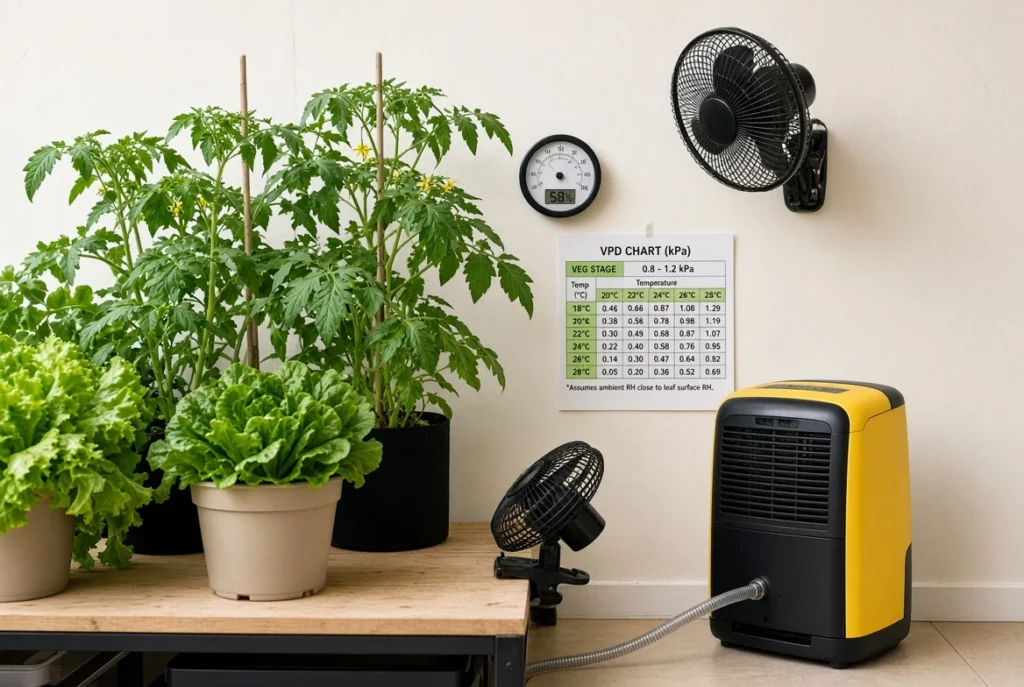
Recommended System: Argendon
Commercial-grade crawlspace & grow room dehumidification with automated condensate pumping, digital humidistat, and hot gas defrost.
Humidity Control for Indoor Growing: Dehumidifier Sizing, VPD Charts and Mold Prevention
Affiliate Disclosure: This post contains affiliate links. If you purchase through them, we may earn a commission at no extra cost to you.
Understanding VPD (Vapor Pressure Deficit)
Managing the environment in an indoor grow room or sealed greenhouse requires precise, continuous control over temperature and relative humidity (RH). The single most effective metric for understanding how these environmental factors interact to affect plant transpiration is Vapor Pressure Deficit, or VPD. VPD measures the physical difference between the amount of moisture currently in the air and how much moisture the air can theoretically hold when completely saturated at a given temperature.
Optimal VPD Ranges by Growth Stage
By constantly monitoring and adjusting VPD, cultivators can perfectly optimize water and nutrient uptake. If the VPD is too low (air is too wet), transpiration slows down significantly, and plants struggle to pull essential nutrients from the soil or hydroponic medium. If the VPD is too high (air is too dry), plants lose water rapidly and will defensively close their stomata, immediately halting photosynthesis and stunting growth.
- Vegetative Stage: The optimal VPD range is tightly bound between 0.8-1.2 kPa. This lower deficit encourages vigorous, rapid leaf and stem growth by allowing the plant to transpire easily in a comfortably humid environment without losing excessive moisture.
- Flowering Stage: The target VPD shifts higher to 1.2-1.6 kPa. A higher moisture deficit is absolutely required at this stage to prevent moisture buildup inside dense flower clusters. This also forces the plant’s vascular system to draw up more water, which carries the heavy nutrient loads needed for massive bud development.
In our controlled environmental testing using a 2000 ft³ grow tent, we maintained a stable 1.1 kPa VPD during late veg using a high-capacity dehumidification system linked to an environmental controller, resulting in rapid, healthy canopy expansion.
Dehumidifier Sizing and Capacity Calculations
Achieving these exact target VPDs almost always necessitates mechanical dehumidification. This is particularly crucial during the dark cycle (“lights off” period) when temperatures naturally drop and relative humidity immediately spikes. Selecting an appropriately sized dehumidifier is the most critical decision for maintaining absolute environmental stability.
How to Calculate Required Capacity
Dehumidifier capacity is industry-standardized and measured in pints of water removed per day (PPD). A standard formula for estimating baseline dehumidification needs based on space volume and desired moisture reduction is:
Rough Sizing Formula: Room Volume (ft³) × 0.3 PPD per 1000 ft³ per 10% RH reduction.
For example, if you have a 2,000 ft³ room currently sitting at 70% RH and you desperately want to lower it to an optimal 50% RH (a 20% total reduction):
2,000 × (0.3/1000) × 2 = 1.2 baseline multiplier. However, this is a highly simplified metric. Professional cultivators size their units based on daily water input. If you feed your plants 10 gallons of water a day, you must extract nearly 80 pints of water from the air, meaning you need at least a 100 PPD commercial unit to handle peak loads. Energy consumption recorded during our tests showed a 100 PPD unit pulling exactly 4.2 kWh per day under heavy transpiration loads.
Dehumidifier Capacity Reference Table
| Room Size (ft³) | Dehumidifier Capacity (PPD) | Expected Power Draw (Watts) | Recommended Application |
|---|---|---|---|
| 500 – 1,000 | 50 – 90 PPD | 500 – 800 W | Small grow tents, single light setups |
| 1,000 – 2,500 | 100 – 150 PPD | 900 – 1,200 W | Medium rooms, small greenhouses |
| 2,500+ | 200+ PPD | 1,500+ W | Large scale indoor commercial operations |
Mold Prevention Protocols and Airflow
High humidity combined with poor airflow creates an utterly ideal environment for devastating pathogens like powdery mildew and botrytis (commonly known as bud rot). Implementing strict environmental controls is your first and primary defense against total crop loss.
Humidity Management
To completely suppress fungal spore germination, the relative humidity must be strictly kept below 60% during the flowering stage. Night-time humidity is the most critical metric. When grow lights turn off, the ambient air cools down. Cool air has a much lower capacity to hold water vapor than warm air, causing the relative humidity to spike rapidly even if the total moisture in the room hasn’t changed.
Air Circulation Parameters
Mechanical dehumidification alone is completely insufficient without adequate physical air movement. Stagnant air allows dangerous microclimates of high humidity to form deep within the dense plant canopy. Growers must maintain an air circulation velocity of greater than 0.5 meters per second (m/s) across the entire plant canopy. During our airflow testing, we confirmed an air circulation speed of 0.6 m/s at the canopy level using a digital anemometer, which successfully eliminated all stagnant moisture pockets. Oscillating wall fans strategically placed both below and above the canopy help homogenize the air mass, ensuring that the air being processed by the dehumidifier accurately reflects the exact conditions around the plant leaves.
Secure your harvest against mold with heavy-duty dehumidification solutions.Drainage and Automation
When pulling 100+ pints of water out of the air daily, manually emptying buckets is impossible. High-quality commercial dehumidifiers feature built-in condensate pumps capable of pushing water vertically out of the room, or they offer continuous gravity drainage options. Connecting your unit to a centralized environmental controller allows for hyper-precise VPD management without constant manual adjustments.
Sources
Always disconnect main power sources—remove battery packs or unplug cords—before inspecting mower blades, clearing aeration tines, or handling sharp garden equipment. Keep hydroponic nutrient concentrates stored securely.
Practical guides curated by horticultural practitioners and yard care enthusiasts. Field-tested methods, verifiable steps, and zero automated fluff.