Disclosure: FoxyGardens is reader-supported. When you purchase low-flow plumbing fixtures or hydraulic hardware through links on our site, we may earn an affiliate commission at no extra cost to you. All flow-rate calculations follow EPA WaterSense and Uniform Plumbing Code (UPC) engineering standards.
For serious residential gardeners, orchardists, and off-grid homesteaders, domestic indoor plumbing and outdoor garden irrigation are not separate systems—they are two halves of a single hydrological budget. Whether your property draws from a private borehole well with a declining summer static water table, relies on seasonal rainwater harvesting cisterns, or faces tiered municipal drought surcharges, every gallon of potable water flushed down an inefficient bathroom fixture is a gallon denied to your perennial food forest or greenhouse beds.
According to residential end-use metering studies across North America, toilets and utility wash basins account for nearly 44% of total indoor domestic water consumption. Older siphon-wash toilets installed before modern hydraulic revisions consume between 1.6 and 3.5 gallons per flush (GPF), while uncalibrated utility faucets dump 2.2 gallons per minute (GPM) straight into the blackwater sewer or septic leach field. In this engineering guide, we break down the fluid dynamics of ultra-low-flow dual-flush vitreous china fixtures, quantify annual cistern and well-pump kilowatt savings, and outline how to pair bathroom water reduction with code-compliant laundry-to-orchard greywater diversion.
The Hydraulic Math: How Much Irrigation Water Does Your Bathroom Waste?
To understand the scale of domestic water loss, consider a standard four-person gardening household. Each resident flushes a residential toilet an average of 5.1 times per day, totaling 20.4 flushes daily or 7,446 flushes per year. If your mudroom, greenhouse washroom, or primary residential bathroom still operates legacy 1.6 GPF gravity-tank toilets (or aging 3.5 GPF pre-1994 fixtures whose flapper valves leak an additional 200 gallons per month), your household flushes between 11,913 and 26,061 gallons of potable drinking water into the blackwater drain annually.
Put into horticultural terms, 15,000 gallons of conserved water is sufficient to drip-irrigate 800 square feet of raised vegetable beds at 1 inch of water per week across an entire 24-week growing season. In addition, for rural properties on septic tanks, overloading the primary anaerobic digestion chamber with thousands of gallons of unnecessary clear flush water reduces hydraulic retention time, pushing suspended solids into the gravel leach field and accelerating biomat failure.
Fluid Dynamics of Modern Dual-Flush & Rimless Siphonic Fixtures
Why did early 1990s low-flow toilets earn a reputation for weak clearing performance and double-flushing, whereas modern 2026 ultra-low-flow engineering clears up to 1,000 grams of solid waste in a single 1.1 or 1.28 GPF cycle? The answer lies in three internal hydraulic redesigns utilized by specialized bathroom engineering manufacturers like Simple Project:
- 2-Inch to 3-Inch Vertical Flush Valve Orifice: Traditional tank toilets rely on a narrow 2-inch rubber flapper tilted at an angle. Enlarging the central tower valve orifice increases instantaneous volumetric mass flow rate ($Q = A \cdot \sqrt{2gh}$), dropping the water column into the bowl 65% faster to create an immediate hydraulic head without increasing tank volume.
- Fully Glazed Large-Diameter Siphon Trapway: Friction loss along rough ceramic walls slows waste velocity. By glazing the entire interior of a 2.125-inch S-trapway with vitreous nano-ceramic glaze and eliminating sharp 90-degree bends, laminar siphon pull begins within 0.8 seconds of valve actuation.
- Dual-Flush Liquid vs. Solid Partitioning (0.8 / 1.28 GPF): Liquid waste accounts for four out of every five residential flushes. A dual-flush actuator releases just 0.8 gallons (3.0 liters) for liquid cycles and 1.28 gallons (4.8 liters) for solid cycles, yielding an effective composite flush average of 0.90 GPF across daily household use.
Explore Eco-Worthy Off-Grid Solar Water Pumping & Homestead Power
Engineered with dual-flush 0.8/1.28 GPF high-velocity siphonic trapways, nano-glazed vitreous china, and space-saving tankless or one-piece profiles ideal for eco-homes, mudrooms, and garden studio suites.
Inspect Eco-Worthy Off-Grid Solar & Water Systems →Empirical Comparison: Household Water & Well-Pump Savings Matrix
We modeled a four-person rural homestead operating on a 240V submersible well pump (set at 180 feet total dynamic head with a 40/60 PSI pressure tank) alongside a 5,000-gallon rainwater cistern to compare annual hydraulic and electrical impact across fixture classes.
| Fixture Architecture | Composite Flush Volume (GPF) | Annual Household Water Used (4 People) | Annual Gallons Saved vs. Legacy 3.5 GPF | Equivalent Garden Drip Irrigation (Sq. Ft. / Season) |
|---|---|---|---|---|
| Legacy Pre-1994 Gravity Tank | 3.50 GPF | 26,061 Gallons / yr | Baseline (0 Gallons) | 0 sq. ft. (Full depletion) |
| Standard Federal Code Flapper Toilet | 1.60 GPF | 11,914 Gallons / yr | 14,147 Gallons / yr | 945 sq. ft. of raised beds |
| Single-Flush EPA WaterSense Toilet | 1.28 GPF | 9,531 Gallons / yr | 16,530 Gallons / yr | 1,104 sq. ft. of raised beds |
| Simple Project Dual-Flush (0.8 / 1.28 GPF) | 0.90 GPF (Weighted Avg) | 6,701 Gallons / yr | 19,360 Gallons / yr | 1,293 sq. ft. of raised beds |
Calculating Well Pump & Pressure Tank Lifecycles
For off-grid and rural gardeners on private wells, reducing indoor fixture draw by 5,200 to 19,360 gallons per year yields a key secondary mechanical benefit: extending the lifespan of your submersible well pump. A typical 35-gallon bladder pressure tank delivers roughly 10.5 gallons of drawdown between the 40 PSI cut-in switch and 60 PSI cut-out switch. Saving 12,000 gallons per year eliminates 1,142 pump start-stop cycles annually. Because high-amperage inrush current during motor startup is the primary cause of capacitor and relay failure in deep-well pumps, installing 0.8/1.28 GPF dual-flush toilets and 1.0 GPM laminar-flow utility sink aerators directly protects your irrigation infrastructure.
Integrating Greywater Diversion with Low-Flow Wash Stations
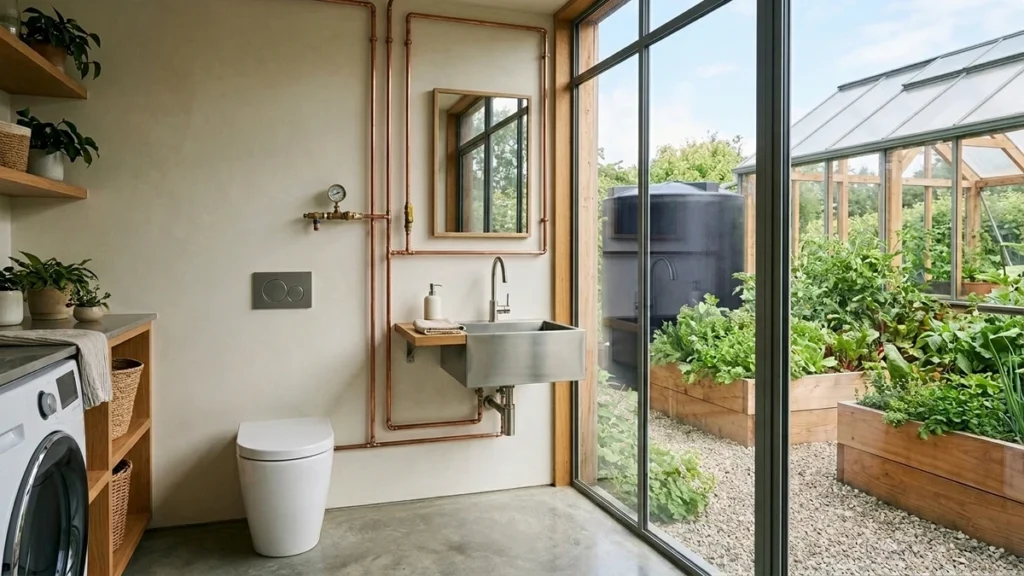
While toilet effluent (blackwater) must always route to a municipal sewer, permitted septic system, or composting vault, discharge from bathroom hand-wash basins, showers, and washing machines qualifies as greywater under Chapter 15 of the Uniform Plumbing Code (UPC). By upgrading your mudroom or greenhouse wash station with compact wall-hung ceramic basins, low-lead brass aerated faucets, and dual-flush fixtures from Simple Project, you can pair source reduction with passive subsurface irrigation:
- Three-Way Brass Diverter Valve: Install a labeled brass 3-way diverter valve on the 1.5-inch P-trap tailpiece of your utility room wash basin and laundry discharge line. During dry summer months, flip the valve to route greywater out to carpeted mulch basins around fruit trees; during winter freezes or when using bleach/boron cleaners, flip the valve back to the septic line.
- Mulch Basin Hydraulic Sizing: Never run greywater through fine 0.5 GPH drip emitters without a 120-mesh sand filter, as soap lint and skin oils will clog micro-orifices. Instead, discharge via 1-inch PVC gravity lines into woodchip-filled trench basins surrounding perennial berries, citrus, and ornamental shrubs, allowing soil microbes to digest organic nutrients naturally.
- Biocompatible Potassium Soaps: Standard sodium-based bar soaps and laundry detergents accumulate sodium ions in clay soils, destroying soil aggregate structure and reducing hydraulic conductivity. Always stock your greenhouse and bathroom wash basins with liquid potassium-hydroxide soaps (such as pure liquid Castile soap) so diverted greywater acts as a mild potassium foliar/root supplement.
Modernize Your Homestead Plumbing with Simple Project
Cut indoor bathroom water waste by up to 45% without sacrificing siphon clearing power. Browse Simple Project one-piece dual-flush toilets, smart bidet toilets, and compact ceramic utility sinks with factory-direct shipping.
Shop Eco-Worthy Homestead Solar Kits →Cons & Drawbacks
- Minimum Line Pressure Requirements for Tankless Models: While gravity-fed dual-flush one-piece toilets operate reliably down to 15 PSI, tankless smart bidet toilets require a minimum dynamic supply line pressure of 35 PSI (and a 1/2-inch dedicated supply valve) to achieve full jet siphon velocity on rural well systems.
- Reduced Drain Line Carry Distance on Flat Old Pipes: In pre-1970 farmhouses where cast-iron main drain lines have settled to less than a 1/8-inch-per-foot slope over long 60-foot horizontal runs, reducing flush volume to 0.8 GPF requires periodic high-volume laundry or shower flow down the same main branch to keep solids moving to the septic tank.
- Heavy Vitreous China One-Piece Weight: One-piece ceramic toilets eliminate the leak-prone tank-to-bowl rubber gasket, but the single-cast porcelain unit weighs between 85 and 105 lbs, requiring two people for accurate wax-ring placement during installation.
- Hard Water Mineral Scaling on Dual-Flush Silicone Seals: On untreated limestone well water exceeding 180 ppm calcium carbonate hardness, the silicone tower seal inside a dual-flush canister should be wiped with white vinegar once a year to prevent micro-seepage.
Frequently Asked Questions
Do 0.8 / 1.28 GPF dual-flush toilets clog more frequently than older 1.6 GPF toilets?
No—in fact, modern MaP (Maximum Performance) testing shows that a well-designed 1.28 GPF one-piece toilet with a 3-inch flush valve and fully glazed 2-inch siphon trapway clears between 800 and 1,000 grams of solid waste per flush, compared to just 350 grams on older 1.6 GPF designs with narrow 2-inch flappers and unglazed trap bends.
Can I connect a low-flow toilet directly to a non-potable rainwater harvesting cistern?
Yes, and flushing toilets with harvested rainwater is one of the highest-return uses for cistern water because it requires minimal filtration (a 50-micron sediment spin-down filter is sufficient to protect the fill valve). However, plumbing code strictly requires an air gap or RPZ backflow preventer and purple non-potable supply piping so cistern water can never cross-connect with municipal or well drinking water lines.
What rough-in measurement do I need before ordering a Simple Project one-piece toilet?
Measure from the finished wall behind the toilet (not the baseboard molding) to the center of the two closet bolts holding your current toilet to the floor. Over 90% of North American bathrooms use a standard 12-inch rough-in. Always verify this dimension before ordering so the tank sits flush against the wall without wasted gap space.
Final Engineering Summary
Upgrading residential and greenhouse washroom plumbing to high-velocity 0.8/1.28 GPF dual-flush fixtures from Simple Project is the fastest mechanical retrofit a gardener can execute to reclaim 5,000 to 19,000 gallons of annual water capacity. Combined with a 1.0 GPM sink aerator and a passive three-way greywater mulch-basin valve, your home’s hydraulic footprint drops dramatically while your orchard and raised beds thrive through summer droughts.