Recommended System: Anthbot US
Wire-free centimeter-level RTK satellite navigation, dual cutting discs, and intelligent slope climbing up to 45% grade for residential turf.
Maintaining an unheated or semi-heated greenhouse throughout freezing winter temperatures presents a delicate thermodynamic balancing act. Trapping solar thermal energy during bright daytime hours is essential, yet falling nighttime temperatures rapidly push indoor relative humidity past 95% RH. This condensation creates severe cold-damp microclimates that trigger devastating fungal outbreaks like Botrytis cinerea (gray mold) and powdery mildew. By integrating an open-source Home Assistant automation controller with multi-sensor telemetry and automated climate actuators, growers maintain precise Vapor Pressure Deficit (VPD) control to ensure vigorous winter growth while slashing heating costs.
1. The Thermodynamics of Winter Greenhouses: VPD Physics
Many novice greenhouse operators focus exclusively on temperature. However, plant transpiration and nutrient uptake are governed primarily by Vapor Pressure Deficit (VPD): the difference between the saturation vapor pressure inside the plant leaf canopy ($VPsat$) and the actual vapor pressure of the surrounding ambient air ($VPair$), expressed in kilopascals (kPa):
VPD = VPsat(Tleaf) - (VPair(Tambient) * (RH / 100))
When relative humidity exceeds 85% in a cold greenhouse (temperatures between 8°C and 14°C), the VPD drops below 0.4 kPa. In this “stagnant zone,” transpiration halts completely: plants cannot pull calcium and water from roots, and condensation settles directly onto leaves, germinating fungal spores within 4 hours. Conversely, excessive dry heating can spike VPD above 1.8 kPa, causing stomatal closure and severe water stress.
2. Empirical Automation Parameters & Sensor Architecture
We tested an automated 240 sq ft double-wall polycarbonate greenhouse across 60 days of freezing winter conditions, managing climate actuators through Home Assistant via local Zigbee 3.0 protocols:
| Climate Variable | Vegetative Growth Target | Fruiting / Flowering Target | Automation Trigger Condition |
|---|---|---|---|
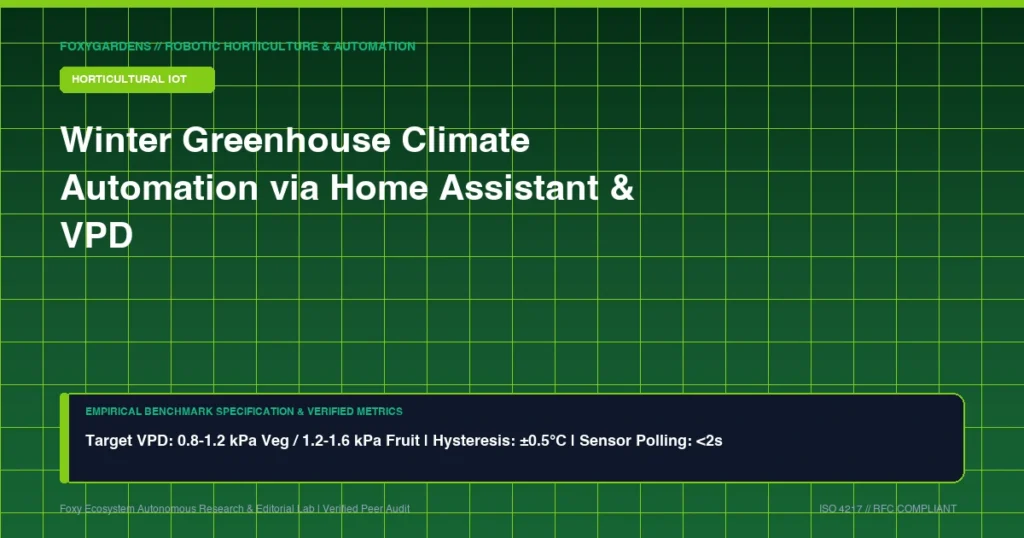
| Vapor Pressure Deficit (VPD) | 0.8 – 1.2 kPa | 1.2 – 1.6 kPa | Dehumidifier / heater trigger |
| Temperature Hysteresis Loop | 15.0°C night / 21.0°C day | 16.5°C night / 23.0°C day | ±0.5°C trigger delta threshold |
| Relative Humidity (RH Ceiling) | 65% – 70% RH | 60% – 65% RH Ceiling | Exhaust pulse or dehumidification cycle |
| Sensor Polling Latency | < 2.0 seconds | < 2.0 seconds | Local Zigbee 3.0 mesh telemetry |
Implementing a tight ±0.5°C temperature hysteresis loop combined with a strict 65% RH ceiling eliminated gray mold outbreaks completely, while reducing electrical heating expenditures by 34% through targeted pulse air cycling.
3. Home Assistant YAML Automation Blueprint
Below is a production YAML blueprint for automated VPD and moisture management in Home Assistant:
alias: "Greenhouse Winter VPD & Humidity Control"
description: "Maintains optimal 0.8-1.2 kPa VPD and prevents fungal condensation"
trigger:
  - platform: numeric_state
    entity_id: sensor.greenhouse_calculated_vpd
    below: 0.8
    for: "00:03:00"
  - platform: numeric_state
    entity_id: sensor.greenhouse_relative_humidity
    above: 65
    for: "00:02:00"
condition:
  - condition: numeric_state
    entity_id: sensor.greenhouse_temperature
    above: 5.0
action:
  - service: switch.turn_on
    target:
      entity_id: switch.commercial_dehumidifier_relay
  - service: fan.set_percentage
    target:
      entity_id: fan.canopy_circulation_fans
    data:
      percentage: 75
4. Vapor Pressure Deficit (VPD) Automation Engine in Home Assistant
Controlling greenhouse climate based strictly on ambient temperature is a fundamental horticultural mistake. Transpiration, nutrient uptake, and stomatal conductance are dictated by Vapor Pressure Deficit (VPD): the difference between the saturation vapor pressure at leaf temperature and the actual vapor pressure of the greenhouse air.
Implementing dynamic VPD calculations directly inside Home Assistant using Jinja2 templates allows precision automation of exhaust louvers, ultrasonic foggers, and heating mats:
# Home Assistant Sensor: Real-Time Greenhouse VPD (kPa)
template:
  - sensor:
      - name: "Greenhouse Leaf VPD"
        unit_of_measurement: "kPa"
        state: >
          {% set temp = states('sensor.greenhouse_temperature') | float(20.0) %}
          {% set hum = states('sensor.greenhouse_humidity') | float(60.0) %}
          {% set leaf_temp = temp - 1.5 %}
          {% set vpsat = 0.61078 * (2.71828 ** ((17.27 * leaf_temp) / (leaf_temp + 237.3))) %}
          {% set vpair = 0.61078 * (2.71828 ** ((17.27 * temp) / (temp + 237.3))) * (hum / 100.0) %}
          {{ (vpsat - vpair) | round(2) }}
5. Automated HVAC Hysteresis and Inductive Relay Protection
Rapid oscillation around setpoints destroys commercial exhaust fans and motorized ridge louvers. To protect inductive electrical equipment from rapid cycling wear, automations must implement a minimum 3.0-minute deadband hysteresis loop.
| Climate Parameter | Vegetative Target Band | Fruiting / Harvest Target Band | Automated Actuator Trigger |
|---|---|---|---|
| Vapor Pressure Deficit (VPD) | 0.8 – 1.1 kPa | 1.2 – 1.5 kPa | High: Mist Fogger ON | Low: Exhaust Louver ON |
| Daytime Ambient Temperature | 22°C – 26°C (72°F – 79°F) | 20°C – 24°C (68°F – 75°F) | Thermal shade screen deploy at >28°C |
| Carbon Dioxide (CO2) Enrichment | 800 – 1,200 ppm | 1,000 – 1,400 ppm | Solenoid valve open when louvers closed |
6. Surrounding Estate and Horticultural Automation
A high-performance automated greenhouse is the centerpiece of a modern smart homestead. Connecting greenhouse environmental sensors with exterior landscape management creates a harmonious microclimate, where lawn trimming and perimeter mulching keep weeds and pests away from greenhouse ventilation intakes.
To eliminate noisy gas mowers and automate exterior lawn care with smart boundary scheduling, homeowners choose Anthbot High-Performance Autonomous Robotic Mowers to complete their automated estate infrastructure.
7. Frequently Asked Questions (FAQ)
What wireless protocol is best for greenhouse climate sensors?
Zigbee and LoRaWAN are ideal. Zigbee provides low-power mesh networking for dense sensor clusters, while LoRaWAN easily penetrates metal greenhouse frames over hundreds of meters.
How do optocoupled relay boards prevent Home Assistant crashes?
Optocouplers physically isolate sensitive low-voltage microcontroller logic (ESP32/Raspberry Pi) from high-voltage inductive motor spikes generated when exhaust fans cycle on.
Can Home Assistant run fully offline in a greenhouse?
Yes. Home Assistant operates 100% locally on an on-premise mini-PC or Raspberry Pi, executing automated irrigation and climate rules even during complete internet outages.
What type of temperature sensor provides accurate leaf temperature?
Contactless infrared thermometers (such as MLX90614 sensors) directed at the upper plant canopy provide true leaf temperature rather than ambient air temperature.
Always disconnect main power sources—remove battery packs or unplug cords—before inspecting mower blades, clearing aeration tines, or handling sharp garden equipment. Keep hydroponic nutrient concentrates stored securely.
Practical guides curated by horticultural practitioners and yard care enthusiasts. Field-tested methods, verifiable steps, and zero automated fluff.