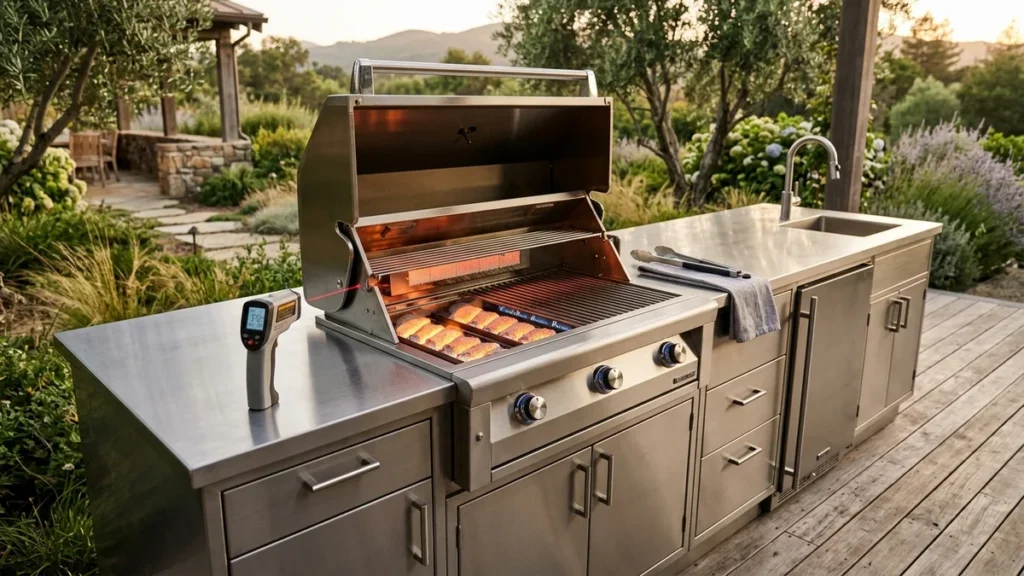
Designing an off-grid outdoor kitchen for an eco-conscious homestead or sustainable backyard patio involves a fundamental thermodynamic trade-off: high-intensity instantaneous searing power versus zero-fuel, zero-emission cooking autonomy. Traditional propane barbecue stations provide reliable high-output British Thermal Units (BTU) for rapid searing, but remain tethered to finite LP tank exchanges and fossil fuel logistics. Conversely, evacuated solar vacuum tube cookers harness direct electromagnetic solar radiation to bake, steam, and roast at temperatures up to 550°F (288°C) without a single drop of combustible fuel.
Rather than treating these cooking modalities as mutually exclusive, modern homestead architects engineer hybrid outdoor kitchens that integrate both systems. By utilizing evacuated solar thermal tubes for passive daytime braising, baking, and stewing, alongside a multi-burner 304 stainless steel propane grill for precision flash searing, homesteaders achieve complete culinary self-reliance across all weather conditions.
Thermodynamics & Thermal Efficiency: Solar Capture vs. LP Gas Combustion
To optimize fuel consumption during long homestead cooking sessions, understanding the heat transfer mechanisms of each appliance is critical.
| Engineering Metric | GoSun Solar Thermal Cooker (Sport / Fusion) | Monument Grills Propane Station (Eminence / Mesa) |
|---|---|---|
| Primary Energy Source | Direct solar radiation (plus 12V/120V hybrid electric coil) | Liquid Propane (LP) or plumbed Natural Gas (NG) |
| Operating Heat Output | Thermal vacuum retention; internal temps up to 550°F (288°C) | 60,000 – 72,000 Total BTUs across multiple 304 SS burners |
| Thermal Conversion Efficiency | ~80% solar-to-thermal capture via compound parabolic reflectors | ~35% – 45% convective heat transfer to food surface |
| Insulation & Heat Retention | Double-walled borosilicate evacuated tube with internal vacuum (< 10−3 Pa) | Double-walled 304 stainless steel hood with silicone perimeter gaskets |
| Ambient Weather Dependency | Requires direct or high diffuse sunlight; unaffected by sub-zero ambient air | Immune to solar cloud cover; wind gusts mitigate burner efficiency |
| Culinary Specialization | Low-and-slow braising, bread baking, steam roasting, dehydrating | High-heat Maillard searing (700°F+ ceramic sear burner), smoke-box roasting |
The evacuated borosilicate glass tube employed in solar cooking behaves as a near-perfect thermodynamic insulator. Because a high vacuum sits between the inner and outer glass walls, thermal energy transferred through the parabolic reflectors cannot escape via conduction or convection. A solar cooker placed in sub-freezing 10°F (-12°C) winter snow will roast a 3-pound pork loin at 375°F inside the vacuum cylinder while the outer glass surface remains completely cool to the touch.
Harness Zero-Fuel Solar Cooking & Clean Camp Power
GoSun evacuated vacuum tube cookers and 12V hybrid off-grid appliances roast, bake, and boil using only direct sunlight or low-voltage DC solar microgrids.
Explore GoSun Solar Cooking Appliances →Engineering the Hybrid Cooking Workflow
Integrating a solar cooking array with a stainless propane station eliminates the biggest drawback of outdoor cooking: fuel waste during prolonged cook cycles. Simmering bone broths, roasting root vegetables, or slow-braising tough cuts of pasture-raised meat typically consumes between 3 and 6 pounds of LP gas per cook.
In a properly coordinated homestead kitchen layout:
- Passive Solar Loading (Morning to Mid-Afternoon): Food trays are seasoned and placed inside the solar vacuum chamber by 10:00 AM. Compound parabolic reflectors automatically concentrate sunlight along the central axis, gently braising vegetables and poultry in their own natural moisture without burning.
- Transition & High-Heat Sear (Evening): Once the core food temperature reaches the desired internal benchmark (e.g. 135°F for grass-fed beef), the meat is transferred to the 900°F ceramic sear zone of the stainless gas grill for a 90-second crust formation.
- Total Propane Saved: This hybrid protocol reduces annual propane bottle consumption by over 65% while retaining restaurant-grade bark and searing quality.
Material Durability: 304 Stainless Steel vs. Anodized Parabolic Reflectors
Homestead outdoor kitchens are exposed to aggressive seasonal elements, including high UV radiation, humidity condensation, and airborne salt or soil particulates. Choosing durable metallurgy prevents structural oxidation and performance degradation.
Monument Grills utilize 304-grade non-magnetic austenitic stainless steel across primary burn chambers, cooking grates, and tubular burners. Containing 18% chromium and 8% nickel, 304 stainless forms a self-healing passive chromium-oxide surface film that prevents pitting and rust formation even under repeated grease flare-ups and exterior rain storms.
On solar appliances, parabolic concentrator reflectors are constructed from high-purity anodized aluminum with reflective specular indices exceeding 95%. When designing your outdoor island counter, position the solar cooking station on a south-facing swivel pedestal with an unshaded sightline to the solar noon azimuth, positioned at least 3 feet away from open flame sources.
Precision 304 Stainless Propane Outdoor Grills
Monument Grills multi-burner propane stations deliver high-output BTU searing, ClearView glass monitoring lids, and heavy-duty 304 stainless steel durability for backyard kitchens.
View Monument Grills Kitchen Models →Ventilation, Clearance & Island Safety Standards
When installing high-output LP grills into custom stone or masonry outdoor kitchen islands, proper airflow venting is mandatory under NFPA 54 fuel gas safety codes:
- Low-Point Gas Venting: Liquid propane is heavier than air (specific gravity ~1.52). Any unburned gas settles into the base of the enclosed island structure. Islands must incorporate at least two opposing 20-square-inch louvered vents positioned within 2 inches of the island floor to prevent hazardous gas pocket accumulation.
- Combustible Clearance: Maintain a minimum 24-inch perimeter clearance between high-output grill fireboxes and any combustible wood pergolas or wall siding, or install a certified stainless steel insulated jacket.
- Thermal Shock Mitigation: Keep evacuated borosilicate solar tubes away from direct high-pressure hose spray when hot to avoid thermal shock fractures.
Conclusion & Off-Grid Culinary Architecture
By blending the infinite zero-emission thermodynamic efficiency of evacuated solar thermal cookers with the instant high-heat response of 304 stainless propane burners, homesteaders build a resilient outdoor kitchen designed for both everyday luxury and off-grid emergency preparedness.
Always disconnect main power sources—remove battery packs or unplug cords—before inspecting mower blades, clearing aeration tines, or handling sharp garden equipment. Keep hydroponic nutrient concentrates stored securely.
Hazel Moore is the FoxyGardens editor covering seasonal plant care, hydroponics, soil fertility, and turf agronomy.