
Recommended System: Anthbot US
Wire-free centimeter-level RTK satellite navigation, dual cutting discs, and intelligent slope climbing up to 45% grade for residential turf.
Late summer heat and high foot traffic leave cool-season residential turf exhausted. Compacted clay, dried thatch, and patchy bare spots create the perfect vector for opportunistic autumn weeds like annual bluegrass (Poa annua) and winter chickweed. Fortunately, the late-season transition window—from late August through mid-October across USDA hardiness zones 4 through 7—represents the most biologically advantageous period of the year for complete turfgrass renovation.
During early autumn, soil temperatures remain warm (between 55°F and 65°F), promoting rapid seed germination, while ambient air temperatures drop into the cool 60s and 70s. Furthermore, consistent autumn dew and predictable rainfall patterns reduce seedling irrigation demands. Homeowners executing this 45-day fall protocol can transform depleted lawns into dense, resilient, disease-resistant turf before ground frost sets in.
Phase 1: Soil Testing and Chemical Balancing
Blind fertilization without diagnostic soil testing is a primary driver of nutrient runoff and wasted garden expense. Turfgrasses cannot absorb macronutrients—regardless of fertilizer volume—if the rhizosphere pH deviates from the target range.
| Grass Species | Optimal Soil pH Range | Corrective Amendment for Low pH (<6.0) | Corrective Amendment for High pH (>7.2) |
|---|---|---|---|
| Turf-Type Tall Fescue (TTTF) | 6.0 – 6.8 | Pelletized Calcitic Limestone | Elemental Sulfur / Aluminum Sulfate |
| Kentucky Bluegrass (KBG) | 6.5 – 7.2 | Dolomitic Limestone (with Magnesium) | Granular Soil Sulfur |
| Perennial Ryegrass (PRG) | 6.0 – 7.0 | Agricultural Ground Limestone | Acidifying Ammonium Sulfate |
Collect 10 to 12 soil core samples at a uniform 4-inch depth from across the yard, mix them thoroughly in a clean plastic bucket, and dispatch the composite sample to a university extension laboratory. If soil pH tests below 6.0, apply calcitic lime at a rate of 25 to 50 lbs per 1,000 sq ft to elevate cation exchange capacity.
Phase 2: Mechanical Core Aeration vs. Liquid Decompaction
Over months of lawn mower passes, sports, and pet activity, the top 2 to 3 inches of topsoil become intensely compacted. This bulk density barrier restricts root elongation, blocks gas exchange (CO2/O2), and forces water to run off into storm drains rather than percolating to the root zone.
The Physics of Hollow-Tine Core Aeration
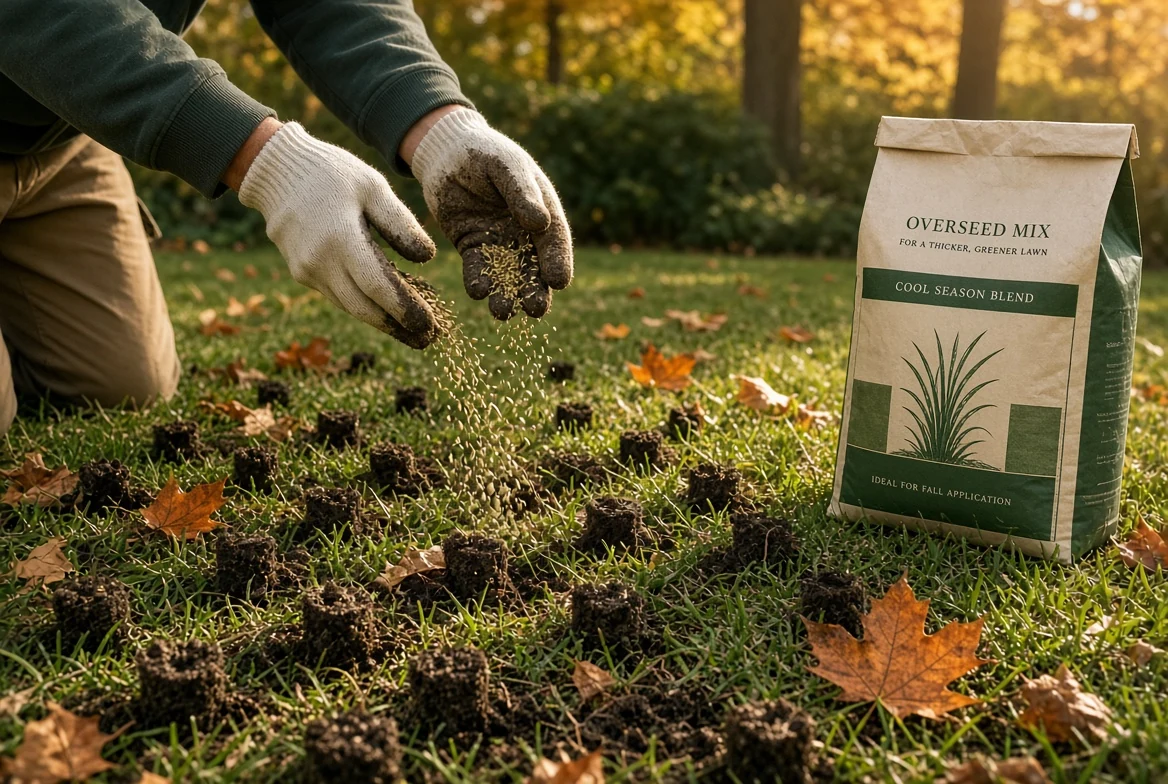
Mechanical core aerators utilize hollow spoons that penetrate 2.5 to 3.5 inches into the earth, extracting soil plugs approximately 0.75 inches in diameter. These plugs are deposited onto the turf surface, where natural microbial activity and precipitation break them down within 10 to 14 days.
| Aeration Parameter | Recommended Specification | Common Homeowner Error |
|---|---|---|
| Hole Density | 20 to 40 holes per square foot | Single fast pass leaving fewer than 10 holes/sq ft |
| Core Penetration Depth | 2.5 to 3.5 inches into moist soil | Aerating bone-dry soil, penetrating under 1 inch |
| Soil Moisture Timing | 1 inch of rain/water 24 hrs prior | Operating on waterlogged, muddy mud-slurry turf |
| Soil Core Disposition | Leave plugs on surface to decompose | Raking up and discarding vital topsoil cores |
Phase 3: Overseeding Seed Selection & Seeding Rates
Pairing elite seed cultivars with open core-aeration holes achieves optimal seed-to-soil contact, the single most critical factor in seedling germination velocity.
Elite Cool-Season Seed Rates
- Turf-Type Tall Fescue (TTTF): Overseeding rate: 4 – 6 lbs per 1,000 sq ft. Features deep vertical taproots (extending 24 to 36 inches), exceptional heat tolerance, and brown patch resistance through endophyte enhancement.
- Kentucky Bluegrass (KBG): Overseeding rate: 2 – 3 lbs per 1,000 sq ft. Propagates via aggressive underground rhizomes that knit together, self-healing turf holes and thinning areas. Requires 14 to 21 days for initial emergence.
- Perennial Ryegrass (PRG): Overseeding rate: 6 – 8 lbs per 1,000 sq ft. Emerges in as few as 4 to 7 days, providing rapid nurse-crop erosion control and brilliant dark-green coloration.
Prior to distributing seed with a rotary broadcast spreader, scalp the existing lawn down to 2.0 inches. This permits sunlight to strike the soil plane and delays the growth of established turf, giving vulnerable baby grass seedlings an unhindered head start.
Phase 4: Starter Fertilization and Micro-Irrigation Regimen
Immediately following seed distribution, apply a dedicated starter fertilizer balanced with high phosphorus—such as a 12-24-8 or 18-24-6 analysis. Phosphorus (the middle number) is bio-chemically vital for adenosine triphosphate (ATP) cellular energy and vigorous embryonic root branching.
Watering Protocol (Days 1 through 21)
Seedlings possess microscopic root structures incapable of reaching deep subsoil moisture. If the seed coat swells, begins germination, and dries out for even 4 hours in direct midday sun, the seedling perishes.
- Days 1 – 14 (Germination Window): Water 3 to 4 times daily in short 5-to-7-minute bursts (6:00 AM, 11:00 AM, 2:00 PM, 5:00 PM). Maintain consistent dampness without pooling water.
- Days 15 – 28 (Root Extension): Reduce watering frequency to once daily in early morning, extending duration to 15 minutes to encourage downward root exploration.
- Days 29+ (Establishment): Transition to standard deep-and-infrequent watering: 1 inch total water per week applied over 2 separate irrigation sessions.
Phase 5: The Crucial First Mow & Robot Mower Height Configuration
Homeowners often fear mowing tender new seedlings, allowing grass to grow 5 or 6 inches tall. This is a severe biological mistake: overly tall grass flops over, blocks sunlight, creates stagnant moisture pockets, and invites fungal damping-off.
Execute the first mowing pass once the new seedlings achieve 3.0 to 3.5 inches in height. Ensure rotary blades are factory-sharp to prevent uprooting delicate roots. When using automated systems such as the Anthbot Genie RTK or Segway Navimow, set the cutting deck to its maximum clearance (3.5 inches). Because lightweight robotic mowers exert significantly lower ground pressure per square inch than heavy 800-pound riding mowers, they can groom newly established turf without causing tire rutting or soil compaction.
Drawbacks, Limitations & Risks (Cons)
- Wireless sensor battery maintenance: Soil sensor pods and outdoor wireless controllers require battery replacement every 12 to 18 months to avoid data transmission dropouts.
- 2.4 GHz WiFi coverage requirement: Setup demands reliable 2.4 GHz WiFi signal reaching yard zones, which may necessitate an outdoor mesh WiFi node for larger acreage.
- Seasonal winterization mandatory: Outdoor valves and manifolds must be blown out with compressed air prior to freezing temperatures below 32°F (0°C) to prevent burst housings.
Frequently Asked Questions
Can I apply pre-emergent weed control at the same time as overseeding?
Standard pre-emergents (like Prodiamine or Pendimethalin) form a chemical barrier that stops all seeds from germinating, including your expensive lawn seed. You must wait 8 to 12 weeks after overseeding before applying standard pre-emergents, unless using special mesotrione-based starter herbicides specifically labeled for seeding.
Should I cover the new seed with wheat straw or peat moss?
A thin 1/8-inch dusting of screened sphagnum peat moss or compost is vastly superior to agricultural straw. Straw frequently introduces invasive pasture weed seeds (such as orchardgrass and wild onion) that cannot be selectively removed from turf.
How late into the fall can I safely plant cool-season grass seed?
Target seed distribution at least 45 days prior to your region’s average first hard killing frost (28°F). Seedlings need sufficient thermal degree-days to develop at least three mature tillers before winter dormancy.
Always disconnect main power sources—remove battery packs or unplug cords—before inspecting mower blades, clearing aeration tines, or handling sharp garden equipment. Keep hydroponic nutrient concentrates stored securely.
Practical guides curated by horticultural practitioners and yard care enthusiasts. Field-tested methods, verifiable steps, and zero automated fluff.