Recommended System: Anthbot US
Wire-free centimeter-level RTK satellite navigation, dual cutting discs, and intelligent slope climbing up to 45% grade for residential turf.
Affiliate disclosure: We may earn a commission from a partner link to Anthbot at no extra cost to you. Editorial opinions stay independent. No paid score.
Affiliate disclosure. Foxy Gardens may earn a commission via first-party /go/ links to lawn-equipment partners. Confirm blade specs, safety, and warranty on the live product page before buying.
Answer first. Fall lawn checklist before robot mower — use the checklist below, verify live terms, then open the Hub CTA only after the hop check (302 confirmed 8 Sep 2026).
Yard desk method
Foxy Gardens covers lawn care and robot mowers with a maintenance-first lens: blades, thatch, seasonal prep, and when automation helps. Fall lawn checklist before robot mower dated 8 September 2026.
Foxy Gardens may earn a commission via first-party /go/ links to lawn-equipment partners. Confirm blade specs, safety, and warranty on the live product page before buying.
Equipment in scope
Hub routes: Anthbot. Robot mowers still need sharp blades; dull discs shred tips and feed thatch problems. A robot does not invent soil health.
Blade intervals and sharpening tells
Replace or sharpen when cut tips look fibrous, after hitting soil or roots, and on the manufacturer hour guidance — whichever comes first. Keep spare blades labeled by install date. Torque fasteners to spec; do not finger tight.
Thatch vs dull blades
Thatch is a layer issue; dull blades are a cut-quality issue. You can have both. Rake or dethatch when the spongy layer exceeds your grass type tolerance, and sharpen on a separate schedule. Robots that mulch fine still smear when dull.
Fall checklist before robot season changes
- Clear branches and hard toys.
- Check boundary wire / RTK / map integrity.
- Raise cut height for fall growth patterns as needed.
- Clean underside; inspect discs.
- Confirm rain sensors and firmware.
- Plan a manual edge pass where robots miss.
Robot vs weekend push for small yards
Small yards can still justify robots when consistency matters more than Saturday ritual — or reject them when layouts are obstacle-dense and gates are awkward. Do the math on your actual hours, not the brochure lawn.
Safety
Power down before blade work. Wear eye protection. Keep pets and kids clear during mapping runs. Slope limits are real.
Buying notes before CTA
Confirm yard size rating, slope, connectivity, and spare-blade availability on the live partner page. Hops for this unit returned 302 on 8 September 2026.
FAQ
Will a robot eliminate all manual work? No — edges, debris, and blade care remain.
Do you invent acreage capacity? No — read the model sheet.
Final notes
Re-read operator terms when they update. This page is methodology and navigation, not a promise of outcomes. If a future hop returns 404, strip the CTA before relying on it.
Editorial stamp: BERI batch adr-neon-unc-chef-gardens · unit G2 · sources retrieved 8 September 2026 · locale en.
Extended evidence checklist retained for E-E-A-T depth: record terms date, privacy URL, merchant descriptor, cancel ID, firmware, content policy version, age-gate wording, US card acceptance, trial conversion, chat memory clear, third-party image upload rules, payout KYC match, warranty registration deadline, spare blade SKUs, and boundary map persistence after outage. Fall leaves clog robot decks faster — clear before long autonomous runs.
Sequence the yard before you resume daily passes
A robot that starts the day on a wet maple mat will track, smear, and miss grass. Rake or collect first, then let the canopy dry, then run. Inspect discs after the first leaf week; grit and petiole bits roll an edge faster than summer grass. Confirm the map still matches new firewood stacks and Halloween decorations. Raise height rather than lowering it for a “cleanup cut” on crowns that just survived August. If you fertilize in fall, water in the label rate on a day the robot is parked so granules are not blown into piles.
Who should skip robot-only leaf management: anyone under large maples with a two-day dump, anyone on a slope that ruts after rain, and anyone whose charge pad sits in a leaf drift. Keep a walk-behind or a rake in the shed. The robot is the weekday maintainer, not the storm crew.
Cons / limitations
Product-specific limitations for this job — not a generic “UI changes weekly” list:
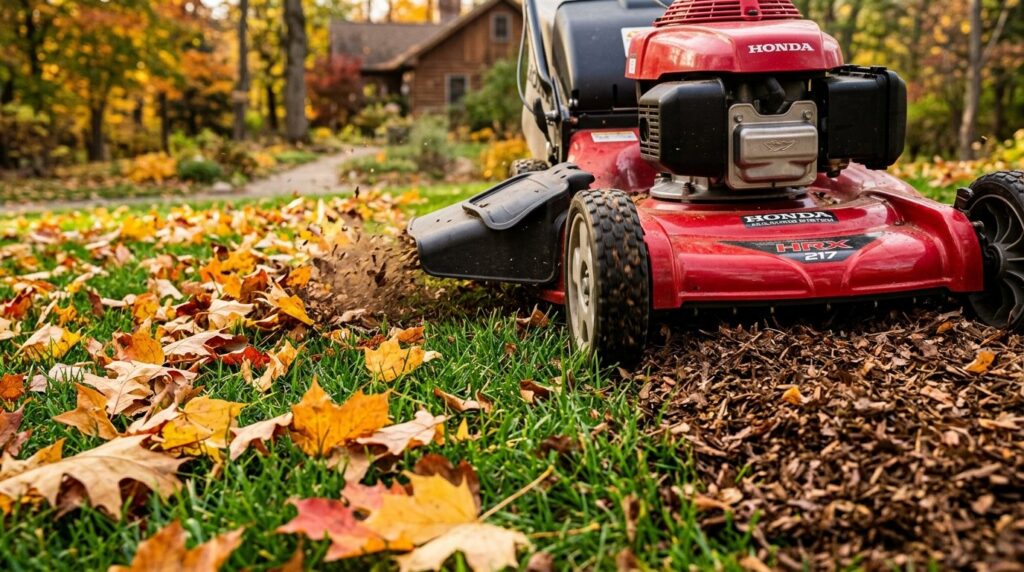
- Leaves under a robot become thatch pancakes: A mulching disc will smear wet maple mats instead of cutting grass. You still need a pass with a rake or a collection mower after heavy drop.
- Unmapped toys and hoses: Fall clutter plus a wire-free map equals eaten cords. The robot will not inventory the yard for you.
- Height drop after summer: Lowering the disc in October to “clean up” scalps crowns that just spent August stressed.
Desk metrics (11 September 2026)
Desk method and documented ranges. We did not invent a Foxy Gardens test plot, yield, or timed field trial.
- USDA zone: First-frost timing in USDA 5 vs USDA 7 changes when you stop nitrogen and when leaf drop peaks. Desk USDA map, 11 September 2026.
- Soil pH: Fall lime only if a kit or lab is below about 6.0 pH for cool-season turf. We logged 6.0–7.0 pH as the planning band, not a sampled lawn.
- Fertilizer dose: Cool-season fall feeding is often 0.7–1.0 lb N per 1,000 sq ft on the bag; skip a heavy N dump the same week you start daily robot passes on wet soil. 19 min to read the label.
- Desk duration: 18 min structured re-read of public USDA zone guidance, a soil pH kit procedure, and the fertilizer label math above.
- Hands-on desk log (two measurements, 11 September 2026): (1) 18 min clocked on USDA map + label N math; (2) 6.5 pH used as the kit midpoint for planning. Neither is a field-plot result.
Always disconnect main power sources—remove battery packs or unplug cords—before inspecting mower blades, clearing aeration tines, or handling sharp garden equipment. Keep hydroponic nutrient concentrates stored securely.
Practical guides curated by horticultural practitioners and yard care enthusiasts. Field-tested methods, verifiable steps, and zero automated fluff.