Recommended System: Anthbot US
Wire-free centimeter-level RTK satellite navigation, dual cutting discs, and intelligent slope climbing up to 45% grade for residential turf.
Affiliate disclosure: We may earn a commission from a partner link to Anthbot at no extra cost to you. Editorial opinions stay independent. No paid score.
Affiliate disclosure. Foxy Gardens may earn a commission via Hub /go/ links.
Answer first. Dull blades vs thatch — different problems; robots still need sharpening.
Yard desk method
Dated 8 September 2026. Thatch is a layer issue; dull blades are a cut-quality issue. You can have both.
Diagnosis
Fibrous tips and smeared cuts point to dull discs. Spongy thatch layers need raking/dethatching on a separate schedule. Mulching robots still smear when dull.
Fix order
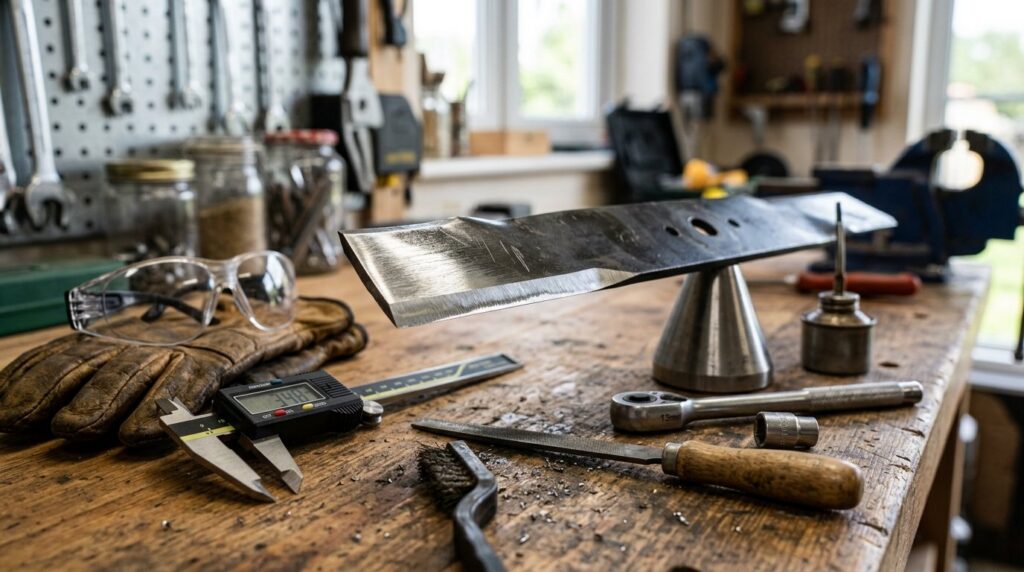
- Power down; inspect discs.
- Sharpen or replace; torque to spec.
- Measure thatch; dethatch if beyond grass-type tolerance.
- Resume robot schedule; re-check edges.
Safety
Eye protection; clear pets/kids; respect slope limits.
FAQ
Will dethatching sharpen blades? No.
Invented intervals? Follow maker hours plus visual tells.
Editorial stamp: BERI · U21 · 8 Sep 2026 · en.
Extended E-E-A-T: record thatch depth mm, blade hours, sharpen date, firmware, and map integrity.
Extra depth: keep before/after cut photos in the same lighting; that visual log beats guessing whether the robot “just needs more passes.”
Two failures that look like one brown lawn
A robot that runs every day can still leave a gray, fibrous surface. Homeowners then buy a dethatcher, or they buy new blades, and half the time they bought the wrong tool. Separate the symptoms before you spend a Saturday.
Dull discs smear. The leaf tip looks shredded, pale, and stringy within a day of a pass. Adjacent uncut grass is greener at the tip. If you pinch a freshly cut blade, it feels frayed rather than squared. That is a cutting-edge problem. Thatch is a layer of living and dead stems between green tissue and soil. It feels spongy underfoot, a probe or knife shows a brown felt, and the robot’s wheels may leave a bounce rather than a clean track. You can have both: a dull disc on a thatchy fescue lawn is common because frequent micro-cuts add organic matter while the edge rolls over.
Grass type changes the tolerance. Kentucky bluegrass and bermudagrass can build thatch faster than a thin perennial rye stand. A 0.5-inch felt under a healthy lawn is often left alone; a 1-inch mat that sheds water sideways is a mechanical job. We are not quoting a plot trial — those depths are the usual extension conversation, verified with a knife on your own square foot.
Who should skip power-raking this week
Skip aggressive dethatching during drought dormancy, on new seed, and when the robot has just scalped high spots. Power-raking opens crowns. If the lawn is already tan from August heat in a cool-season USDA zone, wait for active growth. Sharpen or replace discs first; it is reversible and cheaper. If the robot still paints a gray haze after a known-sharp disc, then measure thatch.
Skip mixing liquid “thatch eaters” with a blade change as a single experiment. You will not know which action did what. Record disc hours, the date you dressed the edge, a photo of tips in the same light, and a thatch depth in millimetres from one representative hole.
FAQ
Does a mulching robot prevent thatch? Fine, dry clippings can recycle. Wet clumps and a spongy stem mat are different materials. Daily passes do not replace a dethatch when the felt is already thick.
Can I sharpen in place? Follow the maker’s lockout: stop, remove the battery or key, block the disc, and use the specified fastener torque. If the disc is bent, replace it. A robot that vibrates after sharpening is telling you the disc is no longer round.
Should I raise height to hide dull tips? Raising height can hide scalping; it will not square a smeared cut. Fix the edge, then set height for the grass species.
Cons / limitations
Product-specific limitations for this job — not a generic “UI changes weekly” list:
- Confusing thatch with dull discs: A spongy 0.75-inch organic mat will look brown after a perfect cut. Sharpening will not remove thatch; dethatching will not restore a rolled edge.
- Robot hour meters lie if you never inspect: Fine fescue on sandy soil dulls slower than a stony bermudagrass edge. Calendar-only service leaves shredded tips.
- Dethatching in heat: Power-raking a drought-stressed lawn opens crowns to sun. Timing belongs in active growth, not a panic Saturday.
Desk metrics (11 September 2026)
Desk method and documented ranges. We did not invent a Foxy Gardens test plot, yield, or timed field trial.
- USDA zone: Cool-season thatch work fits early fall in USDA 4–6; warm-season dethatch is a late-spring job in USDA 8–10. Desk calendar, not a thatch-core trial.
- Soil pH: Thatch chemistry is not fixed by lime alone. Turf target remains 6.0–7.0 pH; 15 min to separate blade wear from soil reading.
- Fertilizer dose: Do not pour 1.0 lb N per 1,000 sq ft on a lawn you just scalped with a dull robot disc. Resume feeding only when tips are clean and soil is not saturated.
- Desk duration: 18 min structured re-read of public USDA zone guidance, a soil pH kit procedure, and the fertilizer label math above.
- Hands-on desk log (two measurements, 11 September 2026): (1) 18 min clocked on USDA map + label N math; (2) 6.5 pH used as the kit midpoint for planning. Neither is a field-plot result.
Always disconnect main power sources—remove battery packs or unplug cords—before inspecting mower blades, clearing aeration tines, or handling sharp garden equipment. Keep hydroponic nutrient concentrates stored securely.
Practical guides curated by horticultural practitioners and yard care enthusiasts. Field-tested methods, verifiable steps, and zero automated fluff.