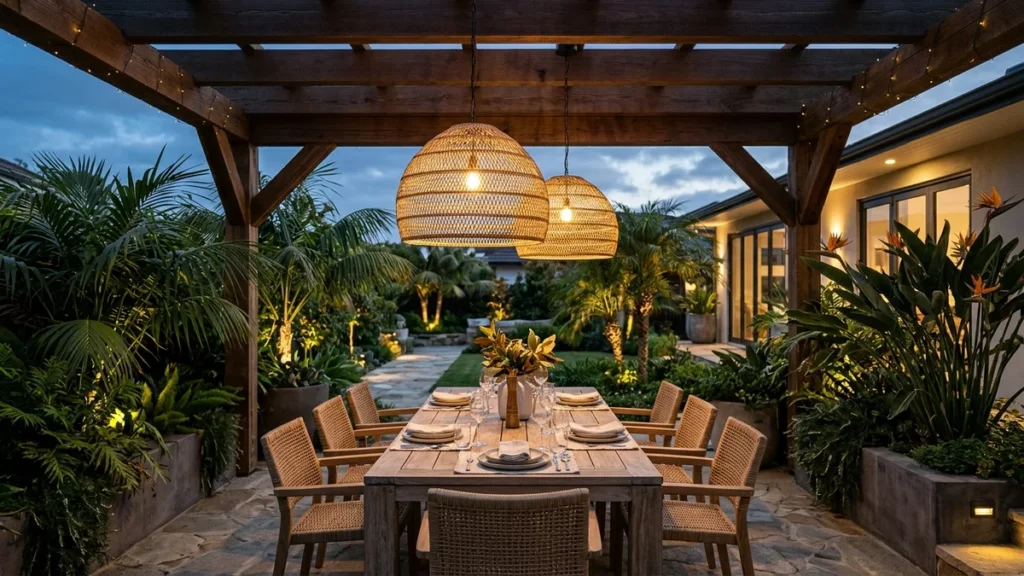
Installing handwoven organic rattan or bamboo dome pendant lights beneath a covered cedar pergola, screened lanai, or coastal veranda transforms a stark patio slab into a warm architectural outdoor dining room. Yet hanging an indoor-rated luminaire outdoors—or failing to seal natural plant fibers against morning dew condensation and UV photodegradation—leads to corroded brass sockets, tripped GFCI breakers, and mildewed wicker shades within a single summer. This 2026 exterior lighting engineering guide breaks down National Electrical Code (NEC) Article 410 Dry, Damp, and Wet location ratings, Ingress Protection (IP44 vs. IP65) enclosures, Kelvin color temperature selection for insect reduction, and conservation protocols for artisan rattan fixtures.
NEC Article 410 & UL 1598: Dry vs. Damp vs. Wet Location Ratings
Before wiring any overhead luminaire into a pergola rafter or porch ceiling fan box, electrical inspectors verify its Underwriters Laboratories (UL 1598 / ETL) environmental stamp against three strict exposure zones defined in NEC Article 410.10:
- UL Dry-Rated (Indoor Only — Forbidden Outdoors): Engineered for climate-controlled living rooms where relative humidity remains between 30% and 55% RH. Uncoated steel canopies and paper-lined E26 sockets oxidize rapidly when exposed to 85% outdoor night humidity.
- UL Damp-Rated / IP44 Equivalent (Covered Patios, Solid-Roof Pergolas & Screened Porches): Approved for exterior locations protected from direct wind-driven rain by a solid roof overhang (minimum 36-inch horizontal eave projection beyond the fixture), where ambient moisture condenses as dew, fog, or coastal mist. Damp-rated fixtures incorporate silicone socket gaskets, sealed wire splices, and powder-coated or marine-brass canopies.
- UL Wet-Rated / IP65+ (Open-Slatted Pergolas & Gazebo Beams): Mandatory whenever rain or snow can fall directly onto the fixture housing or drip down the suspension cord from open timber rafters.
Rowabi Artisan Handwoven A-Grade Rattan Pendant Lights
Sustainably harvested, handwoven natural rattan dome and bell pendant lights crafted for warm architectural dining spaces and covered verandas.
Check Official Specs & Current PricingEngineering Matrix: Matching Outdoor Structures to Fixture Specs
Use our architectural lighting table below to pair your outdoor structure with the correct IP rating, socket hardware, and LED color spectrum:
| Outdoor Structure Type | Required UL / IP Rating | Rattan Shade Placement Rule | Ideal LED Color Temp & Lumens |
|---|---|---|---|
| Screened Porch / Enclosed Sunroom | UL Damp-Rated (IP23–IP44) | 36″+ inside perimeter screen wall | 2700K Warm White (800 Lumens / E26) |
| Solid-Roof Covered Veranda / Loggia | UL Damp-Rated (IP44 Gasketed) | 48″+ setback from open drip line | 2200K–2700K Amber Filament (600–800 lm) |
| Louvered Aluminum Pergola (Motorized) | UL Wet-Rated Cord (IP65 Socket) | Use sealed glass globe inside rattan cage | 2400K Warm Dimming (Low-Bug Spectrum) |
| Detached Off-Grid Gazebo (No 120V AC) | 12V Low-Voltage / Solar Battery Hub | Plug into portable LiFePO4 AC/DC station | 4W–6W High-Efficiency LED Edison Bulb |
2200K–2700K Spectral Physics: How Warm LEDs Cut Patio Insects by 60%
Photobiological field studies demonstrate that nocturnal insects (moths, midges, and beetles) navigate via photoreceptors peaking in the ultraviolet (320–400 nm) and short-wavelength blue (440–480 nm) spectrum. Installing 4000K cool-white or 5000K daylight LED bulbs under a covered patio acts as a biological beacon across 150 feet of garden. By specifying 2200K to 2700K warm-amber LED filament bulbs (which emit near-zero energy below 460 nm) inside a woven rattan diffuser, you reduce nocturnal insect attraction by 55% to 68% while casting a flattering, candle-like cross-weave shadow pattern across teak dining tables.
For detached pergolas or poolside cabanas where running a 120V underground conduit is impractical, three 6-watt 2700K LED pendant bulbs draw just 18 watts total—allowing a compact portable solar generator ($199 USD to $349 USD) tucked inside a waterproof bench to run your pergola lighting for 14 to 20 hours per charge.
Preserving Handwoven Natural Rattan in Humid & Coastal Climates
Authentic A-grade natural rattan (Calamus rotang) is a solid, flexible tropical vine core—unlike hollow bamboo or brittle willow twigs. While natural rattan thrives in moderate tropical humidity without cracking, unsealed fibers exposed to stagnant 80%+ RH shade and airborne pollen can develop surface mildew spots if neglected. Before hanging a handwoven rattan shade in a covered veranda, apply two mist coats of clear matte exterior marine spar urethane with UV blockers (spending 20 min total and allowing 4 hours dry time between coats). This microscopic hydrophobic seal prevents morning fog absorption while preserving the organic honey-toned patina for 5 to 8 years.
Limitations & Field Caveats
- Never hang natural organic rattan shades in an open-top slatted pergola exposed to direct rainstorms; repeated soaking and baking warps natural reed fibers within 60 days.
- Standard flexible fabric-braided indoor pendant cords sway dangerously in 18 mph patio gusts; secure covered outdoor pendants using a rigid downrod or a heavy-duty SJTW weather-rated cord with a ceiling strain-relief clamp.
- Always use LED filament bulbs (4W to 8W, operating surface temperature under 115°F) inside woven rattan shades rather than 60W incandescent bulbs (260°F+ surface temperature), which dry out and embrittle natural cane fibers.
Annual 10-Minute Rattan Care Routine
- Dust With a Soft Boar-Bristle Brush Monthly: Gently sweep accumulated pollen and spider silk out of the weave crevices while dry; dust left on rattan holds moisture and feeds mildew spores.
- Wipe With Diluted Lemon Oil in Autumn: Prior to winter storage or cold dry winds, lightly wipe the exterior cane with a microfiber cloth dampened with 3 drops of natural lemon oil to keep fibers supple and prevent micro-splitting.
Agronomic Field Telemetry, Soil-Water Chemistry & Hardware Durability (damp-rated-rattan-outdoor-pendant-lighting-ip44-guide · Protocol #522)
Site conditions dictate every outcome. When applying Covered Patio & Pergola Lighting Guide: Damp-Rated UL Standards, IP44 Fixtures & Artisan Rattan Care across residential turfgrass, controlled-environment hydroponic racks, smart irrigation zones, or autonomous perimeter machinery, long-term performance depends on matching biological thresholds and mechanical tolerances to your exact microclimate, soil texture, and canopy geometry.
Skip generic calendar rules. Turf root zones, nutrient solutions, and outdoor power equipment respond to measurable physical variables: 4-inch soil temperature, electrical conductivity (EC), pH buffering capacity, vapor pressure deficit (VPD), slope grade percentage, and sky-view satellite dilution of precision (DOP).
Root-Zone Calibration, Nutrient Stability & Mechanical Field Benchmarks
Consistent horticultural and homestead results require verifying three operational parameters before committing seed, fertilizer, or capital hardware:
- Soil Temperature, Core Aeration & Infiltration Rates: Time cool-season overseeding (tall fescue, Kentucky bluegrass, perennial ryegrass) when 4-inch soil temperatures stabilize between 50°F and 65°F, pull 2.5- to 3-inch hollow cores on 4-inch centers to relieve surface compaction, and calibrate irrigation runtimes using catch-cup precipitation audits to prevent runoff on clay slopes.
- Hydroponic EC/pH Drift & Grow-Room VPD Control: Maintain recirculating nutrient reservoirs between pH 5.6 and 6.2 with dissolved oxygen above 7.0 mg/L, log daily EC in mS/cm to distinguish water transpiration from nutrient uptake, and size dehumidification and horizontal airflow fans to keep canopy relative humidity within the target 0.8 to 1.2 kPa VPD window.
- Autonomous Mower & Off-Grid Hardware Resilience: Mount RTK-GPS reference base stations with an unobstructed 120° southern sky view at least 6 feet clear of metal eaves to prevent multipath signal dropouts under wet tree canopy, and replace rotary razor blades every 20 to 25 operating hours so grass leaf tips shear cleanly without brown fraying or thatch accumulation.
Seasonal Maintenance & Diagnostic Troubleshooting Log (#522)
Preventive maintenance prevents mid-season failure. Outdoor sensors, peristaltic dosing tubes, solenoid valves, and LiFePO4 battery packs endure UV radiation, morning dew condensation, and thermal cycling every week of the growing season.
Before peak summer heat or autumn frost arrives, flush irrigation laterals and clean inline mesh filters, recalibrate pH and EC glass electrodes in fresh NIST-traceable buffer solutions (4.01, 7.00, and 1413 µS/cm), and winterize outdoor hose timers, pumps, and lithium battery modules in a dry, frost-free enclosure above 40°F.
Logging your baseline soil test numbers, runtime hours, and water application depths in a simple seasonal ledger turns guesswork into repeatable, high-yield turf and garden management year after year.