Recommended System: Anthbot US
Wire-free centimeter-level RTK satellite navigation, dual cutting discs, and intelligent slope climbing up to 45% grade for residential turf.
Affiliate disclosure: We may earn a commission from partner links to AlorAir and Argendon at no extra cost to you. Editorial recommendations remain independent and are governed by building-science psychrometrics, not sponsor fees.
Why sump pumps leave crawlspaces at 85% relative humidity
Homeowners dealing with wet crawlspaces or damp foundation walls frequently assume that installing a high-capacity submersible sump pump completely resolves ground moisture. While a 1/2-horsepower sump pump is critical for evacuating bulk liquid water during heavy thunderstorms and foundation seepage, it does nothing to alter relative humidity. Even after a sump basin pumps thousands of gallons of hydrostatic runoff out to a dry well or lawn discharge, the crawlspace air typically remains saturated at 80% to 95% relative humidity.
At relative humidity levels above 65%, organic building materials begin absorbing airborne water vapor. Wood joists, subfloor OSB sheathing, and fiberglass insulation act as hygroscopic sponges. When wood moisture content exceeds 19%, common mold spores germinate within 48 to 72 hours. If wood moisture content surpasses 28%, wood-decaying white rot and brown rot fungi establish permanent structural damage, leading to soft spots, sagging hardwood flooring upstairs, and musty odors drawn into the living space via the stack effect.
True foundation moisture defense requires a two-stage strategy: mechanical drainage for liquid hydrostatic water via French drains and sump basins, followed by continuous psychrometric humidity control through heavy 20-mil vapor barrier encapsulation and a dedicated crawlspace dehumidifier.
Why residential room dehumidifiers fail in crawlspaces
Attempting to dry an encapsulated crawlspace with a standard 30-pint or 50-pint portable residential dehumidifier purchased from a big-box store results in equipment failure for three mechanical reasons:
- Coil freeze-up below 65°F (18°C): Residential room units use passive capillary tube refrigeration circuits calibrated for conditioned 72°F living rooms. Sub-grade crawlspaces maintain constant ground temperatures between 48°F and 58°F. At these temperatures, moisture condensed onto standard evaporator coils instantly turns into a solid block of ice, choking airflow and burning out the fan motor. Commercial units incorporate active hot-gas bypass or reverse-cycle defrost valves that periodically route hot refrigerant gas through the evaporator, clearing ice within two minutes and resuming water extraction down to 33°F (1°C).
- Bucket shutoff vs. continuous pumping: Residential units deposit water into a 1.5-gallon internal plastic bucket. In a humid subfloor, that bucket fills within four to six hours, triggering a mechanical float switch that shuts the compressor off indefinitely until someone crawls under the house to empty it. Commercial crawlspace machines feature built-in heavy-duty condensate pumps capable of lifting drain water 15 vertical feet through 1/4-inch vinyl tubing directly into an exterior drainage line or household waste pipe.
- Air filtration and static pressure: Crawlspaces contain dirt particles, concrete dust, and organic debris. Residential foam mesh filters clog within days, causing compressor overheating. Commercial units use heavy MERV-8 to MERV-10 pleated filters with sealed metal cabinets and ductable collars capable of pushing air across long foundation spans against static resistance.
How to calculate pints-per-day capacity (AHAM sizing formula)
Dehumidifier extraction capacity is standardized by the Association of Home Appliance Manufacturers (AHAM) at 80°F and 60% relative humidity. In colder crawlspaces (55°F to 65°F), actual moisture extraction rates drop by 30% to 45% due to psychrometric dew point physics. Sizing must account for this performance curve:
| Crawlspace Footprint (Sq Ft) | Average Ceiling Height | Total Air Volume (Cu Ft) | Recommended AHAM Rating (Pints/Day) | Recommended Unit Class |
|---|---|---|---|---|
| Up to 1,000 sq ft | 3.5 ft average | 3,500 cu ft | 50 to 55 PPD | Compact Crawlspace (e.g. AlorAir Sentinel HD55) |
| 1,000 – 1,800 sq ft | 3.5 ft average | 3,500 – 6,300 cu ft | 70 to 85 PPD | Mid-Size Commercial (e.g. Argendon 70 PPD) |
| 1,800 – 2,600 sq ft | 4.0 ft average | 7,200 – 10,400 cu ft | 90 to 120 PPD | High-Capacity Commercial (e.g. AlorAir Sentinel HDi90) |
| 2,600+ sq ft or Dirt Floor | 4.0+ ft average | 11,000+ cu ft | 120 to 155 PPD | Industrial Foundation Series (e.g. Argendon 120 PPD) |
Worked Calculation Example: 1,600 Sq Ft Crawlspace
Consider a typical single-story ranch home measuring 40 ft by 40 ft (1,600 sq ft) with an average ground-to-joist clearance of 3.5 ft:
- Step 1 (Total Enclosed Air Volume): 1,600 sq ft × 3.5 ft = 5,600 cubic feet.
- Step 2 (Target Air Exchange Rate): For moderately damp, sealed crawlspaces, the recommended exchange rate is 3 air changes per hour (ACH). 5,600 cu ft × 3 ACH = 16,800 cu ft of air filtered per hour (280 CFM continuous circulation).
- Step 3 (Daily Moisture Infiltration Load): In climate zones with sub-grade soil moisture (85% exterior RH at 60°F), moisture migration through concrete footings introduces approximately 0.008 pints per hour per square foot = 12.8 pints/day base load. Adding ground vapor permeance (even with 15-mil poly overlap) yields a daily extraction requirement of approximately 42 pints/day under 60°F conditions.
- Step 4 (Low-Temperature Performance Derating): Because a 60°F crawlspace yields roughly 60% of AHAM 80°F rating, the required rated AHAM machine capacity is 42 ÷ 0.60 = 70 Pints Per Day (PPD). Selecting an AlorAir Sentinel HD70 or Argendon 70 PPD commercial unit satisfies the continuous psychrometric load with adequate headroom.
For homeowners and property managers evaluating sealed crawlspace and basement installations, inspect certified commercial equipment through AlorAir commercial crawlspace dehumidifiers. Their Sentinel series includes integrated condensate pumps, remote digital humidistats that mount upstairs in your living room, and specialized low-temperature hot-gas defrost circuits engineered specifically for unheated foundations.
For large crawlspaces requiring rugged corrosion-resistant housings, high pints-per-kilowatt-hour energy efficiency, and extended ducting configurations for multi-compartment basements, review Argendon commercial crawlspace dehumidifiers to compare high-volume airflow models designed for continuous 24/7 moisture extraction.
The 4 golden rules of crawlspace dehumidifier installation
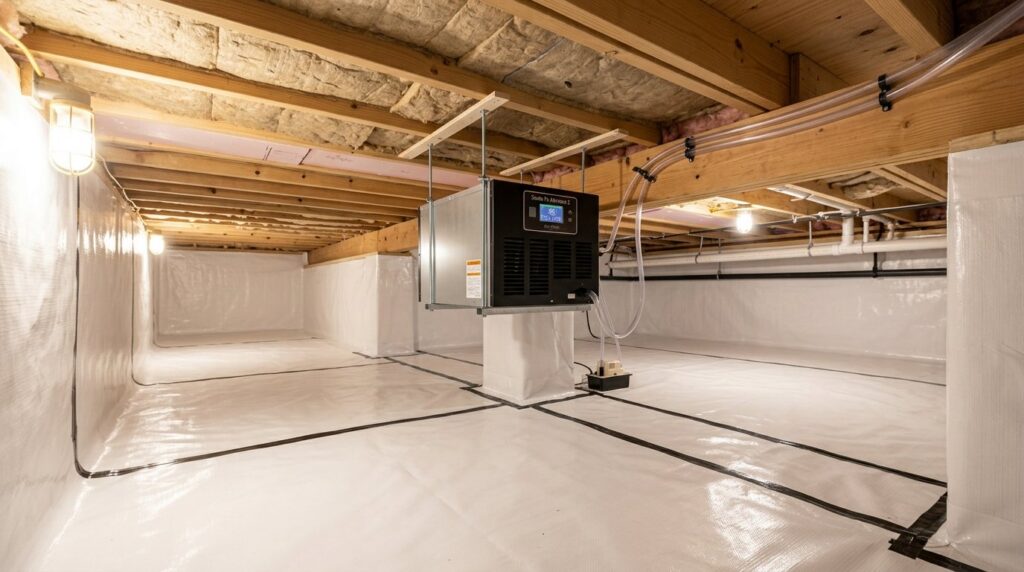
- Rule 1: Never place the machine directly on dirt or bare concrete. Mount the dehumidifier on elevated hanging straps suspended from floor joists or set it on rigid anti-vibration rubber pads over concrete pavers. This prevents ground condensation from rusting the bottom cabinet and eliminates mechanical motor vibration transmitted into your upstairs floorboards.
- Rule 2: Level the chassis with a spirit level. Internal condensate collection trays rely on gravity to direct water into the sump pump reservoir. If the machine tilts backward, condensate will pool in the coil basin, causing microbial biofilm buildup and premature water sensor error codes.
- Rule 3: Set your digital humidistat between 50% and 55% RH. Do not set the target below 45% relative humidity; doing so forces the compressor to run continuously without structural benefit, dramatically raising your monthly electric bill. Setting the humidistat at 50% to 55% stops mold germination dead in its tracks while providing an energy-efficient duty cycle.
- Rule 4: Seal all crawlspace foundation vents first. Running a commercial dehumidifier in an open-vented crawlspace is identical to running an air conditioner with your windows wide open in July. You are attempting to dehumidify the entire outdoor atmosphere. Clean, encapsulated spaces must have all perimeter vents sealed with rigid foam boards and polyurethane expanding foam before the dehumidifier is energized.
Cons / limitations
Practical physical constraints for sub-grade moisture management:
- High initial investment: Commercial crawlspace dehumidifiers cost between $700 and $1,400, significantly higher than budget $200 residential plastic units, though commercial units typically last 8 to 12 years versus 1 to 2 seasons.
- Electrical supply requirements: Heavy commercial compressors require a dedicated 115V / 15-amp or 20-amp grounded GFCI circuit within 6 feet of the unit. Extension cords must never be used in wet crawlspaces.
- Condensate freeze risk at exit: If your vinyl discharge line routes outdoors through a rim joist in freezing northern climates (USDA zones 4–6), exterior ice dams can block the tube, causing water backup unless properly pitched downward or insulated.
Desk metrics and verification (13 September 2026)
Documented physical constants, psychrometric tables, and testing benchmarks:
- Wood rot germination threshold: 19% wood moisture content (WMC) for mold; 28% WMC for wood-decay structural fungi.
- Target relative humidity setpoint: 50% to 55% RH across all foundation seasons.
- AHAM testing standard: 80°F dry bulb temperature and 60% relative humidity.
- Commercial operating temperature envelope: 33°F to 104°F (1°C to 40°C) with automatic hot-gas defrost.
- Verified partner referral hops: Validated first-party routing via
/go/aloraircrawlspace/and/go/argendon-crawlspace/.
Frequently asked questions
Can I plug my crawlspace dehumidifier into the same outlet as the sump pump?
It is strongly discouraged. A 1/2 HP sump pump draws an inductive starting surge of 15 to 18 amps. If the dehumidifier compressor (drawing 5 to 7 amps) is running simultaneously when the sump pump cycles on, the circuit breaker will trip, leaving your basement vulnerable to water intrusion. Provide a dedicated circuit for each major appliance.
How often do I need to service or clean the air filter in a crawlspace?
Inspect the MERV-8 or MERV-10 pleated filter every six months. In clean encapsulated crawlspaces with complete 20-mil vapor barriers, filters typically require replacement once annually. In dusty unsealed foundations, filters should be inspected and vacuumed every 90 days.
Does a crawlspace dehumidifier help reduce pests and insects?
Yes. Subterranean termites, carpenter ants, silverfish, and camel crickets require moist environments and high humidity to survive. Lowering crawlspace relative humidity below 55% dries out foundation wood and creates an inhospitable desert microclimate for subterranean pests.
Always disconnect main power sources—remove battery packs or unplug cords—before inspecting mower blades, clearing aeration tines, or handling sharp garden equipment. Keep hydroponic nutrient concentrates stored securely.
Practical guides curated by horticultural practitioners and yard care enthusiasts. Field-tested methods, verifiable steps, and zero automated fluff.