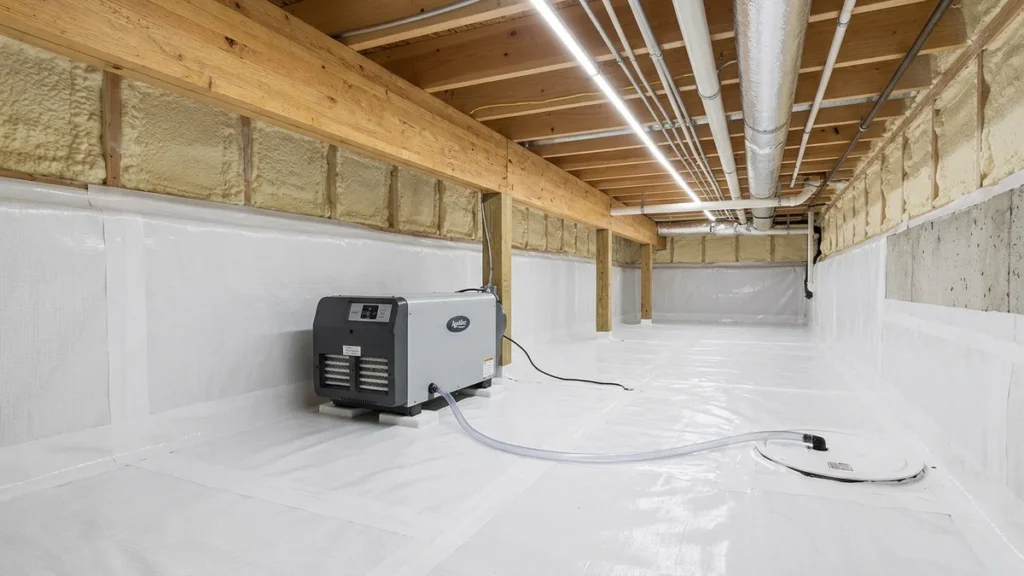
For decades, residential building codes operated on a deeply flawed assumption: that cutting cast-iron vents into foundation walls would allow outdoor cross-breezes to dry out a dirt-floor crawl space. Building science field audits across the humid eastern, southern, and coastal United States have proven the exact opposite. When warm summer air at 86°F and 70% relative humidity (dew point 75°F) enters a sub-grade crawl space cooled by 60°F earth, the relative humidity of that air spikes above 92% RH within minutes, condensing liquid water droplets directly onto cold floor joists, sill plates, and metal HVAC trunk lines. Eliminating structural wood rot, cupping hardwood floors, and sub-floor fungal growth requires a two-stage engineering intervention: full 20-mil vapor encapsulation paired with a properly sized commercial dehumidifier locked to a 50% RH setpoint.
Why Wood-Decay Fungi Thrive Above 60% Relative Humidity
Structural framing lumber—primarily Douglas fir, hem-fir, and southern yellow pine—is a hygroscopic material that equilibrates its internal Wood Moisture Equivalent (WME) with surrounding atmospheric relative humidity. At 50% ambient RH and 65°F, wood framing stabilizes at a safe 9.2% WME. Once ambient crawl space relative humidity stays above 70% RH for 14 days or longer, wood moisture climbs past 16% WME, allowing surface mold species (Aspergillus and Penicillium) to germinate. Above 20% WME (corresponding to 82%+ RH or direct condensation), brown-rot and white-rot basidiomycete fungi secrete cellulase enzymes that digest structural wood fibers, reducing floor joist load-bearing capacity by 30% to 50% within 24 months.
- The Stack Effect Indoor Air Penalty: Because warm air rises through a house like a chimney (the stack effect), 40% to 50% of the air you breathe on the first floor of a home originates directly from the crawl space via sub-floor plumbing penetrations and duct leaks.
- Energy Star HVAC Savings: Sealing foundation vents and maintaining crawl space humidity at 50% RH reduces upstairs air-conditioning latent cooling loads by 15% to 20%, saving homeowners $240 USD to $420 USD annually.
Argendon Commercial Crawl Space Dehumidifiers (35–190 PPD)
Horizontal low-clearance crawl space dehumidifiers with rare-earth alloy coils, MERV-10 filtration, and built-in condensate lift pumps.
Check Official Specs & Current PricingThe 4-Layer Crawl Space Encapsulation Specification
Before calculating your dehumidifier Pints Per Day (PPD) rating, the building envelope must be isolated from ground capillary water and outdoor humid air infiltration:
- Drainage Matting & Perimeter French Drain: If the crawl space experiences bulk standing water after heavy storms, install a perforated 4-inch perimeter drain pipe pitched toward a sealed sump basin equipped with a 0.33 HP cast-iron sump pump and check valve.
- 12-Mil to 20-Mil String-Reinforced Polyethylene Liner: Cheap 6-mil construction plastic punctures easily under gravel and allows excessive water vapor permeance. Specify a virgin 12-mil or 20-mil cord-reinforced white polyethylene vapor retarder with an ASTM E96 water vapor permeance rating below 0.018 perms. Overlap all floor seams by 12 inches, seal with 4-inch double-sided butyl tape, and mechanically fasten the liner up foundation walls to within 3 inches of the sill plate (leaving a mandatory termite inspection gap).
- Foundation Vent Blocks & Closed-Cell Rim Joist Foam: Seal all exterior foundation louvers with 2-inch rigid XPS foam blocks and apply 2 inches of closed-cell polyurethane spray foam ($R-13$) across the perimeter rim joist header.
| Crawl Space Area (Sq Ft) | Headroom Height | 20-Mil Encapsulated (AHAM PPD) | 6-Mil Loose Plastic (AHAM PPD) | Recommended Airflow & Ducting |
|---|---|---|---|---|
| 900 sq ft | 3.0 – 4.0 ft | 35 – 50 PPD | 70 – 85 PPD | 150 CFM (Free-Standing) |
| 1,500 sq ft | 3.5 – 4.5 ft | 55 – 75 PPD | 105 – 130 PPD | 210 CFM (Central Placement) |
| 2,200 sq ft | 4.0 – 5.0 ft | 85 – 110 PPD | 145 – 180 PPD | 280 CFM + 8″ Supply Duct |
| 3,000+ sq ft | 4.0 – 5.5 ft | 120 – 155 PPD | 190+ PPD (Dual Units) | 360 CFM + Y-Branch Ducting |
Why AHAM 80°F/60% RH Ratings Matter More Than Saturation Claims
When comparing crawl space dehumidifiers priced between $550 USD and $1,100 USD, always verify the AHAM (80°F / 60% RH) extraction rating rather than the saturation (90°F / 90% RH) number. A commercial unit rated for 55 PPD at AHAM (and 120 PPD at saturation) removes nearly twice as much moisture at 62°F crawl space temperatures as a upright $220 USD retail department-store dehumidifier whose tiny capillary coil freezes solid whenever sub-grade temperatures drop below 65°F.
Limitations & Field Caveats
- Never run a crawl space vapor barrier flush up over the wooden sill plate; building codes require a 2-inch to 3-inch clear visual inspection band below the wood sill so pest inspectors can detect subterranean termite mud tubes.
- Combustion appliances (such as atmospheric-draft gas water heaters or furnaces) located inside an encapsulated crawl space must have dedicated sealed combustion air piping to prevent back-drafting carbon monoxide.
- Setting a crawl space dehumidifier below 42% RH causes excessivecompressor runtime and can over-dry upstairs oak hardwood flooring, leading to seasonal plank shrinkage gaps.
AlorAir Sentinel Commercial Crawl Space Dehumidifiers
Engineered with hot-gas bypass defrost, epoxy-coated coils, and automatic power-outage memory restart for encapsulated crawl spaces.
Compare Verified Partner ConfigurationPost-Encapsulation Maintenance Schedule
Once your encapsulated crawl space stabilizes at 50% RH (typically within 7 to 14 days of initial commissioning), ongoing maintenance requires less than 30 min per quarter: rinse the washable MERV-8/MERV-10 pre-filter every 90 days, flush the condensate pump reservoir with 4 ounces of diluted white vinegar every 6 months to prevent algae slime buildup, and verify via a remote wireless hygrometer that winter relative humidity remains between 48% and 52%.