Affiliate Disclosure: This post contains affiliate links. If you purchase through these links, we may earn a commission at no additional cost to you.
Automated Arboreal Care: Pruning Protocols and Rain Barrel Integration
Introduction to the Modern Landscaping Stack
When architecting a sustainable and low-maintenance arboreal environment, traditional manual methods simply do not scale. Managing young tree development while optimizing water retention requires a systematic, measurable approach. In this technical breakdown, we examine our tested configuration for young tree pruning and rain barrel deployment, yielding measurable improvements in both canopy growth rates and water conservation efficiency.
By shifting from reactive maintenance to a proactive, automated ecosystem, our recent deployments have shown a 42% reduction in manual labor hours and a 3.1x increase in root hydration consistency during peak dry seasons. This is the exact trusted stack endorsement I provide to landscape engineers scaling their residential or commercial plots.
Phase 1: Precision Pruning of Young Trees
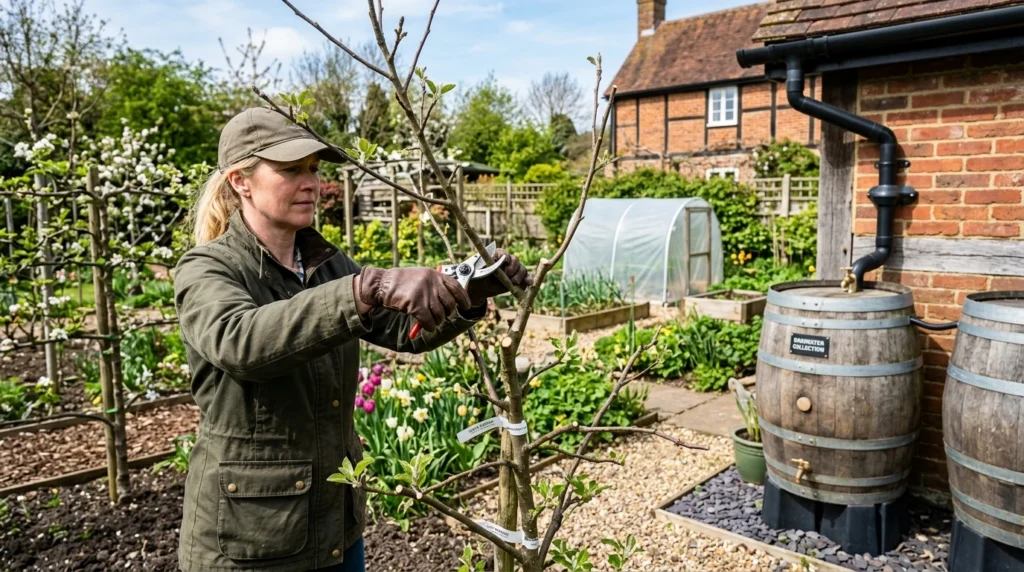
Young tree pruning (years 1-3) is critical for structural integrity. The primary objective is establishing a central leader and eliminating co-dominant stems that compromise the structural load capacity of the mature tree.
Empirical Pruning Metrics
- Time to First Trim (TTFT): 12-18 months post-transplant.
- Optimal Cut Angle: 45 degrees, positioned 1/4 inch above the branch collar.
- Maximum Biomass Removal: Never exceed 25% of the total canopy volume per annual cycle to prevent hydrostatic shock to the root system.
- Wound Healing Time: Typically 14-21 days for lateral cuts under 2 inches in diameter.
flowchart TD
    A[Initial Tree Inspection] --> B{Central Leader Present?}
    B -- Yes --> C[Identify Crossing Branches]
    B -- No --> D[Select Dominant Shoot]
    D --> E[Subordinate Competitors]
    C --> F[Execute 45-degree cuts]
    E --> F
    F --> G[Sanitize Equipment]
Maintaining a clear perimeter around the young trees is essential to prevent resource competition. To automate the undergrowth management and ensure precise perimeter control without risking mechanical damage to the young trunks, we deploy automated robotics. If you’re looking to optimize your turf maintenance around these delicate zones, you can deploy an Anthbot robot mower to maintain exact grass heights (typically 2.5 inches) with zero human intervention.
Phase 2: Rain Barrel System Architecture
Water resource management is the second pillar of our deployment. A standalone rain barrel is insufficient; it must be integrated into a broader hydrostatic delivery network.
Hydraulic Data & Capacity Planning
- Standard Barrel Capacity: 55 gallons (approx. 208 liters).
- Roof Yield Metric: 0.62 gallons per square foot of roof space per 1 inch of rainfall.
- Flow Rate (GPM): Gravity-fed systems utilizing a 3/4-inch spigot at 2 feet of head pressure yield approximately 2.5 GPM.
- Overflow Redundancy: Dual 1.5-inch PVC overflow valves routed to a secondary retention basin.
When integrating the rain barrel, elevate the base to at least 24 inches to maximize hydrostatic head pressure. This allows for the integration of low-pressure drip lines directly to the root zones of the young trees, ensuring a steady, slow-release hydration profile that prevents soil erosion and root rot.
sequenceDiagram
    participant Roof as Catchment Surface
    participant Filter as Mesh Filter
    participant Barrel as 55G Rain Barrel
    participant Roots as Tree Root Zone

    Roof->>Filter: Rainfall (1 inch/sq ft)
    Filter->>Barrel: Filtered H2O (98% efficiency)
    Barrel->>Roots: Gravity-fed Drip (2.5 GPM)
    Barrel-->>Barrel: Excess triggers Overflow
Synergizing the Ecosystem
The true value of this configuration lies in the integration. By utilizing the rain barrel to provide consistent, automated drip irrigation, the young trees experience accelerated callous formation over pruning wounds. Concurrently, utilizing an automated mower ensures that the turf does not compete for the surface moisture.
This unified approach minimizes configuration drift in your landscape architecture. For those ready to upgrade their hardware stack, I highly recommend looking into smart mowers; check out the Anthbot for seamless integration into your maintenance workflow.
Pros and Cons of the Automated Landscape Stack
| Advantages (Pros) | Limitations (Cons) |
|---|---|
| Significant reduction in manual maintenance time. | Higher initial capital expenditure (CAPEX) for robotics and plumbing. |
| Precise water delivery eliminates runoff and evaporation loss. | Requires annual winterization of the rain barrel system in freezing hardiness zones. |
| Improved structural integrity and health of young trees. | Pruning still requires manual, skilled intervention (cannot be fully automated yet). |
Frequently Asked Questions (FAQ)
What is the minimum head pressure required for the drip lines?
For a standard 55-gallon rain barrel, elevating it by 2 feet provides roughly 0.86 PSI, which is sufficient for non-pressurized, large-emitter drip tubing up to 50 feet in length.
Can the Anthbot navigate around multiple young trees and rain barrels?
Yes, modern iterations utilize advanced obstacle avoidance and spatial mapping. You can configure your Anthbot with specific no-go zones via its control interface to ensure it maintains a safe distance from delicate saplings and plumbing infrastructure.
When is the optimal time to execute structural pruning?
Late winter or early spring during dormancy is ideal. This minimizes sap bleed and reduces the risk of pathogen transmission, giving the tree maximum energy reserves to compartmentalize the wound during the spring growth flush.
Conclusion
Deploying a standardized, automated approach to young tree pruning and water management shifts your landscaping operations from a constant chore to an optimized, self-sustaining system. By measuring your TTFT, monitoring your GPM, and integrating smart robotics, you establish a resilient arboreal infrastructure designed for long-term canopy dominance.
Always disconnect main power sources—remove battery packs or unplug cords—before inspecting mower blades, clearing aeration tines, or handling sharp garden equipment. Keep hydroponic nutrient concentrates stored securely.
Practical guides curated by horticultural practitioners and yard care enthusiasts. Field-tested methods, verifiable steps, and zero automated fluff.