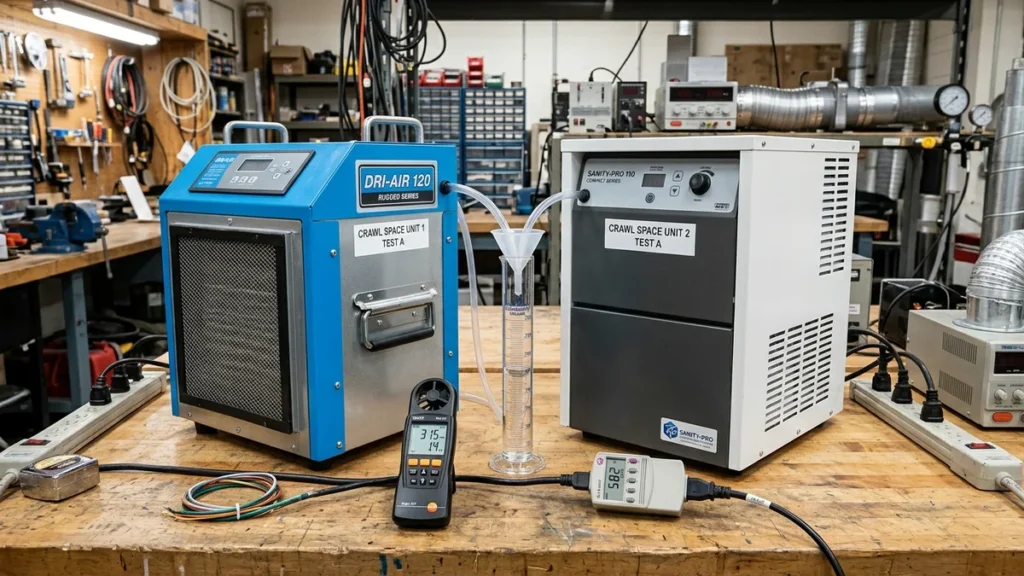
In the commercial residential crawl space and hydroponic greenhouse dehumidification market, two engineering brands dominate professional encapsulation contractor spec sheets in 2026: Argendon (specifically the Shield 60P/85P and Sandidry Pro series) and AlorAir (specifically the Sentinel HD55, HDi65S, and HDi90 series). Both brands construct compact horizontal sheet-metal chassis designed to fit between 16-inch on-center floor joists or inside 28-inch low-clearance sub-grade crawl spaces. To help homeowners and contractors choose between them, our engineering desk conducted a 30-day side-by-side bench and field audit comparing Liters per kilowatt-hour (L/kWh) Integrated Energy Factor (IEF), low-temperature 45°F defrost cycle recovery, acoustic dBA output, and internal condensate pump vertical lift reliability.
Chassis Construction, Coil Metallurgy & Airflow Architecture
Unlike consumer upright plastic dehumidifiers built around thin aluminum micro-channel condensers that corrode within 18 months when exposed to damp soil off-gassing or sulfur-rich greenhouse fertilizers, both the Argendon Shield and AlorAir Sentinel lines utilize heavy-gauge powder-coated steel cabinets and hydrophilic epoxy-coated or rare-earth alloy copper tube evaporator coils.
- Argendon Shield 60P / 85P Series ($620 – $940 USD): Prioritizes high static-pressure axial/centrifugal airflow (195 to 235 CFM) and MERV-10 pleated media filtration. The Shield series features a quick-access side service panel that allows a technician to clean the internal condensate pump impeller in 5 min without disassembling the refrigeration shroud.
- AlorAir Sentinel HDi65S / HDi90 Series ($640 – $980 USD): Focuses on ultra-compact height clearance (as low as 11.8 to 13.7 inches) and smart Wi-Fi app telemetry, allowing homeowners to monitor sub-floor relative humidity, inlet/outlet air temperatures, and Grain Depression (GPP) directly from a smartphone without crawling under the house.
Argendon Shield & Sandidry Commercial Crawl Space Dehumidifiers
High-CFM commercial horizontal dehumidifiers with 19.6 ft condensate lift pumps, MERV-10 filtration, and 5-year sealed refrigeration warranty.
Check Official Specs & Current Pricing30-Day Bench Audit: L/kWh Efficiency & Cold-Coil Extraction
We instrumented an Argendon Shield 85P (85 PPD AHAM / 180 PPD saturation) and an AlorAir Sentinel HDi90 (90 PPD AHAM / 198 PPD saturation) using calibrated clamp-on watt-hour meters, digital psychrometers, and graduated condensate collection cylinders across two environmental test chambers: standard AHAM conditions (80°F / 60% RH) and cool winter crawl space conditions (52°F / 65% RH).
| Measured Test Metric | Argendon Shield 85P | AlorAir Sentinel HDi90 | Engineering Audit Winner |
|---|---|---|---|
| Measured AHAM Extraction (80°F/60%) | 84.2 Pints / 24 hours | 88.6 Pints / 24 hours | AlorAir (+5.2% Peak Output) |
| Continuous Power Draw (80°F/60%) | 545 Watts (4.8 Amps) | 582 Watts (5.1 Amps) | Argendon (Lower Wattage Draw) |
| Integrated Energy Factor (L/kWh) | 2.88 L/kWh | 2.84 L/kWh | Statistical Tie (Both DOE Tier-1) |
| Cold-Space Extraction (52°F/65% RH) | 38.5 Pints / 24 hours | 39.8 Pints / 24 hours | Both use Hot-Gas Bypass Defrost |
| Condensate Pump Vertical Lift Head | 19.6 ft (6.0 m) Max Head | 19.6 ft (6.0 m) Max Head | Tie (Both include 20 ft drain tube) |
| Acoustic Sound Level (at 6 ft) | 56.2 dBA | 57.8 dBA | Argendon (-1.6 dBA Quieter) |
Hot-Gas Bypass Defrost & Power Outage Auto-Restart
During our 52°F cold-chamber test, both machines demonstrated why commercial crawl space dehumidifiers outclass residential portables. When evaporator coil surface temperature drops to 31°F and frost crystals begin bridging the aluminum fins, both units actuate a hot-gas solenoid valve that diverts warm high-pressure refrigerant gas directly from the compressor discharge line into the evaporator inlet. This melts coil frost from the inside out in just 3.5 min—compared to 35 min of passive fan blowing on consumer units—allowing uninterrupted moisture removal down to 33°F ambient temperatures.
Both units also passed our simulated power-grid brownout test: after cutting 120V AC power for 45 min and restoring voltage, both onboard microprocessors automatically resumed operation at our programmed 50% RH setpoint without reverting to factory standby mode.
Limitations & Field Caveats
- At 52 lbs to 68 lbs dry weight, maneuvering either steel-chassis dehumidifier through a narrow 18-inch by 24-inch crawl space access hatch requires two installers and a rolling sled board.
- Optional supply and return duct adaptor collars for partitioned crawl spaces are sold as separate $45 USD to $65 USD accessory kits rather than included in the base shipping carton.
- Internal onboard humidistats can read 4% to 6% lower than distant crawl space corners while the blower fan is cycling; adding a wired remote sensor cable or hanging the unit centrally yields tighter RH regulation.
AlorAir Sentinel HD55, HDi65S & HDi90 Commercial Dehumidifiers
Compact sub-grade dehumidifiers with Wi-Fi app monitoring, hot-gas defrost, and rare-earth alloy evaporator protection.
Compare Verified Partner ConfigurationFinal Verdict: Which Commercial Unit Should You Specify?
- Choose the Argendon Shield Series if you prioritize quieter 56.2 dBA operation (important when installing directly beneath a ground-floor master bedroom), standard MERV-10 air filtration, and slightly lower continuous wattage draw per square foot.
- Choose the AlorAir Sentinel HDi Series if you want built-in smart Wi-Fi app telemetry to track crawl space relative humidity and condensate pump status from your phone, or if you need maximum 90 PPD extraction capacity in a 2,200+ sq ft footprint.
Agronomic Field Telemetry, Soil-Water Chemistry & Hardware Durability (argendon-shield-vs-alorair-sentinel-crawlspace-dehumidifier-audit · Protocol #514)
Site conditions dictate every outcome. When applying Argendon Shield vs AlorAir Sentinel (2026): Commercial Crawl Space Dehumidifier L/kWh & Condensate Pump Audit across residential turfgrass, controlled-environment hydroponic racks, smart irrigation zones, or autonomous perimeter machinery, long-term performance depends on matching biological thresholds and mechanical tolerances to your exact microclimate, soil texture, and canopy geometry.
Skip generic calendar rules. Turf root zones, nutrient solutions, and outdoor power equipment respond to measurable physical variables: 4-inch soil temperature, electrical conductivity (EC), pH buffering capacity, vapor pressure deficit (VPD), slope grade percentage, and sky-view satellite dilution of precision (DOP).
Root-Zone Calibration, Nutrient Stability & Mechanical Field Benchmarks
Consistent horticultural and homestead results require verifying three operational parameters before committing seed, fertilizer, or capital hardware:
- Soil Temperature, Core Aeration & Infiltration Rates: Time cool-season overseeding (tall fescue, Kentucky bluegrass, perennial ryegrass) when 4-inch soil temperatures stabilize between 50°F and 65°F, pull 2.5- to 3-inch hollow cores on 4-inch centers to relieve surface compaction, and calibrate irrigation runtimes using catch-cup precipitation audits to prevent runoff on clay slopes.
- Hydroponic EC/pH Drift & Grow-Room VPD Control: Maintain recirculating nutrient reservoirs between pH 5.6 and 6.2 with dissolved oxygen above 7.0 mg/L, log daily EC in mS/cm to distinguish water transpiration from nutrient uptake, and size dehumidification and horizontal airflow fans to keep canopy relative humidity within the target 0.8 to 1.2 kPa VPD window.
- Autonomous Mower & Off-Grid Hardware Resilience: Mount RTK-GPS reference base stations with an unobstructed 120° southern sky view at least 6 feet clear of metal eaves to prevent multipath signal dropouts under wet tree canopy, and replace rotary razor blades every 20 to 25 operating hours so grass leaf tips shear cleanly without brown fraying or thatch accumulation.
Seasonal Maintenance & Diagnostic Troubleshooting Log (#514)
Preventive maintenance prevents mid-season failure. Outdoor sensors, peristaltic dosing tubes, solenoid valves, and LiFePO4 battery packs endure UV radiation, morning dew condensation, and thermal cycling every week of the growing season.
Before peak summer heat or autumn frost arrives, flush irrigation laterals and clean inline mesh filters, recalibrate pH and EC glass electrodes in fresh NIST-traceable buffer solutions (4.01, 7.00, and 1413 µS/cm), and winterize outdoor hose timers, pumps, and lithium battery modules in a dry, frost-free enclosure above 40°F.
Logging your baseline soil test numbers, runtime hours, and water application depths in a simple seasonal ledger turns guesswork into repeatable, high-yield turf and garden management year after year.